
The Definitive Playbook for Scaling D2C and Digital Commerce with AI
Executive Summary
For CXOs of mid-sized eCommerce and D2C brands, 2026 is not a year of experimentation, it is a year of reckoning. The global AI-enabled eCommerce market has crossed $9 billion (Precedence Research, 2025), and brands that have yet to operationalise AI are not merely falling behind; they are ceding ground to competitors who have already automated their supply chains, personalised their storefronts at the individual level, and optimised their entire catalogue for discovery by AI agents rather than human search bars.
The era of treating AI as a generative assistant for copywriting or basic image production is over. We have entered the age of Agentic AI, invisible, autonomous systems that execute complex, multi-step operations in the background, fundamentally altering how commerce is conducted.
“According to McKinsey’s 2025 State of AI report, 78% of organisations now use AI in at least one business function, a dramatic jump from 55% in 2023. In retail and consumer goods, that figure climbs to 89%.”
Today’s consumer journey is no longer linear. With AI-led discovery reshaping search behaviour, generative AI traffic to US retail sites surged 4,700% year-on-year as of mid-2025 (Adobe Digital Insights), brands that fail to optimise for Answer Engine Optimization (AEO) and Generative Engine Optimization (GEO) will become invisible to an entire generation of AI-assisted buyers.
This white paper is a tactical playbook for deploying AI not as a top-line novelty, but as a bottom-line protector. It draws on verified global and India-specific data, real-world success stories, and architectural frameworks to help mid-market eCommerce leaders build the infrastructure required to compete and win in the agentic economy.
At a Glance: The AI in eCommerce Opportunity
| $9.01B Global AI in eCommerce market size, 2025 (Precedence Research) | $74.93B Projected market size by 2035 (23.59% CAGR) |
| 4,700% YoY surge in generative AI traffic to retail sites (Adobe, 2025) | 78% Organisations using AI in at least one function (McKinsey, 2025) |
| 40% More revenue earned by companies using AI personalisation (DTC Stats, 2026) | $145B+ India eCommerce market size, 2025 (IBEF) |
Sources: Precedence Research (2025), McKinsey State of AI (2025), Adobe Digital Insights (2025), IBEF India eCommerce Report (2025), Business Research Insights (2026)
The Global Shift, From Search to Answer Engines
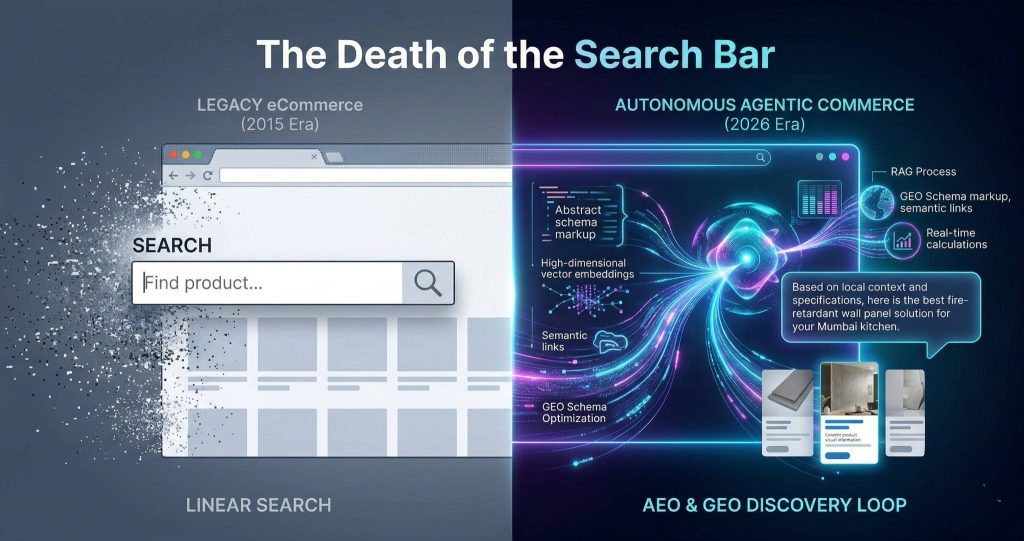
The most consequential structural change in digital commerce right now is not a product feature or a platform update. It is a fundamental rewiring of how consumers discover products. For four decades, eCommerce operated on a simple premise: the consumer types a query into a search engine, scans a results page, and clicks. That loop is breaking.
AI-powered answer engines, from ChatGPT and Perplexity to Google’s AI Overviews and Amazon’s Rufus, are replacing the query-and-scroll model with conversational, intent-driven discovery. When a user asks an AI agent, “What running shoes are best for wet surface under ₹5,000?”, they receive a direct recommendation, not ten blue links. The brand that gets recommended wins. The brand that is not structured for AI comprehension does not appear at all. This is the zero-click purchasing environment.
For mid-market brands, this creates a mandate: your product catalogue, schema markup, and content architecture must be structured for machine comprehension, not just human browsing. Answer Engine Optimization (AEO) and Generative Engine Optimization (GEO) are no longer optional disciplines. They are survival skills.
| Amazon: Rufus AI Shopping Assistant How AI Is Replacing the Search Bar with a Conversation Amazon’s Rufus, trained on the company’s entire product catalogue and millions of community Q&As, transformed product discovery by replacing static search with conversational AI. When a user asks ‘What do I need for cold-weather golf?’, Rufus dynamically assembles a curated product list within a conversational interface—no browsing, no filtering, no comparison shopping. Result: Rufus set the new industry benchmark for AI-native discovery. Mid-market brands supplying to Amazon now structure their product data, enhanced content, and A+ pages to be Rufus-readable, treating the AI as the new buyer. |
Hyper-Personalisation 2.0: The ‘Segment of One’ Storefront
We have moved well past algorithmic ‘Recommended for You’ carousels. AI now restructures website layouts, dynamic pricing bundles, and visual merchandising in milliseconds, analysing micro-behaviours, cursor hesitation, scroll depth, dwell time, purchase velocity, to autonomously mould each digital storefront around the highest-probability conversion path for that specific visitor, at that specific moment.
“Research from Bloomreach confirms that 84% of eCommerce businesses consider AI their top strategic priority, with 65% of senior executives citing personalisation and predictive analytics as critical growth levers. Companies using AI personalisation earn 40% more revenue than those without it.”
| L’Oréal & Sephora The Beauty Industry’s Blueprint for ‘Segment of One’ Commerce L’Oréal Paris deployed Skin Genius, a computer vision tool that analyses a user’s face via their smartphone camera to autonomously build a bespoke skincare routine, eliminating the guesswork of product selection. Sephora’s AI virtual advisor creates a dynamic, real-time consultation experience that replicates one-on-one human interaction but scales infinitely across millions of users simultaneously. Result: Both brands report conversion rates from AI-personalised journeys that significantly outperform static product grids, demonstrating that the segment-of-one storefront is not aspirational; it is commercially proven. |
| Stitch Fix Proving AI Personalisation Without Amazon’s Scale Stitch Fix demonstrated that hyper-personalised, conversational discovery does not require the resources of a global platform. By leveraging zero-party data, information customers voluntarily share about their style preferences, size, lifestyle, and budget, combined with ML-driven style matching, Stitch Fix bypasses standard category browsing entirely. Result: Stitch Fix’s AI-driven personalisation model delivers customer satisfaction scores and repeat purchase rates that rival those of fashion retailers ten times its size. It is a proof point that mid-market brands can win on intelligence even when they cannot win on inventory breadth. |
The Autonomous, Predictive Supply Chain
Global supply chain disruptions have permanently shifted AI from being an analytics tool to an autonomous orchestrator. Leading brands now deploy AI that ingests real-time alternative data streams, geopolitical signals, localised weather events, viral social media trends, and commodity price fluctuations, to predict demand spikes before they materialise. Agentic AI automatically issues purchase orders, re-routes inventory between fulfilment nodes, and adjusts marketing spend to suppress ads for low-stock SKUs, all without human intervention.
“According to Sellers Commerce (2025), approximately 90% of large companies have now trialled AI in their supply chains. The AI in supply chain market reached $11.73 billion in 2025, up from $9.15 billion the year before. For wholesale distributors and manufacturers, these capabilities can generate 5–20% logistics savings through route optimisation, demand prediction, and warehouse efficiency improvements.”
The India Context, Distinct Realities, Autonomous Interventions
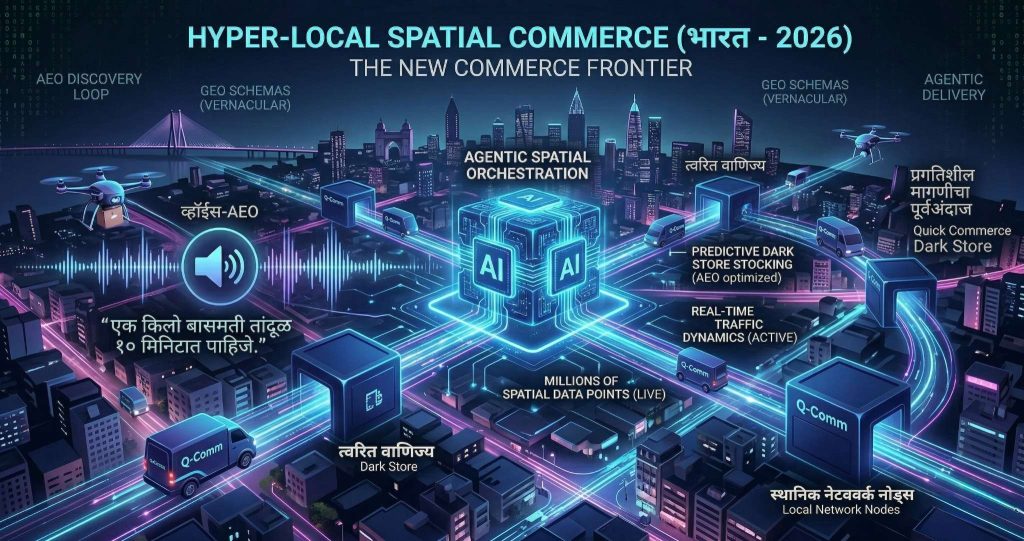
While global trends define the baseline, the Indian eCommerce ecosystem is uniquely demanding and uniquely rewarding. India’s eCommerce market surpassed $145 billion in 2025 (IBEF), propelled by mobile-first behaviour, UPI-powered transactions processing over 20 billion payments per month, and an increasingly AI-literate consumer base. Quick commerce is expanding at a 70–80% CAGR. The D2C market is on track to exceed $100 billion in 2025.
India’s next 100 million digital shoppers are emerging from Tier 2 and Tier 3 cities that drove 21% year-on-year eCommerce growth in the 2025 summer sales, represent a demographic that communicates in regional languages, shops on mobile, and increasingly uses voice-first interfaces. For these consumers, AI is not a differentiator. It is the only scalable path to reach them.
According to EY India’s ‘The AIdea of India: 2025’ report, generative AI could enhance productivity in India’s retail industry by 35–37% by 2030. Already, 48% of Indian businesses have initiated proof-of-concept projects for GenAI, with another 32% planning dedicated budget allocations.
The Quick Commerce Mandate: AI-Driven Hyperlocal Scaling
The expectation of 10-minute to 4-hour delivery has permanently altered consumer psychology in India’s urban markets. Blinkit leads the quick commerce market with approximately 46% market share, followed by Zepto (~29%) and Swiggy Instamart (~25%). Together, this trio controls roughly 90% of the market. Their common denominator is not just speed, it is AI-powered inventory intelligence.
| Zepto Operating as an AI Data Company with 250+ Dark Stores Zepto does not simply rely on fast delivery partners. At its core, it is an AI data company. Zepto’s systems track millions of spatial data points, real-time traffic dynamics, weather patterns, and hyper-local purchasing behaviour to predict precisely which SKUs must be stocked in which neighbourhood dark stores at any given moment. This predictive spatial node mapping eliminates the capital waste of blind inventory stocking while maximising delivery velocity. Result: Zepto doubled its revenue to INR 4,454 crore in FY24 and raised $1.4 billion at unicorn valuation (IBEF, 2025). AI-driven inventory efficiency is central to its path to profitability, Zepto is now preparing for a $1 billion IPO in 2026. |
| 4700BC, D2C Success on Q-Commerce Platforms How a Gourmet Popcorn Brand Built 87% of Sales Through AI-Optimised Quick Commerce 4700BC, a gourmet popcorn brand, now generates 87% of its total sales through quick commerce platforms, Blinkit, Zepto, Swiggy Instamart, Big Basket, and Amazon Now maintaining a 45% year-on-year growth rate. ‘It’s in quick commerce that we see the highest consumer engagement. It’s now integral to our overall digital strategy,’ says Chirag Gupta, Founder & CEO. Result: By optimising product listings, pricing, and inventory placement using AI-driven platform analytics, 4700BC achieved Q-commerce channel dominance without the capital burn of operating its own last-mile logistics. |
Solving the ‘Bharat’ Equation: Vernacular AEO and Voice-First Commerce
Traditional SEO was built for literate, English-language search. But India’s next wave of digital commerce consumers, emerging from Tier 2 and Tier 3 cities, speak into their smartphones in Hindi, Tamil, Bengali, Telugu, Kannada, and over twenty other regional languages. They use voice search. They use WhatsApp. They do not fill in structured search forms.
This creates a categorical imperative for vernacular AEO: structuring product data with multi-lingual schema so that Answer Engines can pull your products into conversational recommendations in any Indian language. Brands that invest in GEO architecture today, wrapping every product and specification in advanced, machine-readable schema, will dominate the AI-assisted discovery layer that is rapidly superseding traditional search in these markets.
| Myntra — MyFashionGPT Breaking Category Filters with Natural Language Commerce Myntra’s MyFashionGPT allows open-ended natural language queries, ‘Show me outfits for a beach wedding in Goa under ₹3,000,’ replacing the rigid filters and category navigation that create friction for new and unfamiliar digital shoppers. This is particularly transformative for Tier 2 and Tier 3 consumers who do not yet know how to navigate traditional eCommerce UX. Result: Myntra’s combined ad revenue (with Flipkart) rose 27% to INR 7,232 crore in FY25. MyFashionGPT is cited as a key driver of new user acquisition from non-metro markets. |
| Swiggy Instamart, Agent-Led Commerce The Voice-to-Cart Journey Becomes Reality Swiggy integrated advanced agentic protocols allowing users to bypass the app interface entirely. A consumer can instruct a voice assistant, ‘Order ingredients for a high-protein vegetarian dinner for four’ and the AI autonomously searches Instamart, constructs the cart, applies relevant offers, and confirms delivery. No app navigation. No manual search. No category browsing. Result: Swiggy entered 2026 with nearly $2 billion in deployable capital and a differentiated high-AOV Instamart model that serves the high-frequency, voice-first consumer (Inc42, 2025). |
Tackling India’s Margin Killers: RTO Fraud and COD Risk
Return-to-Origin (RTO) rates on Cash-on-Delivery orders remain the single largest structural threat to D2C profitability in India. For many mid-market brands, RTO rates on COD orders range from 25% to 45%, representing a direct drain on gross margins through reverse logistics, repackaging, and resale costs.
AI is now the most effective tool for addressing this problem at scale. AI agents automatically cross-reference a buyer’s phone number, IP address consistency, device fingerprint, and regional delivery success rates in milliseconds, scoring each order for RTO risk before dispatch. High-risk orders are automatically routed to prepaid-first or verification-first checkout flows, dramatically improving the ratio of successful first-attempt deliveries.
Indian addresses present an additional challenge. Unstructured, inconsistent, and often incomplete address inputs have historically been a leading cause of delivery failure. AI models now instantly clean, geocode, and standardise address inputs at the point of checkout, converting chaotic free-text into precise delivery coordinates.
ONDC and the Interoperability Opportunity
India’s Open Network for Digital Commerce (ONDC) represents one of the most significant structural opportunities for mid-market brands to reach consumers outside the walled gardens of dominant platforms. But navigating ONDC’s interoperability, synchronising catalogue pricing, inventory mapping, and logistics selection across a decentralised network, is operationally complex at scale.
AI agents are emerging as the orchestration layer that makes ONDC viable for mid-market operators. These agents dynamically adjust catalogue pricing based on demand signals, automatically map and update inventory across the ONDC network, and select the most cost-effective local logistics provider for each transaction in real time.
How AI Can Help, The Practical Playbook
1. Answer Engine Optimization (AEO): Getting Found by AI Buyers
The question every mid-market brand must now answer is not ‘How do we rank on Google?’ but ‘How do we get recommended by AI?‘ AEO is the discipline of structuring your content, product data, and brand narrative so that generative AI systems can confidently cite and recommend you.
How AI helps brands achieve AEO:
- Automated Schema Generation: AI tools analyse your product catalogue and automatically generate structured JSON-LD schema markup that makes product attributes, pricing, availability, and reviews machine-readable for AI crawlers.
- FAQ and Conversational Content Creation: AI identifies the exact natural-language questions your target customers are asking AI engines and generates concise, authoritative answers structured to be cited in AI responses.
- Brand Entity Reinforcement: AI tools identify knowledge gaps about your brand across the web and generate structured content that reinforces your entity, ensuring AI systems have accurate, consistent information to draw from when recommending your products.
2. Generative Engine Optimization (GEO): Building AI-Visible Content Architecture
GEO extends AEO into the architectural layer of your digital presence. It is the practice of structuring all brand and product content so that generative engines, not just traditional crawlers, can comprehend, trust, and retrieve it.
How AI helps brands achieve GEO:
- Vector-Ready Product Data: AI converts flat product descriptions into semantically rich, vector-embedded data that AI retrieval systems can query with precision.
- Dynamic Content Adaptation: AI automatically adapts product content for different AI discovery contexts, conversational queries, comparison requests, category exploration, ensuring your brand appears in diverse AI-generated recommendation scenarios.
- Multilingual GEO for India: AI generates and maintains vernacular product schemas in regional Indian languages, ensuring discoverability across the voice-first, regional-language AI discovery layer rapidly emerging in Tier 2 and 3 markets.
3. E-E-A-T Signals: Building AI-Trusted Brand Authority
Google’s E-E-A-T framework (Experience, Expertise, Authoritativeness, Trustworthiness) is no longer just a search ranking factor, it is increasingly the standard by which AI systems evaluate whether to recommend a brand in a conversational response. A brand without demonstrable E-E-A-T signals is a brand AI agents cannot trust.
How AI helps brands build E-E-A-T:
- Expert Content Generation at Scale: AI enables brands to produce high-quality, technically authoritative content, detailed buying guides, ingredient analyses, use-case comparisons that signals genuine expertise to both human readers and AI evaluation systems.
- Review Intelligence and Reputation Management: AI aggregates and analyses customer reviews across platforms, identifying patterns that can be addressed in product improvements and content, while helping brands respond to reviews at scale in a way that reinforces trustworthiness.
- Provenance and Certification Visibility: For categories where credentials matter, food, supplements, industrial products, AI automatically surfaces and structures certifications, test reports, and compliance documentation in formats that AI discovery systems can verify and cite.
4. Hyper-Personalisation and Dynamic Storefronts
AI analyses each visitor’s micro-behaviour in real time, not just historical purchase data, but live signals like scroll patterns, cursor hesitation, time-on-product, and abandonment triggers, to dynamically restructure the storefront, pricing, and product sequencing for that individual, in that moment.
- Personalised product recommendations that drive up to 31% of eCommerce revenue (Bloomreach, 2025)
- Dynamic pricing that adjusts based on inventory levels, demand patterns, and individual customer value
- Automated merchandising that surfaces the right bundle or cross-sell at the highest-conversion moment in the session
5. Intelligent Customer Support and Conversational Commerce
AI resolves 80–90% of standard customer support queries autonomously, order tracking, return initiation, product queries, delivery updates, at a fraction of the cost of human agents, and at any hour, in any language. This is not about replacing human empathy; it is about freeing human agents for the complex, high-EQ situations that actually require it.
- 73% of consumers are now open to AI-powered chatbots for customer service (Sellers Commerce, 2025)
- AI customer support resolves tickets 18% faster with 71% success rates on first contact
- WhatsApp AI agents conduct full consultative sales conversations in regional Indian languages, capturing intent and converting directly within the messaging interface
The Reference Architecture, Building the Agentic Tech Stack
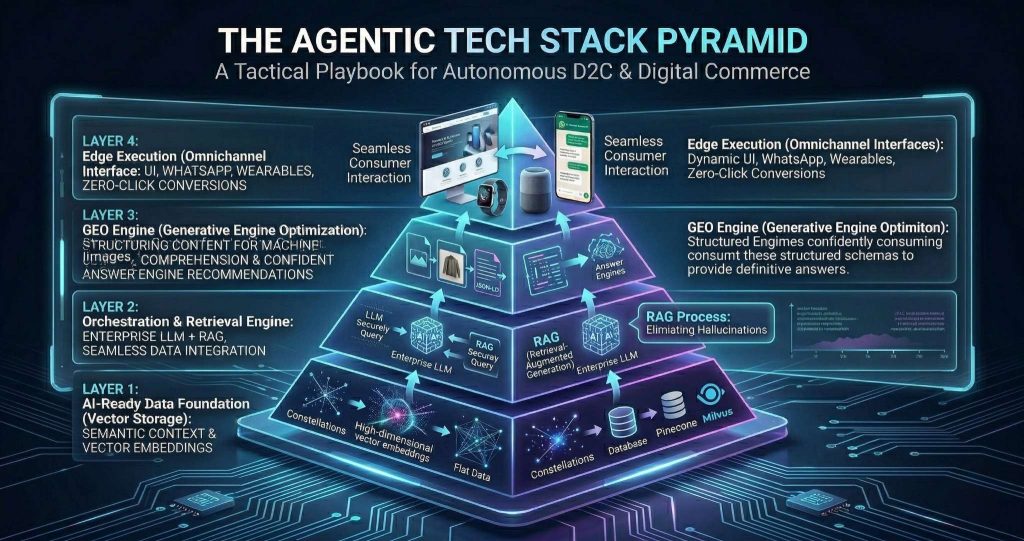
For the mid-market CXO, the greatest barrier to AI adoption is not vision, it is infrastructure. Attempting to bolt a Large Language Model onto a static, 2015-era Product Information Management system will produce AI hallucinations, incorrect pricing, and frustrated customers. Autonomous AI operations require a purpose-built Agentic Intelligence Network built on four interdependent layers.
| THE AGENTIC INTELLIGENCE NETWORK: 4-LAYER ARCHITECTURE Layer 1: AI-Ready Data Foundation (Vector Storage) Legacy PIMs store flat data. In the agentic stack, product data is enriched with semantic context and converted into mathematical vectors (embeddings) in databases like Pinecone or Milvus. This enables AI agents to retrieve exact semantic matches instantly. Layer 2: Orchestration & Retrieval Engine (RAG Architecture) Enterprise LLMs combined with Retrieval-Augmented Generation (RAG) force the AI to query your Vector Database before generating any response—eliminating hallucinations. Layer 3: GEO Engine (Generative Engine Optimization Layer) Automatically wraps every product, specification, and brand claim in advanced schema markup. Answer Engines consume these structured schemas natively to recommend your products with confidence. Layer 4: Edge Execution (Omnichannel AI Interfaces) The autonomous system intercepts the consumer via dynamic website UI generation, WhatsApp Business API conversations, or voice-first interfaces in regional languages. |
The Build vs. Buy Decision
Not every AI capability needs to be custom-built. Mid-market brands should apply a clear decision matrix:
- Buy: Enterprise SaaS for horizontal, non-differentiating functions, standard customer support, generic product description generation, basic analytics.
- Build/Fine-Tune: Proprietary AI models for operations that directly impact your unique margins, hyper-local demand forecasting for your specific product categories, custom GEO pipelines for your brand’s specific competitive landscape, RTO scoring models trained on your own returns data.
For mission-critical operations like real-time inventory routing, high-maturity brands are allocating CapEx to fine-tune smaller, open-source models (such as Llama 3) to run locally, driving marginal AI inference costs towards near-zero.
The Economics of Agentic AI, ROI and Token Realities
Understanding Token Economics: The New Cost of Goods
Every AI agent interaction consumes tokens, the computational units that power LLM queries. As organisations scale autonomous operations, token costs become a material line item in the P&L. The key lever for controlling this cost is the RAG architecture described above: by forcing the AI to retrieve only the precise, relevant data before generating a response, brands can reduce token consumption by up to 90% compared to un-optimised, full-context AI calls.
The ROI Case for Mid-Market Brands
The return on an agentic AI deployment is realised across multiple dimensions, typically within the first two to three quarters of deployment:
- Customer Acquisition Cost Suppression: By capturing zero-click Answer Engine traffic, consumers sent directly to your brand by AI recommendations, brands reduce their paid search dependency. Shoppers arriving from generative AI sources show 10% higher engagement, 32% longer session duration, and 27% lower bounce rates (Adobe Digital Insights, 2025).
- Margin Protection via RTO Mitigation: Converting high-risk COD orders to prepaid, and improving first-attempt delivery success rates through AI address intelligence, directly recaptures logistics spend that would otherwise be lost to reverse supply chain costs.
- Operational Leverage: AI-resolved customer support, handling 80–90% of queries autonomously, dramatically reduces per-interaction costs while maintaining service quality standards.
- Inventory Efficiency: AI-driven demand forecasting reduces forecast error by 30–50% and improves inventory optimisation by 35%, directly improving working capital efficiency (Sellers Commerce, 2025).
Organisational Readiness, Restructuring for the AI Era
The New AI-First Org Chart
You cannot execute a 2026 agentic AI strategy with a 2015 organisational structure. Agentic AI enables revenue to scale exponentially with a lean, highly leveraged team, but only if the team is structured to manage intelligent systems rather than manual processes.
The roles mid-market D2C brands must now build or acquire:
- AI Data Modeller / PIM Ontologist: Defines the semantic relationships within the Vector Database, ensuring that product and brand data is structured precisely for Answer Engine retrieval and AI agent comprehension.
- AEO & Intent Strategist: The evolved role of the SEO Manager. Focuses on Answer Engine Share of Voice (AESoV), the frequency with which your brand appears as the recommended answer in conversational AI interfaces, by reverse-engineering the multi-variable prompts buyers are using.
- Conversational Flow Architect: Maps the psychological journey of a customer interacting with a WhatsApp or voice AI agent, dictating negotiation guardrails, escalation triggers, and vernacular empathy parameters.
- AI Red Team Specialist: A critical new function that routinely audits AI agents by feeding them adversarial prompts, ensuring guardrails hold under real-world pressure and that the brand’s AI cannot be manipulated into reputationally damaging outputs.
Data Privacy and DPDP Compliance, The Zero-Party Data Vault
Building an AI personalisation engine on a foundation of third-party, unconsented data is not just ethically questionable, under India’s Digital Personal Data Protection (DPDP) Act, it is financially reckless. The future of AI-driven commerce lies in the Zero-Party Data Vault: a consent-first, privacy-native data architecture where customers voluntarily share high-value information in exchange for better, more personalised experiences.
How Agentic AI Enables Privacy-Compliant Personalisation
- Voluntary Data Collection by Design: When a consumer interacts with a Consultative AI Agent, they naturally share high-value data, say dietary restrictions, budget constraints, size preferences, use-case requirements, to receive a more useful recommendation. This is zero-party data by design.
- Autonomous Consent Management: Agentic AI is programmed to act as its own compliance officer. When a conversation veers toward sensitive personal data, the AI automatically pauses, generates a localised consent request, and creates a cryptographic record of that consent.
- Federated Learning and Vector Anonymisation: AI models learn from individual user behaviour locally, sending only learned mathematical weights, not raw data, to central servers. User profiles are stored as anonymised vectors, preventing the exposure of raw Personally Identifiable Information.
The CXO Action Plan, Phased Strategy for 2026–2027
Phase 1: Data Foundation (Months 1–3)
Before any AI deployment can succeed, the data infrastructure must be sound. Decouple your Order Management System from legacy siloes to create a single, real-time stream of truth spanning D2C channels, marketplaces, ONDC, and offline stores. Migrate your Product Information Management data into a vector-ready format. Audit your existing schema markup against current AEO standards.
Phase 2: AEO and GEO Activation (Months 3–6)
Deploy your GEO Engine: the schema layer that makes every product page, category page, and brand asset machine-readable for AI discovery systems. Launch your AEO content programme, building authoritative, conversational content designed to be cited in AI responses. Begin tracking Answer Engine Share of Voice as a primary KPI alongside traditional search rankings.
Phase 3: Agentic Operations Deployment (Months 6–12)
Deploy your first autonomous AI agents across the highest-impact operations: customer support resolution, RTO risk scoring, inventory demand forecasting, and WhatsApp conversational commerce. Implement token cost monitoring and RAG architecture optimisation. Begin measuring Agentic Resolution Rate (ARR) and Predictive Margin Saved (PMS).
The New AI-Era KPI Set
| ARR Agentic Resolution Rate: % of customer interactions resolved by AI with zero human intervention | AESoV Answer Engine Share of Voice: frequency of brand recommendation in AI conversational responses |
| PMS Predictive Margin Saved: capital recovered through autonomous RTO mitigation & demand forecasting | Token CPI Token Cost Per Interaction: the new efficiency benchmark for AI operational costs |
Looking Ahead: The Path to Spatial Commerce
For the mid-market CXO, the mandate for 2026 is unambiguous: transition from experimental, human-prompted AI to autonomous, agentic infrastructure. The brands that build this infrastructure now are not merely positioning for the next product cycle. They are building the data foundations and AI architectures that will power the next frontier of commerce.
By 2028, AI will dynamically generate fully immersive, personalised 3D storefronts in real time based on individual Answer Engine queries. The GEO architectures, vector databases, and agentic pipelines built today will become the precise data streams that feed these spatial commerce environments. The investment is not in a current-cycle technology. It is in a permanent infrastructure upgrade.
The consumer has already moved. AI agents are already making purchasing decisions. Answer Engines are already recommending, or ignoring, brands based on the quality of their machine readable data. The question for every mid-market CXO is not whether to build for the agentic economy. It is how quickly they can close the gap between where their organisation is today and where their most aggressive competitors will be by the end of this year.
| THE FINAL TAKEAWAY AI is no longer a bolt-on feature or a generative novelty. It is the foundational infrastructure of profitable digital commerce in 2026. Mid-sized D2C and eCommerce brands that shift their strategic focus to Answer Engine Optimization, autonomous operations, and rigorous data structuring will not just survive the quick-commerce and enterprise onslaught. They will outmanoeuvre it. |
References & Further Reading
The following sources informed the data, statistics, and case studies presented in this report:
1. Precedence Research (2025). Artificial Intelligence in E-Commerce Market Size Report 2025–2035.
2. McKinsey & Company (2025). The State of AI: Global Survey.
3. Adobe Digital Insights (2025). Generative AI Traffic to US Retail Sites — July 2025 Update.
4. IBEF — India Brand Equity Foundation (2025). India eCommerce Industry Report.
5. EY India (2025). The AIdea of India 2025: GenAI in Retail.
6. Bloomreach (2025). AI for eCommerce: How It’s Transforming the Future.
7. SellersCommerce (2025). AI in eCommerce Statistics 2025.
8. Business Research Insights (2026). DTC eCommerce Statistics 2026.
9. Inc42 (2025). Swiggy in 2025: Cash Rich and Ready for the Quick Commerce Battle.
10. Blume Ventures (2025). India Quick Commerce Report.
11. Mukund Mohan Blog (2025). 10 Quick Commerce Trends Reshaping Indian Retail in 2025.
12. Envive.ai (2025). 46 eCommerce AI Implementation Statistics That Define Digital Success in 2026.
13. Shopify (2026). AI Statistics for 2026: Top eCommerce Trends.
Disclaimer: This white paper is produced for informational and strategic guidance purposes. All statistics cited are attributed to their original sources. Market projections are inherently subject to change. Readers are encouraged to verify data directly with source organisations before making material business decisions.