
Contents
Introduction: The five-imperative framework for B2B websites in the AI era
The Opportunity Hiding in Plain Sight: Why pre-qualified AI traffic is the most valuable cohort your site has ever seen
Imperative 1 — Win the Citation Game: Generative Engine Optimization (GEO) for B2B
Imperative 2 — Make Your Expertise Queryable; Building the adaptive expertise platform
Imperative 3 — Build the RFP-Ready Website: Agent-mediated qualification, not agentic commerce
Imperative 4 — Rebuild Trust Signals for AI Discovery: Resolving the gated-content reckoning
Imperative 5 — Realign Sales and Marketing: The compressed funnel and what it changes
The Strategic Imperative; Proprietary expertise as your new moat
The Bottom Line for B2B Leadership: Vertical-specific calls to action
Introduction
Right now, many B2B leaders are stuck in an AI grey zone. The technology is moving fast. The buyer’s research behaviour has already changed. However the playbook for B2B websites, the asset most marketing budgets are still organized around hasn’t caught up.
Should you be re-architecting? Standing pat? Pouring more budget into content? Cutting your form-gated assets loose? Competitor signals are unreliable, vendor pitches are louder than they’ve ever been, and most CMO and CTO conversations end with the same question: where do we actually start?
What’s often missing is a framework that fits B2B specifically. Not B2C agentic commerce. Not consumer SEO advice repackaged. A framework that takes seriously what makes B2B different: long buying cycles, multi-stakeholder committees, regulated industries, technical specifiers, and the fact that nobody is buying a $4M annual contract through an AI shopping agent.
That’s what this paper provides. We’ve organized our recommendations into five strategic imperatives, each addressing a specific shift the AI era is forcing on B2B websites. Together they form a sequence: each imperative builds on the one before it.
| 1 Win the Citation Game Earn placement inside AI-generated answers, not just on Google. | 2 Make Expertise Queryable Let buyers interrogate your site, not navigate it. |
| 3 Build the RFP-Ready Website Prepare for agent mediated research and qualification. | 4 Rebuild Trust Signals Make certifications and proof points machine readable. |
| 5 Realign Sales and Marketing Rebuild the funnel for AI-compressed buyer journeys. | The B2B AI Readiness Framework Five imperatives every CMO and CTO should answer before re-architecting their B2B website. |
In this paper, we’ll explore:
- Why being cited by LLMs has replaced ranking on Google as the new top-of-funnel
- How to make technical expertise extractable for both human evaluators and AI agents
- What “trust signals” actually look like when AI is filtering your buyer’s shortlist
- Why your sales motion is breaking and what to do about it
- How proprietary expertise becomes the only durable moat in an AI-mediated market
AI is moving fast. Specificity, structure, and discoverability are what allow B2B firms to make the most of that motion, instead of being quietly excluded from the consideration sets that decide their next decade.
Setting the Stage
Your website used to be where the buying journey started. Now it’s where it ends.
The AI shift isn’t a future quarter’s problem. It’s already changing how procurement teams build vendor longlists, how architects specify materials, how biotech sponsors evaluate CDMOs, and how CIOs scope service partners. If you’re a CMO or CTO at a B2B firm, your job description quietly changed: you’re no longer competing for clicks. You’re competing to be cited.
Two data points worth sitting with, from Cloudflare’s CEO at Cannes:
- It now takes 3x more content to earn a single visit from Google than it did a decade ago.
- 75% of searches never leave the browser. AI answers them directly.
Layer on the B2B-specific reality. Forrester and Gartner have been tracking it for years: B2B buyers complete 70% or more of their evaluation before contacting a vendor. AI compresses that further. By the time a procurement officer or specifying engineer reaches your “Contact Sales” form, they’ve already asked Perplexity, ChatGPT, Gemini, or Claude three or four substantive questions about your category and possibly about you specifically.
If you weren’t in those answers, you weren’t in the room.
The Opportunity Hiding in Plain Sight
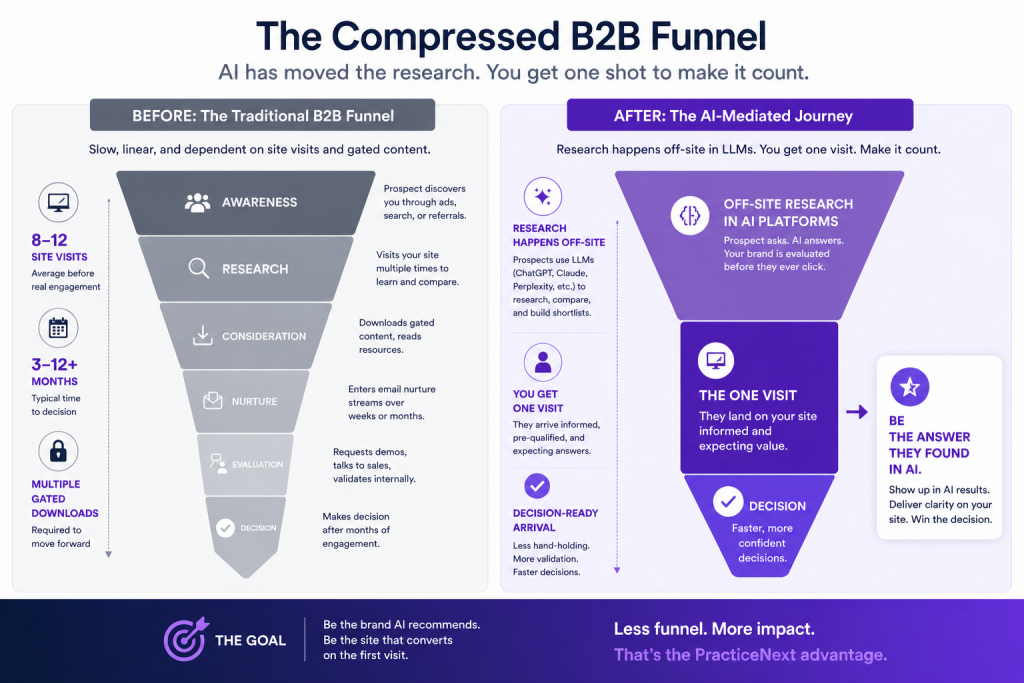
The traffic that does reach your site is fundamentally different now. These aren’t tire-kickers. They’re senior buyers, technical evaluators, or buying committee members who’ve already pre-qualified you through an AI-mediated research process. They arrive with sharper questions, shorter timelines, and higher conversion potential than any cohort you’ve tracked before.
A composite example we see across our client base: a North American CDMO that restructured its capability pages and regulatory documentation for machine readability saw inbound RFI volume drop slightly however shortlist conversion roughly double. Fewer visitors, dramatically better economics. The site stopped attracting researchers and started attracting evaluators.
The same dynamic is showing up in IT services, where buyers are using AI to compare delivery models and certifications before any sales call, and in building materials, where architects use AI to cross-reference performance specs against project requirements. The companies winning these compressed evaluations have one thing in common: their content is structured, specific, and discoverable not just by humans, however by the LLMs increasingly acting as the first filter.
Five Strategic Imperatives
Each of the following sections addresses one of the five shifts the AI era is forcing on B2B websites. They are sequential: Imperative 2 builds on Imperative 1, and the moat described in the closing section is only achievable if all five are in place.
| Imperative: 1 Citation | Imperative: 2 Queryable | Imperative 3: RFP Ready | Imperative 4: Trust | Imperative 5: Sales-Marketing |
Imperative #1: Win the Citation Game
Your funnel doesn’t start at your homepage anymore. It starts inside an LLM. The question isn’t whether you rank, it’s whether you’re cited.
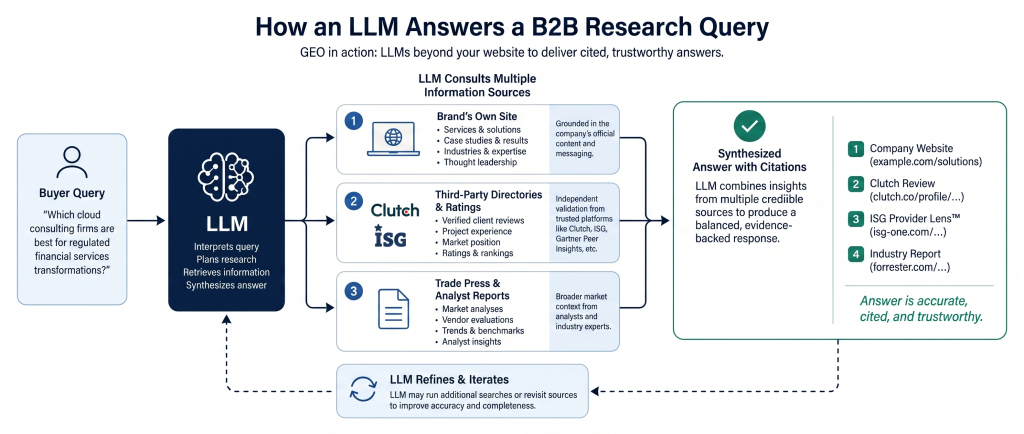
Traditional SEO optimized for ten blue links. That model is collapsing. The new model is Generative Engine Optimization (GEO) earning placement, attribution, and citation inside AI-generated answers. For B2B firms, this is harder and higher stakes than B2C SEO ever was, because the queries are technical, the buyer pool is small, and a single missed citation can mean missing an RFP cycle entirely.
What this looks like in practice for your audience:
A pharmaceutical sponsor types into ChatGPT: “Which US-based CDMOs handle sterile injectable manufacturing for Phase II clinical trials with FDA inspection history in the last 24 months?”
An enterprise CIO types into Perplexity: “Top mid-market IT services partners for SAP S/4HANA migrations in regulated industries, with RISE certification.”
An architect types into Claude: “Acoustic insulation options rated NRC 0.85+ for healthcare ceiling applications, locally available in Western Europe.”
These are real B2B research queries. Each pulls from a small set of cited sources. Being in that set is now the equivalent of page-one ranking and the qualifications for inclusion have nothing to do with backlinks or domain authority alone.
What B2B brand and tech leaders need to do
- Make your specificity legible. LLMs cite content that makes clear, attribution claims. “We serve Fortune 500 clients across industries” gets ignored. “We’ve delivered 14 SAP S/4HANA migrations for life sciences companies subject to 21 CFR Part 11, including [named anchor clients], averaging 9-month implementation timelines” gets cited. Audit every capability page for vague hand waving and replace it with specifics: verticals, certifications, geographies, project counts, regulatory contexts.
- Publish answer shaped content for the questions buying committees actually ask. Not “Why choose us.” Build out comparison content (build-vs-buy frameworks, in-house-vs-outsourced TCO models), switching cost analyses, regulatory pathway primers, and scenario based capability narratives. These are what AI engines pull from when buyers ask evaluative questions.
- Treat third-party authority as part of your AI footprint. LLMs lean heavily on directories, analyst reports, and industry publications. For IT services that means Clutch, Good Firms, ISG and Everest profiles, and trade press coverage. For construction materials it means specifier directories, BIM libraries, and code-body listings. For pharma it means FDA establishment listings, conference proceedings, and trade publication coverage. Your owned site is the foundation; the citation graph around it determines whether AI engines treat you as an authority.
- Implement structured data with B2B intent. Schema.org’s Organization, Service, Product, and FAQ Page markup are table stakes. Beyond that, mark-up case studies, certifications, locations, and capability matrices. Make your capability claims machine extractable.
- Monitor your AI visibility. Tools like Profound, Gumshoe, Peec.ai, and Goodie let you track which queries cite you, which cite competitors, and where your gaps are. This is the new rank-tracking. Budget for it.
Tip: The fastest GEO win for most B2B firms isn’t writing new content, it’s rewriting their existing capability and About pages with named clients, named certifications, named geographies, and named project counts. AI engines reward specificity. Most B2B sites are written for procurement gatekeeping, not LLM extraction.
The executive perspective: This is not a marketing retouch. It’s a re-architecting of how your firm’s expertise enters the buying conversation. CMO and CTO ownership has to be joint, content strategy and content infrastructure are now the same problem.
| Imperative 1 Citation | Imperative 2 Queryable | Imperative 3 RFP-Ready | Imperative 4 Trust | Imperative 5 Sales-Marketing |
Imperative #2: Make Your Expertise Queryable
Your prospects don’t want to navigate your site. They want to interrogate it.
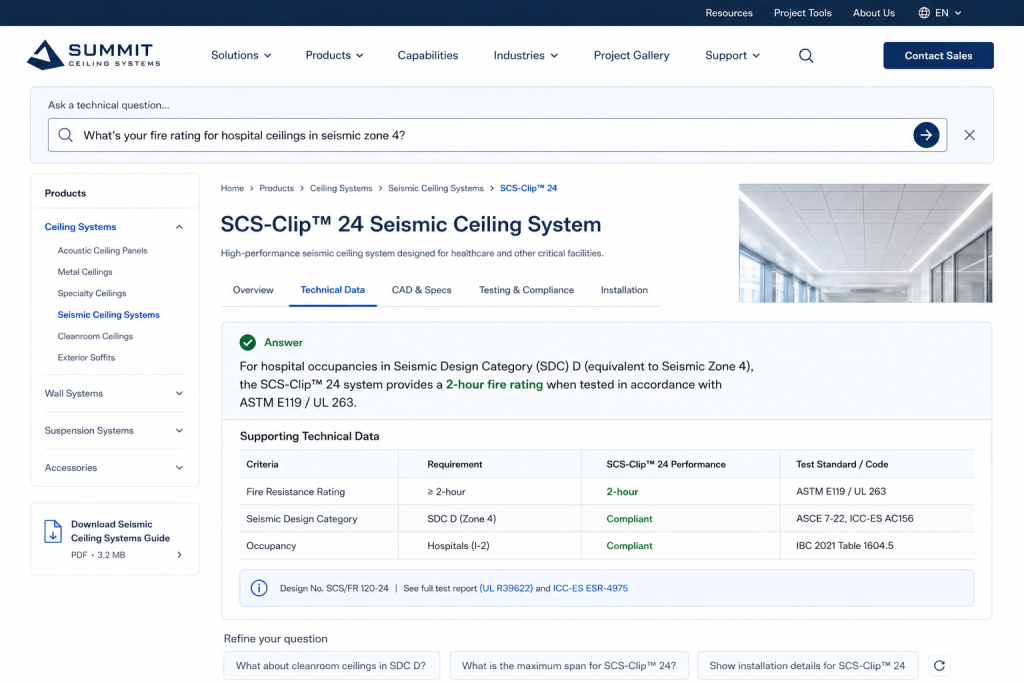
Your buyers aren’t comparison shopping for sneakers. They’re a specifying engineer trying to confirm whether your product meets a fire rating spec for a hospital project in seismic zone 4. They’re a procurement analyst trying to extract your ISO certifications and inspection history into a vendor scorecard. They’re a CIO’s chief of staff trying to figure out, in fifteen minutes, whether your firm has the depth to deliver a global SAP migration in regulated industries.
These aren’t conversational shopping sessions. They’re high-stakes information extraction tasks under time pressure. And right now, on most B2B websites, they’re failing. The architect can’t find the spec sheet without filtering through forty PDFs. The procurement analyst gives up on your certifications page and pings a competitor. The CIO’s chief of staff can’t tell from your homepage whether you serve their vertical at the scale they need, so you don’t make the call list.
Every one of these failures used to be tolerable. AI made it terminal, because your competitors are now answering these questions in seconds, and the buyer’s attention budget for any single vendor has collapsed.
What this looks like reframed for your audience:
A pharmaceutical sponsor’s sourcing analyst pulls up your CDMO site and types: “Show me your sterile injectable capacity by site, with FDA inspection dates and any 483 observations from the last 36 months.” If your site can answer that pulling from structured capability and compliance data, you’ve just compressed three weeks of back-and-forth into a single session. If it can’t, the analyst moves on.
An architect on your building materials site types: “What’s the highest STC-rated wall assembly you offer that meets Type II-B construction requirements and is available through distributors in the Pacific Northwest?” If your product data, code compliance, and distributor network are queryable as connected data, you’ve just become the easiest specification decision of the day. If not, you’ve lost the spec to whoever’s site answered first.
A CIO’s evaluator on your IT services site types: “Compare your offshore, onshore, and nearshore delivery models for 24/7 application support in financial services, with specific examples and certifications.” If your delivery model documentation, vertical case studies, and certifications are connected and extractable, you’ve earned a follow-up call. If they’re scattered across a “Services” page, a “Why Us” page, and a downloadable PDF, you haven’t.
What B2B brand and tech leaders need to do
- Deploy AI-powered site search built on your actual content. Not consumer-grade product search, enterprise document and knowledge retrieval. The infrastructure exists today: Algolia’s AI search, Elastic with semantic layers, Vertex AI Search for documents, Glean-style retrieval for public-facing knowledge. The point is not chatbot novelty. The point is that an architect, procurement analyst, or CIO evaluator can ask a natural language question and get a precise answer with citations to your own technical documents. This is table-stakes infrastructure for 2026.
- Make technical documents the primary asset class, not the afterthought. Spec sheets, white papers, regulatory dossiers, capability statements, methodology documents are the highest-value content on your site. Most firms treat them as PDF downloads behind a forms wall. Reverse the priority; publish them as structured HTML with full-text indexability, version control, and metadata. PDFs can remain as the printable artifact; the canonical source should be web-native, queryable content.
- Instrument what gets asked, not just what gets clicked. Conversational analytics, query patterns, refinement chains, abandonment points, zero-result queries are the most strategic dataset your marketing organization can build right now. They reveal which capabilities buyers care about, which questions your content fails to answer, and which competitor comparisons are top of mind. This is product, marketing, and sales intelligence in one stream. Most firms are sitting on it without instrumenting it.
- Treat zero-result and abandoned queries as the priority backlog. Every unanswered question on your site is a content gap, a positioning weakness, or a feature opportunity. For pharma services firms, repeated unanswered queries about a specific therapeutic area or regulatory pathway tell you exactly where to invest in capability marketing. For IT services, recurring questions about a specific platform or vertical tell you where to commission case studies. For building materials, recurring queries about a code or application tell you where the product team should be looking next. Run this as a monthly review with cross-functional ownership.
- Build sales-enablement chatbots on top of the same knowledge layer. The same structured content that answers buyer queries on your website should power the AI assistants your sales team uses internally. Case-study retrieval, RFP-response acceleration, competitive intelligence. Doing this once, with one knowledge architecture, is dramatically cheaper than building parallel systems. It also closes the loop: questions buyers ask externally become training signal for how reps respond internally.
The executive perspective: This requires genuinely cross-functional investment, and it cannot be delegated downward. The CTO owns the retrieval infrastructure and content architecture. The CMO owns the content quality, structure, and answer design. Marketing operations owns the analytics layer and the feedback loop into content investment. Sales leadership owns the integration into the internal selling motion. Without joint ownership at the top, this fragments into a chatbot pilot that fails, an SEO project that doesn’t move citations, and an unused analytics dashboard.
The firms that get this right are doing something more strategic than improving their website search. They’re building an adaptive expertise platform; a system that learns from every buyer interaction, surfaces capability gaps in real time, and turns the site from a brochure into a continuously sharpening competitive instrument. That’s the actual prize, and it’s available to any B2B firm willing to make the joint investment now rather than waiting for the category to commoditize the move.
| Imperative 1 Citation | Imperative 2 Queryable | Imperative 3 RFP-Ready | Imperative 4 Trust | Imperative 5 Sales-Marketing |
Imperative #3: Build the RFP Ready Website
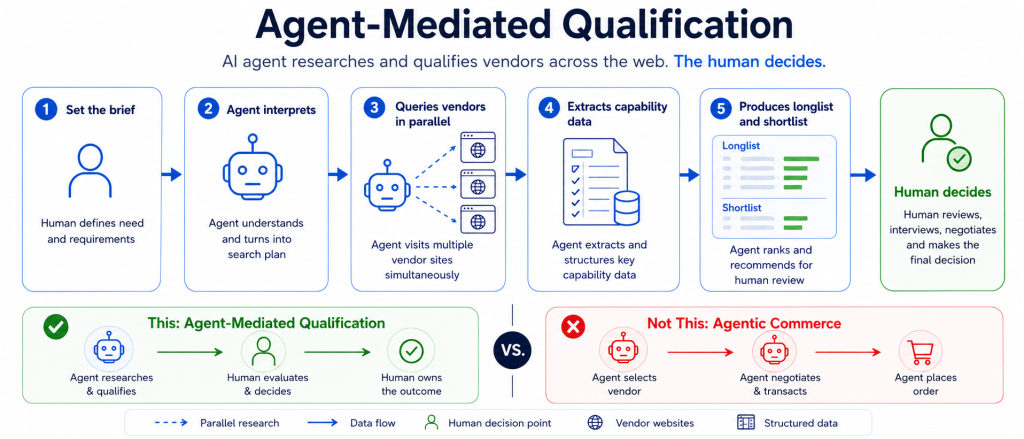
The B2B version of “agentic commerce” isn’t agents buying things. It’s agents researching, qualifying, and shortlisting on behalf of buyers and your site needs to be ready for both.
The hype around agentic AI imagines autonomous purchasing agents. For consumer commerce, that frontier is real. For B2B services, materials, and pharma, it isn’t and won’t be soon. No one is delegating a five-year supply agreement, a multi-million-dollar IT services contract, or a GMP-audited CDMO selection to an autonomous agent. Regulated industries especially have human-in-the-loop requirements baked into their procurement governance.
However the research and qualification phase is already being delegated. A procurement analyst’s AI assistant pulling capability statements from twenty potential vendors. A specifying engineer’s AI tool extracting performance data from manufacturer datasheets to populate a project comparison matrix. A sourcing director’s research agent assembling a regulatory-history summary across CDMO candidates. These workflows are running today, and they’re running against your website whether you’ve prepared for it or not.
“The future isn’t agentic commerce. It’s agent-mediated qualification. And the brands whose sites are agent-readable will dominate longlists.”
What B2B brand and tech leaders need to do
- Build for extraction, not just engagement. Capability matrices, certification rosters, geographic coverage, regulatory inspection history, project galleries with named verticals, all of this should exist in structured, parse able form on your site, not buried in PDF brochures the agent has to OCR. If a buyer’s research agent can’t extract your differentiators in a single pass, you’re invisible in their analysis.
- Adopt protocols for governed agent access. Anthropic’s Model Context Protocol (MCP) and Google’s Agent-to-Agent (A2A) framework are emerging as the standards. The early B2B use case isn’t transactional, it’s letting authorized buyer agents query authoritative product, capability, or compliance data from your systems with proper governance. First movers in pharma and industrial materials are already piloting this.
- Treat your site as an API for your expertise. The mental model shift: stop asking “what do I want visitors to see” and start asking “what would a buyer’s agent need to extract to put us on a shortlist.” Capability data, compliance posture, project references, contact routing, all of it needs to be queryable, not just navigable.
- Define your agent posture. Which AI crawlers do you welcome? Which do you block? Which do you charge (Cloudflare’s Pay-Per-Crawl is one model)? What information do you expose freely versus gate behind authenticated access? These are board-level decisions about how your firm participates in the AI economy.
The executive perspective: This is positioning, not plumbing. The B2B firms who become the easiest, most reliable sources for AI-mediated research will get on more shortlists, win more RFPs, and shape more category conversations. The ones who don’t will get progressively edged out of consideration sets they don’t even know they were excluded from.
| Imperative 1 Citation | Imperative 2 Queryable | Imperative 3 RFP-Ready | Imperative 4 Trust | Imperative 5 Sales-Marketing |
Imperative #4: Rebuild Trust Signals for AI Discovery
B2B buying is governed by risk reduction. AI search is making the proof points either visible or invisible with no middle ground.
For your audience, trust is the deal. A construction client doesn’t switch insulation suppliers on a whim. A pharma sponsor doesn’t change CDMOs casually. A CIO doesn’t sign a managed services contract without exhaustive vetting. The signals that drive B2B trust, certifications, customer logos, analyst recognition, case studies, regulatory inspection history, project galleries, have always been the heart of the website. AI is now changing how, and whether, those signals get surfaced.
Three shifts your team should be planning around:
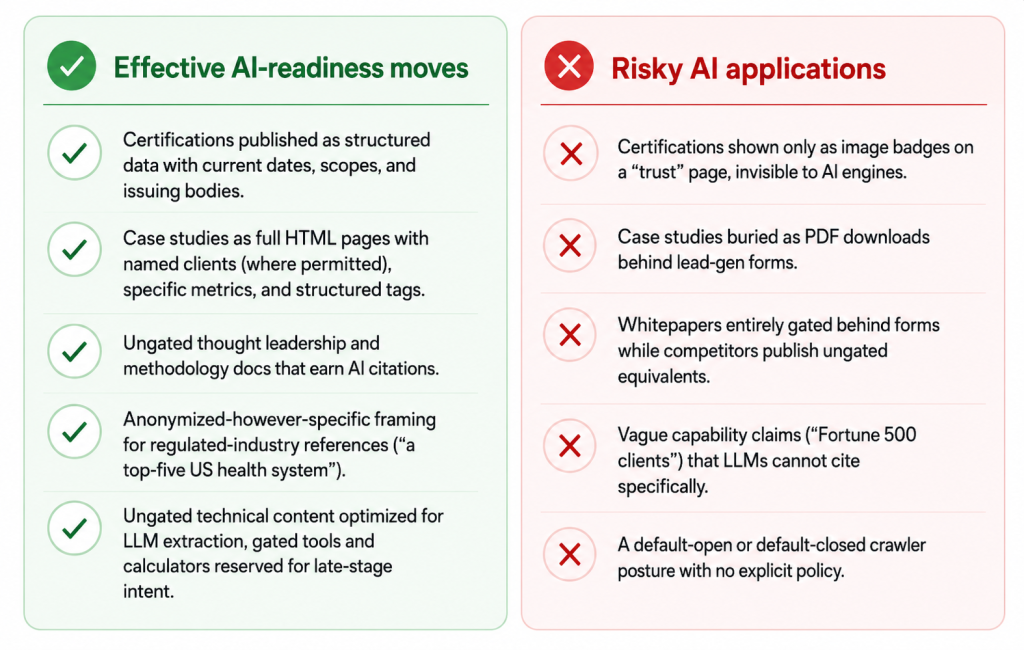
Certifications and compliance as machine-readable assets. ISO 9001, SOC 2, HIPAA, GMP, FDA establishment registration, BIS, Green Guard, EPD certifications, these aren’t decorative badges anymore. They’re the structured attributes AI engines use to filter buyer queries. If your certifications live as image files on a “trust” page, they’re invisible. If they live as structured data with current dates, scopes, and issuing bodies, they become filter criteria that put you on shortlists. This is a near-term, high-leverage fix.
The gated-content reckoning. B2B marketing has spent two decades building lead generation behind whitepaper forms. AI scrapers don’t fill forms. The competitor whose technical paper is ungated gets cited; yours, gated, stays invisible to the LLMs filtering buyer questions. Every CMO in your audience is wrestling with this trade-off right now. The emerging consensus: un-gate the content that builds authority and AI citation; gate the content that signals deep purchase intent (ROI calculators, configurators, RFP templates). Treat the lead form as a qualification mechanism for buyers already convinced, not as the gate to your expertise.
Case studies as both human persuasion and AI fuel. A case study buried in a PDF gallery does no work for AI visibility. Case studies published as full HTML pages, with named clients (where permitted), specific metrics, vertical and geographic tags, and structured metadata, become some of the most powerful AI-citable content a B2B firm produces.
For regulated industries where named-client disclosure is constrained, anonymized, however specific framing (“a top-five US health system,” “a global tier-1 automotive supplier”) still works, provided the specifics around capability, scale, and outcome are concrete.
The executive perspective: Trust signals have always been the moat in B2B. AI didn’t dissolve the moat; it changed what fills it. Structured, specific, accessible proof points are now the entire game. Vague, gated, or PDF-buried proof points are functionally invisible in the new buyer journey.
| Imperative 1 Citation | Imperative 2 Queryable | Imperative 3 RFP-Ready | Imperative 4 Trust | Imperative 5 Sales-Marketing |
Imperative #5: Realign Sales and Marketing
The hidden cost of AI-mediated buyer research isn’t to your website. It’s to your sales motion.
Two years ago, a typical B2B buyer hit your website eight to twelve times across a multi-month evaluation, downloaded two or three gated assets, and got nurtured into a sales conversation. Lead scoring tracked that journey. BDRs ran outbound on accounts showing fit signals. Marketing-sourced pipeline was measured by form fills.
That model is now backwards in three ways:
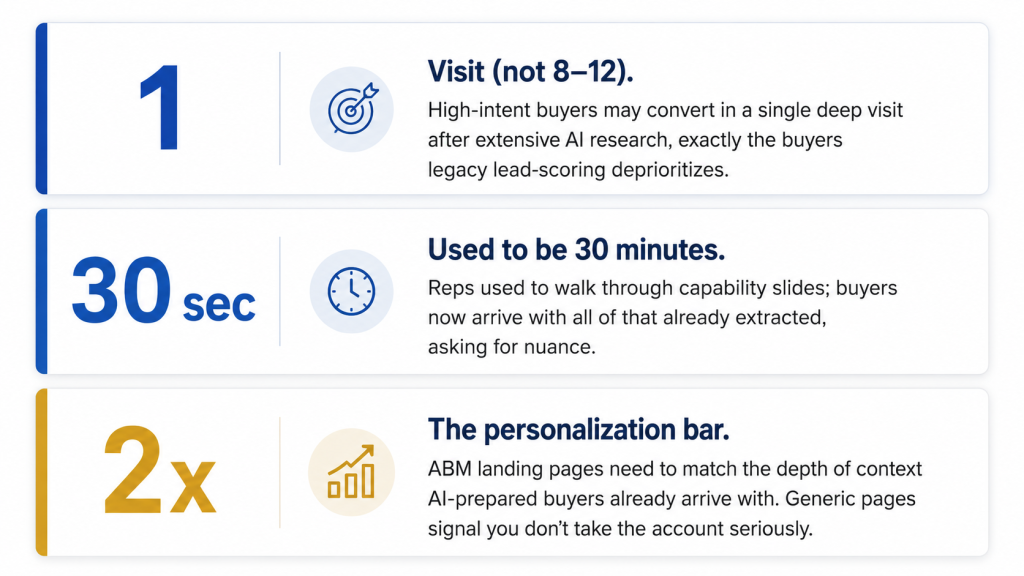
First, high-intent traffic now arrives in fewer visits, later in the cycle. A buying-committee member who’s run six queries in Perplexity, read three competitor sites, and arrived at yours having pre-qualified your category fit may convert in a single visit. The “engagement intensity” lead scoring models flag them as low-priority, one visit, no nurture sequence, exactly when they’re most ready to buy. Firms still running 2022-vintage scoring are systematically deprioritizing their best prospects.
Second, the questions buyers bring to the first sales call are different. They’ve already extracted your capabilities, certifications, geographies, and case study list before the call. The reps who used to spend the first thirty minutes walking through capability slides now find themselves in a conversation that starts at “we’re comparing you against three named competitors on these specific criteria, take us through the nuance.” Reps trained to qualify and present are unprepared. Reps trained to consult and tailor are thriving. The role didn’t disappear. It got harder, more strategic, and worth more per hire.
Third, ABM personalization just got more expensive and neffective. When a buyer arrives at your site having already done AI-mediated research, your one shot to differentiate is whether the experience matches the depth of context they already have. Generic landing pages signal you don’t take the account seriously. Account-specific landing pages, vertical-specific case study clusters, and persona-tailored capability narratives signal you’re prepared for the conversation they’re actually trying to have. The bar on personalization rose; the reward for clearing it rose more.
What B2B leaders need to do
- Rebuild lead scoring around intent depth, not visit frequency. A single visit with deep capability-page exploration, a comparison-content consumption pattern, or a high-specificity site search query is a stronger signal than ten shallow visits. Work with your marketing operations and sales operations leads to redefine the qualification model. This is a 60-day project, not a quarter-long initiative, however it requires both functions in the room.
- Retool, don’t downsize, the BDR and SDR function. The work shifts from cold-list outbound to high-context account intelligence: which accounts are showing AI-mediated research signals, which buying-committee personas have engaged, what specific questions a given account’s queries reveal. The BDRs who succeed in 2026 will look more like research analysts than dialers. Plan the retraining now; the firms that wait will lose their best people to the firms that don’t.
- Treat the sales conversation as the last mile of expertise delivery, not the first. Equip reps with AI-powered internal tools, case study retrieval, RFP-response acceleration, competitive intelligence summaries, that let them respond to a pre-researched buyer’s questions in real time, with depth. The same knowledge layer that powers your queryable website (Imperative 2) should power your sales enablement. Build it once, deploy it twice.
- Realign marketing sourced and sales sourced attribution. When AI compresses the funnel and traffic arrives later, traditional first-touch attribution breaks. Marketing increasingly creates citation-level demand, the brand was in the AI answer that caused the buyer to consider you, without ever logging a first-touch event. Sales operations and marketing operations need a shared model that credits AI-mediated discovery, not just trackable web sessions, or marketing will lose budget for the work that matters most.
The executive perspective: This isn’t an HR conversation about cutting heads. It’s a strategic conversation about what your sales motion is for in a world where buyers know more, faster, and arrive ready for nuance. The firms that retool will compress sales cycles, raise win rates on shortlisted opportunities, and build a sustainable advantage. The firms that try to preserve the 2022 motion will keep wondering why their pipeline metrics are diverging from their revenue.
Proprietary expertise is your new moat
Strip away the hype, and the truth is simpler than the tech press makes it sound: AI runs on data, however for B2B the data that matters isn’t generic. It’s your proprietary expertise and whether you’ve made it discoverable, defensible, and intelligent.
For consumer brands, the AI-and-data conversation is mostly about content volume and crawl monetization. For your audience, it’s about something deeper: the moat is the expertise you’ve built over years of complex projects, regulatory navigation, engineering judgment and whether that expertise is showing up in the queries buyers actually run.
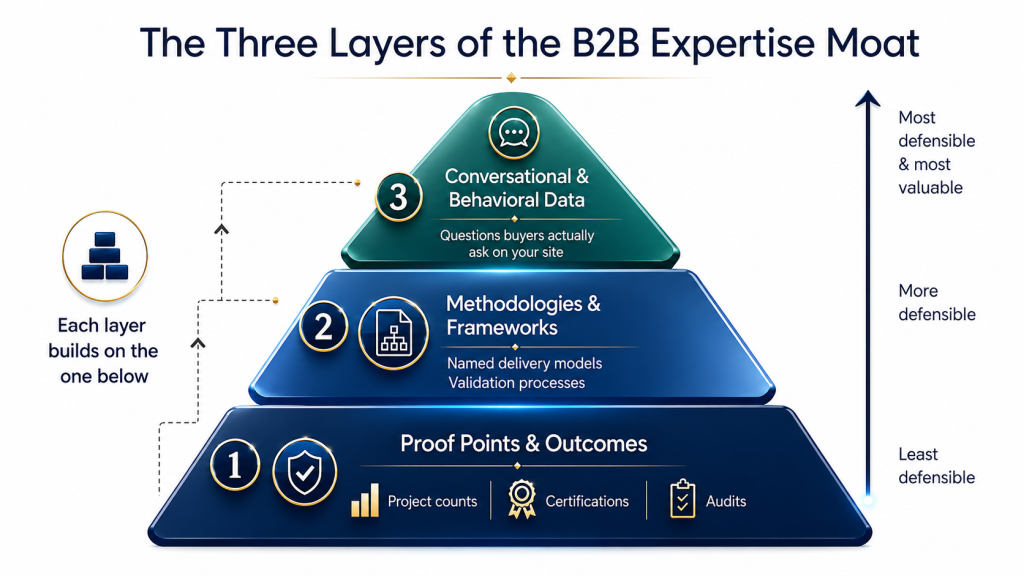
Three layers of moat worth thinking about distinctly:
Layer one: proof points and outcomes. This is the most defensible asset most B2B firms own and the most consistently underexposed. Every project completed, certification earned, audit passed, regulatory submission cleared, and outcome delivered is competitive intelligence, however only if it’s structured, specific, and accessible. A pharma services firm with twenty years of FDA inspection history has a moat. A pharma services firm whose inspection history lives on a “Quality” page as decorative copy doesn’t. Same expertise, radically different visibility.
Layer two: methodologies and frameworks. Every B2B firm of any scale has proprietary ways of working, implementation methodologies, application engineering processes, validation frameworks, delivery models. These are the differentiators sales teams talk about in pitch meetings. They’re almost never published as discoverable content. Naming and codifying your methodology, then publishing it in structured form, does two things at once: it earns AI citations on questions about how work in your category gets done, and it forces internal clarity about what you actually do differently. The firms that name their methodologies become the reference point for the category. The firms that don’t get measured against someone else’s frame.
Layer three: conversational and behavioral data from your own site. Once you’ve made your expertise queryable, the questions buyers ask become the most valuable strategic dataset your firm has access to. Not page views, actual questions. Which capabilities buyers probe deepest. Which comparisons recur. Which regulatory contexts come up unprompted. Which competitors get named in queries. This is product intelligence, positioning intelligence, and partnership intelligence in one stream and it’s available only to firms that built the queryable layer in the first place.
Beyond the moat itself, two governance questions are now board-level:
Who gets to access your data, on what terms. Cloudflare’s Pay-Per-Crawl, OpenAI’s content licensing deals, and emerging robots.txt extensions for AI bots are giving brands real control over how their content fuels AI engines. For B2B firms, the question isn’t just monetization, it’s strategic. Some content you want maximally cited (capability statements, methodology docs, ungated thought leadership). Some content you want gated against scraping for competitive reasons (proprietary benchmarks, customer-specific case studies). Some content has regulatory implications around what can be exposed to third-party AI systems at all. This needs an explicit policy, not a default-open or default-closed posture.
What you expose, in regulated contexts especially. For pharma services firms in particular, what you publish about clients, capabilities, and regulatory posture has compliance implications that don’t apply to consumer brands. Marketing, regulatory affairs, and legal need to be aligned on an AI-content policy now before someone publishes a case study that creates an off-label issue or exposes a client relationship that was supposed to stay confidential. Construction materials firms have analogous concerns around code-compliance claims; IT services firms in financial services have client-confidentiality constraints. The work is straightforward however it’s nobody’s job by default. Make it someone’s job.
The executive perspective: The brands that will win the AI-mediated B2B economy aren’t the ones with the most content or the most aggressive crawl-blocking. They’re the ones who treated their proprietary expertise as a strategic asset class, structured it, named it, published it, and instrumented the feedback loop. That’s what “data as moat” actually means in your category.
The Bottom Line for B2B Leadership
The brands winning B2B in 2026 won’t be the ones with the most polished websites. They’ll be the ones whose expertise is the easiest for both humans and machines to verify, extract, and trust.
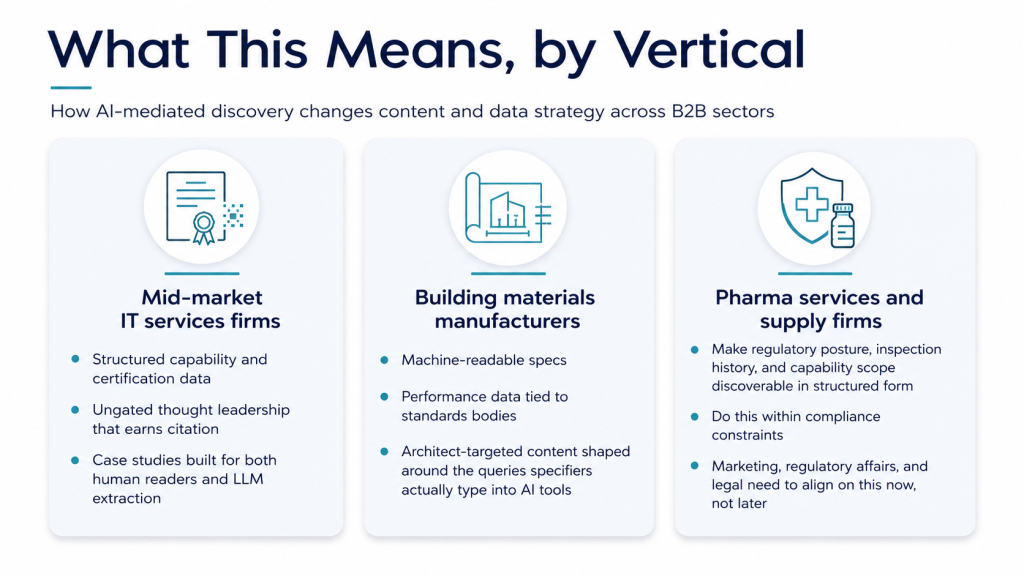
The transformation is already underway in your category. The only question is whether your website is being read into buyer shortlists or being skipped over silently.
Where PracticeNext Comes In
PracticeNext works with B2B firms across IT services, industrial manufacturing, pharma services, and other complex buying-cycle industries to restructure their digital presence for the AI era. Our work spans content architecture audits, GEO implementation, queryable-expertise platform design, and agent-readiness assessments.
We’ve helped clients restructure capability documentation for AI extraction, restore lost organic visibility through GEO methodology, and build AI-readable case study libraries that earn citations in buyer-research queries. We don’t sell tools or run paid media. We help firms make their expertise the easiest in their category to find, verify, and trust.
Let specificity lead the way
If there’s one takeaway from this paper: structured proof beats polished marketing. The leaders who will thrive are those who restructure their expertise for both humans and machines, not those who simply produce more content.
Whether you’re just getting started or refining your next initiative, keep these questions in mind:
- Are we cited. or just ranked, in the queries our buyers run?
- Can a buyer interrogate our site, or only navigate it?
- Could a buyer’s AI agent extract enough from our site to put us on a shortlist?
- Are our certifications, case studies, and proof points machine-readable?
- Does our sales motion match what AI-prepared buyers actually need?
Take the Next Step
Want a 30-minute audit of your site’s AI readiness, scored against the criteria above and benchmarked against your category? Reach us at contact@practicenext.com. We’ll send back a written assessment within five business days, no pitch deck attached. If you’d prefer a vertical-specific deep dive, IT services, industrial materials, pharma services or any other vertical, let us know in your note and we’ll tailor the audit accordingly.