
A Pillar Guide for CXOs, Digital Leaders & Growth Architects
Executive Summary
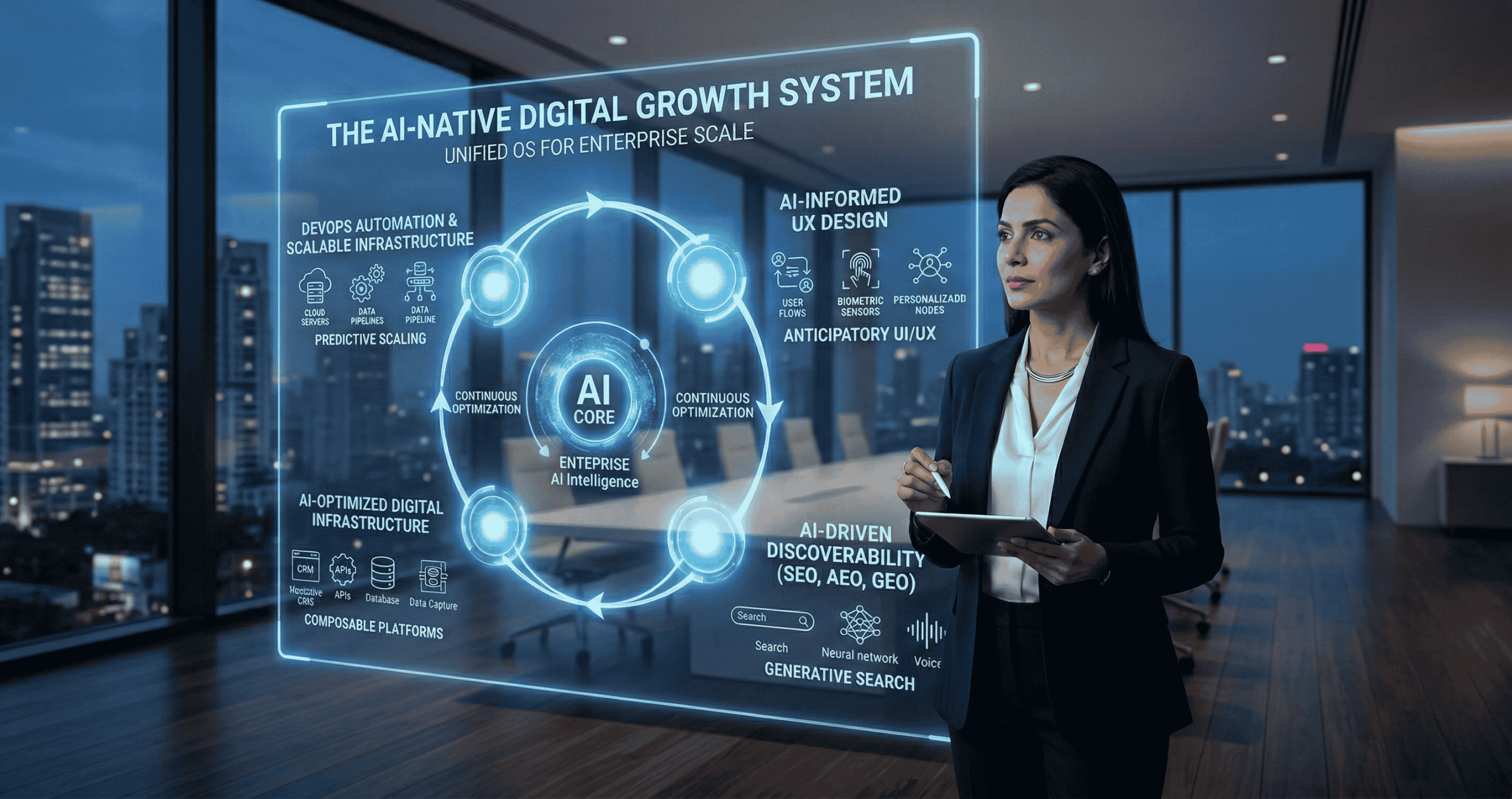
The era of fragmented digital strategy is over. The enterprises winning in 2026 are not those spending more on AI, they are those spending smarter. They have abandoned disconnected marketing, development, and UX departments in favour of a single, integrated framework: the AI-Native Digital Growth System.
An AI-Native Digital Growth System is an integrated operating architecture that unifies DevOps automation, scalable digital infrastructure, AI-informed user experience design, and AI-driven discoverability into one continuous optimization loop. It replaces siloed digital functions with a central nervous system that enables enterprises to scale faster, perform with precision, and compound growth through data and automation.
| The core challenge: 91% of organizations plan to increase AI spending in 2026 (Deloitte), yet only 25% of AI initiatives deliver expected ROI (IBM). The gap between investment and return is an architecture problem — not a technology one. |
For the C-suite, this represents a fundamental shift: from treating AI as a bolt-on capability to embedding it as the foundational layer of the business. The organizations that win the next decade will be those that connect their backend infrastructure, frontend experience, and market discoverability into one autonomous, self optimizing engine. This guide explains precisely how to build it.
What This Guide Covers
- The Paradigm Shift: why siloed digital operations fail and how a unified OS closes the ROI gap
- Pillar 1: DevOps Automation & Scalable Infrastructure: AI-driven foundations for high velocity growth
- Pillar 2: Anticipatory UI/UX Design dynamic: AI-informed experiences that adapt in real time
- Pillar 3: AI-Optimized Digital Infrastructure: architecting websites and eCommerce platforms as enterprise grade assets
- Pillar 4: The New Rules of Discoverability: dominating SEO, Answer Engine Optimization (AEO), and Generative Engine Optimization (GEO)
- The Continuous Optimization Loop: how integrating the four pillars creates compounding, self-reinforcing growth
- Enterprise Evidence: real world examples with quantified outcomes
The ROI Gap: Why Siloed AI Fails
The modern enterprise faces a paradox. AI spending is accelerating at pace, yet the majority of initiatives fail to produce the returns leadership expects. The reason is not the technology, it is the architecture in which it operates.
When AI is deployed in isolation, a customer service chatbot here, a demand forecasting model there, a generative content tool in marketing, it creates intelligence silos. Data generated in one department never enriches another. Decisions remain fragmented. The system has no memory, no shared context, and no capacity to learn at scale.
| Key Metric | Source |
| 91% of organizations increasing AI spend in 2026 | Deloitte Enterprise AI Survey, 2025 |
| Only 25% of AI initiatives deliver expected ROI | IBM Institute for Business Value, 2025 |
| 55% faster task completion with AI-assisted dev tools | GitHub Copilot Enterprise Study, 2025 |
| 10–15% consistent revenue lift from AI-driven personalisation | McKinsey & Company, 2025 |
The solution is not more AI tools. It is a unified architecture that allows intelligence to flow freely, from backend infrastructure to frontend customer interaction, from discoverability signals to UX iteration, and from operating metrics back into strategic decision making.
This is what the AI-Native Digital Growth System delivers: a calm futuristic operating model that is clean, strategic, and hyper efficient by design.
Pillar 1: DevOps Automation and Scalable Infrastructure

Every high performing digital enterprise is built on a foundation of resilient, adaptive infrastructure. In an AI-native ecosystem, traditional IT and DevOps are transformed from reactive, manual disciplines into predictive, autonomous systems.
AI-driven DevOps continuously monitors system health, automates code deployment pipelines, predicts infrastructure demand before bottlenecks materialise, and executes one-click rollbacks when anomalies are detected.
Machine learning models analyze vast streams of operating metrics; server load, latency spikes, traffic patterns, API response times and make intelligent scaling decisions in milliseconds. The result is a digital platform that absorbs traffic surges without disruption, supports aggressive deployment cadences, and frees engineering capacity for the work that drives competitive differentiation.
Why This Matters for the C-Suite
AI-powered DevOps is not an IT upgrade. It is a risk mitigation strategy and a growth enabler simultaneously. When developers are freed from manual debugging, server provisioning, and incident response, feature velocity accelerates. When infrastructure scales autonomously, the platform can support international expansion, peak commercial events, and rapid product launches without engineering bottlenecks becoming business bottlenecks.
| Enterprise Evidence: Siemens deployed AI-driven predictive maintenance across its industrial infrastructure and achieved a 50% reduction in unplanned downtime. Developers using AI-assisted coding tools complete tasks up to 55% faster (GitHub). For digital commerce enterprises, the same principles translate directly to uptime, deployment speed, and release confidence. |
The foundational question for every CXO is simple: can your infrastructure keep pace with the speed at which your market moves? In an AI-native system, the answer must always be yes, automatically and autonomously.
Pillar 2: AI-Informed User Experience (UI/UX) Design

If DevOps is the engine, user experience is where enterprise value is made visible. The AI-Native Digital Growth System fundamentally redefines how customers, partners, and AI agents interact with digital properties, moving away from static, one size fits all interfaces toward dynamic, anticipatory environments that respond to context in real time.
In high velocity sectors, consumer packaged goods, fashion, nutraceuticals, enterprise SaaS, consumer intent shifts rapidly and unpredictably. AI-informed UX design meets that unpredictability with precision. By analyzing behavioral data, interaction history, session context, and biometric proxies, the platform reshapes the interface dynamically for every individual visitor. On a headless Shopify Plus architecture, for example, this means every product discovery journey, every promotional banner, every content module can be uniquely assembled and sequenced for maximum relevance.
Designing for Humans and Machines
There is a dimension of UX design that most organizations are not yet addressing: the AI agent. As autonomous agents begin to browse, compare products, and execute transactions on behalf of human users, the user experience layer must be legible to large language models, not just human eyes. This means interfaces structured with clear semantic hierarchy, machine parsable content, and logical information architecture, the same qualities that drive E-E-A-T signals in content and GEO in discoverability.
Enterprises that invest in AI-ready UX today are not just improving human conversion rates. They are building infrastructure that performs across the entire spectrum of future digital interaction, human, AI-assisted, and fully autonomous.
| Enterprise Evidence: McKinsey research consistently shows a 10–15% revenue lift for companies executing AI-driven personalisation at scale. Spotify’s implementation of AI-enhanced internal search and documentation reduced information retrieval time for employees by 35% and increased cross-team collaboration by 60% — demonstrating that the UX principles powering consumer experiences create equal value inside the enterprise. |
Pillar 3: AI-Optimized Digital Infrastructure
From Marketing Asset to Enterprise Infrastructure
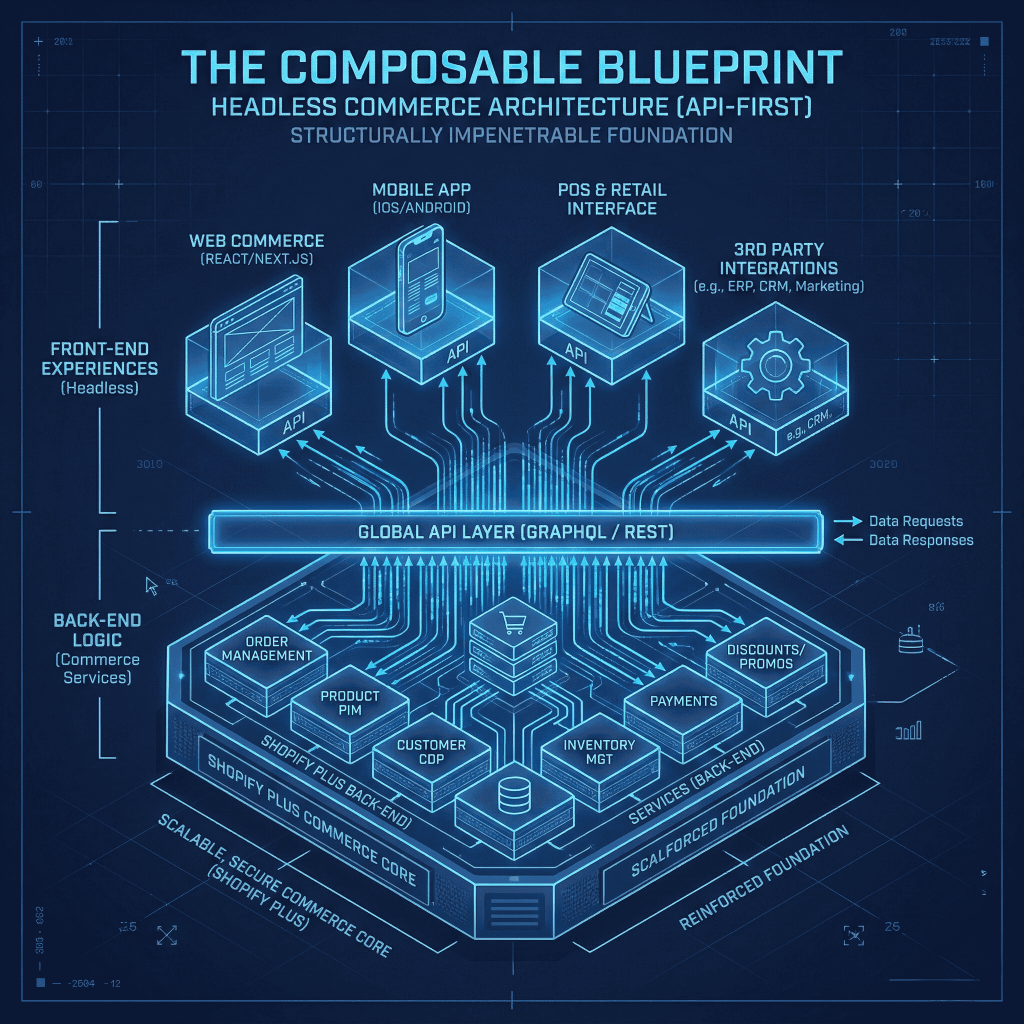
The most consequential reframe in this guide is this: your corporate website and eCommerce platform are not marketing assets. They are enterprise infrastructure and they must be architected accordingly.
Legacy, monolithic web platforms were designed for a world of static content and predictable traffic. They cannot support the data throughput, personalization depth, or integration complexity that AI-native operations demand. To function as a true operating layer for the business, digital infrastructure must be composable, API-first, and decoupled, a headless architecture in which the front-end presentation layer operates independently of the back-end logic.
Frameworks such as headless Shopify Plus, commercetools, and emerging protocols like the Unified Commerce Protocol (UCP) are purpose-built for this paradigm. By decoupling front-end rendering from back-end computation, AI models can ingest datasets at scale, inject dynamically generated content, and optimize edge rendering without engineering bottlenecks. Crucially, every user interaction becomes structured telemetry — immediately routed back into the central AI system to feed the continuous optimization loop.
The Strategic Outcomes
- Technical Agility: Composable architecture eliminates technical debt and compresses time-to-market for new omnichannel and eCommerce initiatives.
- Unified Intelligence: Seamless API connectivity allows CRM, ERP, and supply chain data to be ingested in real time, transforming the platform from an isolated touchpoint into a centralized intelligence hub.
- Conversion and Resilience: Performance engineered platforms deliver measurable improvements in Core Web Vitals, directly correlating to higher organic rankings, superior conversion rates, and zero downtime system resilience.
- AI Search Readiness: Structured data, clean semantic architecture, and fast edge rendering are the technical prerequisites for performing in AEO and GEO environments, making infrastructure investment a direct discoverability investment.
Pillar 4: AI-Driven Discoverability; SEO, AEO, and GEO
Scalable infrastructure and exceptional user experience are inert without discoverability. The mechanics of how enterprises are found by customers, by procurement teams, and increasingly by AI systems, have undergone a structural shift that demands a new strategic posture.
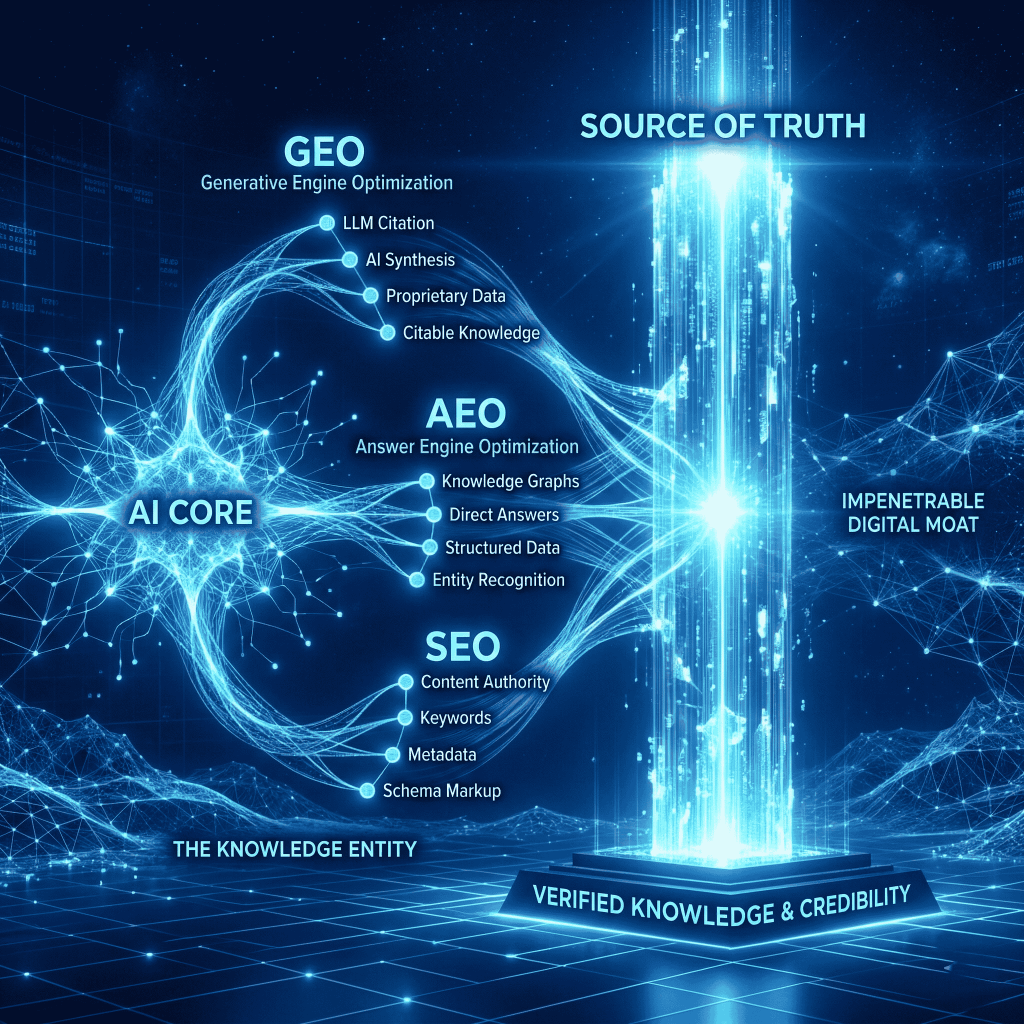
Traditional Search Engine Optimization (SEO) remains the bedrock. But in 2026, it is necessary but not sufficient. To capture market share across the full spectrum of discovery channels, an AI-Native Digital Growth System must integrate Answer Engine Optimization (AEO) and Generative Engine Optimization (GEO) as coordinated, first class disciplines.
| Strategy | Primary Goal | How It Works in 2026 |
| Traditional SEO | Rank in algorithmic search | Technical excellence, entity based topical maps, robust schema markup and authority building |
| Answer Engine Optimization (AEO) | Win direct-answer results and voice search | Concise, structured content architected so AI assistants pull it as the definitive source |
| Generative Engine Optimization (GEO) | Become the cited brand inside LLM outputs | Proprietary data, expert authorship, and semantic depth that LLMs like ChatGPT, Gemini, and Claude reference |
What is Answer Engine Optimization (AEO)?
Answer Engine Optimization is the practice of structuring content to be selected as the direct, authoritative answer by voice assistants, AI-powered search features, and answer engines. Rather than optimizing for ranking positions, AEO optimizes for answer selection, the moment a system chooses your content as the definitive response to a query.
This requires extreme clarity of structure, concise formatting at the paragraph and sentence level, authoritative data sourcing, and FAQ style content architecture that maps directly to the questions your target audience is asking. Every heading, every definition, every statistic must be written as if it will be extracted and surfaced in isolation, because in an AEO environment, it will be.
What is Generative Engine Optimization (GEO)?
Generative Engine Optimization is the discipline of positioning enterprise content to be cited by large language models; ChatGPT, Gemini, Claude, Perplexity, and the AI-augmented search experiences that are rapidly displacing traditional results pages. When an enterprise procurement manager or a consumer asks an LLM to recommend the best eCommerce infrastructure platform, GEO determines whether your brand appears in the synthesized response.
GEO is built on the same foundation as E-E-A-T: demonstrable experience, documented expertise, established authoritativeness, and verifiable trustworthiness. But it goes further. LLMs are trained on and retrieve content that is semantically rich, internally consistent, factually substantiated, and clearly attributed to recognizable entities. Generic content is invisible to generative engines. Thought-leadership content grounded in proprietary data, original research, and expert authorship becomes part of the model’s knowledge and part of its recommendations.
E-E-A-T as the Foundation of All Three
Experience, Expertise, Authoritativeness, and Trustworthiness (E-E-A-T) is not a content checklist. For the modern enterprise, it is a brand architecture strategy. It means transforming the organization into a recognized knowledge entity in its domain — one whose content is verifiable, whose expertise is attributed, and whose data is original.
The practical implication: every piece of content in the AI-Native Digital Growth System must be produced at thought leadership grade. Named authors with demonstrable credentials. Proprietary data and original research rather than aggregated statistics. Clear factual citations. Schema markup that tells crawlers and LLMs exactly what the content is, who produced it, and why it should be trusted. This is the content infrastructure that builds an impenetrable discoverability moat.
The Continuous Optimization Loop

Each of the four pillars described above is powerful in isolation. Together, they form something qualitatively different: a self reinforcing operating system that learns, adapts, and compounds over time.
Consider what happens when the pillars are integrated. A shift in consumer search behavior, a new question pattern emerging in GEO/AEO data, does not simply appear in a marketing report and wait for the next quarterly review. It triggers an immediate cascade. The UX layer receives updated behavioral signals and begins serving adjusted content and layouts. The DevOps infrastructure receives traffic forecasts and scales capacity proactively. The content engine identifies the gap in the topical map and begins producing authoritative material to fill it. The next wave of searchers finds exactly what they need, converts at higher rates, and generates new behavioral data that refines the model further.
| The Compounding Principle: UPS saves an estimated $300–$400 million annually through AI route optimization — not because it has a better map, but because its system simultaneously analyzes traffic, package volume, vehicle health, and delivery timelines. The AI-Native Digital Growth System applies identical mission-control logic to digital commerce: every data point from every layer feeds a central intelligence that becomes more precise with every cycle. |
This is the distinction between a collection of advanced tools and a true operating system. Tools execute tasks. An operating system learns. The continuous optimization loop is the mechanism by which the AI-Native Digital Growth System transcends individual functions and becomes the enterprise’s most durable competitive asset.
The Structural Advantage That Compounds
The enterprises that will define the next decade are not the ones investing most aggressively in AI. They are the ones investing most intelligently, connecting their infrastructure, experience, and discoverability into a single unified system that gets smarter with every interaction.
The four pillars of the AI-Native Digital Growth System are not theoretical ideals. They are practical, implementable disciplines that, when unified, create a structural competitive advantage that legacy organizations cannot replicate by simply increasing their technology budget. The gap between a siloed enterprise and a unified one is not a question of tools, it is a question of architecture. And architectural advantages compound.
Every day that a unified system operates, it generates more data. Every data point refines the model. Every refinement improves performance across infrastructure, experience, and discoverability simultaneously. The system that is built and activated today becomes measurably more capable in six months, significantly more capable in twelve, and exponentially more capable in three years, while competitors still debate which AI vendor to pilot next.
| The Strategic Imperative: The window for building this advantage is open. But it is not permanent. As generative AI reshapes search, as autonomous agents redefine the user journey, and as composable architecture becomes the minimum requirement for competitive digital infrastructure, the cost of inaction compounds just as surely as the benefit of action does. |
The strategic CXO, the mandate is clear and the timeline is now. Audit your current architecture for siloes. Identify where data flows end rather than circulate. Commission a composable infrastructure roadmap. Establish E-E-A-T as a board-level content strategy. Deploy AEO and GEO as first-class discoverability disciplines alongside traditional SEO. And connect every layer into a loop that learns.
The AI-Native Digital Growth System is not the future of enterprise digital strategy. It is the present, and the organizations implementing it today are already widening the distance between themselves and the field. The question for every CXO reading this is not whether to build this system. It is whether to build it now, or spend the next three years watching those who did.
Note: All statistics are sourced from third party enterprise research published in 2024–2026 and are accurate at time of writing. For implementation support, consult the supporting cluster articles linked within this guide.
Ready to act?
Start your transformation today
Here is an FAQ section tailored for a CXO audience, designed to reinforce the strategic value of the article.
Frequently Asked Questions
Q: What exactly is an AI-Native Digital Growth System?
A: An AI-Native Digital Growth System is an integrated framework that combines DevOps automation, scalable digital infrastructure, AI-informed user experience design, and AI-driven discoverability into a continuous optimization loop. It replaces siloed digital functions with a unified operating system that enables enterprises to scale faster, improve performance, and compound growth through data and automation.
Q: Why are so many enterprise AI initiatives currently failing to deliver a return on investment (ROI)?
A: While 2025 and 2026 data shows that enterprise AI spending is surging, isolated pilot programs frequently fail to deliver ROI. The root cause of this failure is not the technology itself, but the architecture. When AI is applied in silos, such as a standalone generative tool for marketing or a single predictive model, it creates friction. The intelligence gathered in one department rarely benefits another, preventing the compounding growth that a unified system provides.
Q: How does this system approach high-volume eCommerce environments like Shopify Plus?
A: The system transitions digital properties away from static pages toward dynamic, anticipatory environments. In high-stakes sectors, AI-informed design analyzes behavioral data, biometric proxies, and historical interactions to reshape the user interface in real-time. A robust enterprise platform, such as a headless Shopify Plus architecture, can present a totally unique, frictionless experience to every single visitor.
Q: What is Generative Engine Optimization (GEO), and why is traditional SEO no longer enough?
A: Traditional Search Engine Optimization (SEO) is no longer sufficient on its own due to a seismic shift in discoverability mechanics. Generative Engine Optimization (GEO) involves positioning enterprise content to be cited by Large Language Models (LLMs) like ChatGPT, Gemini, and Claude. Brands that master SEO, along with GEO and Answer Engine Optimization (AEO), effectively build an impenetrable moat. They become the primary source of truth for both their human target audience and the AI models that increasingly guide enterprise procurement and consumer purchasing decisions.
Q: How does the “Continuous Optimization Loop” actually function in practice?
A: In a unified operating system, data is fluid. For example, when a shift in consumer search behavior is detected through AI-driven discoverability, it is automatically fed into the UI/UX layer to adjust the front-end messaging and layout. Every interaction, every search query, and every system load generates data that trains the overarching AI model. The system learns what drives conversion, what causes friction, and what technical configurations yield the lowest latency. It is a self-reinforcing cycle of continuous improvement.
About PracticeNext: We build custom, AI-native digital commerce infrastructure designed to quickly scale and accelerate your business growth.