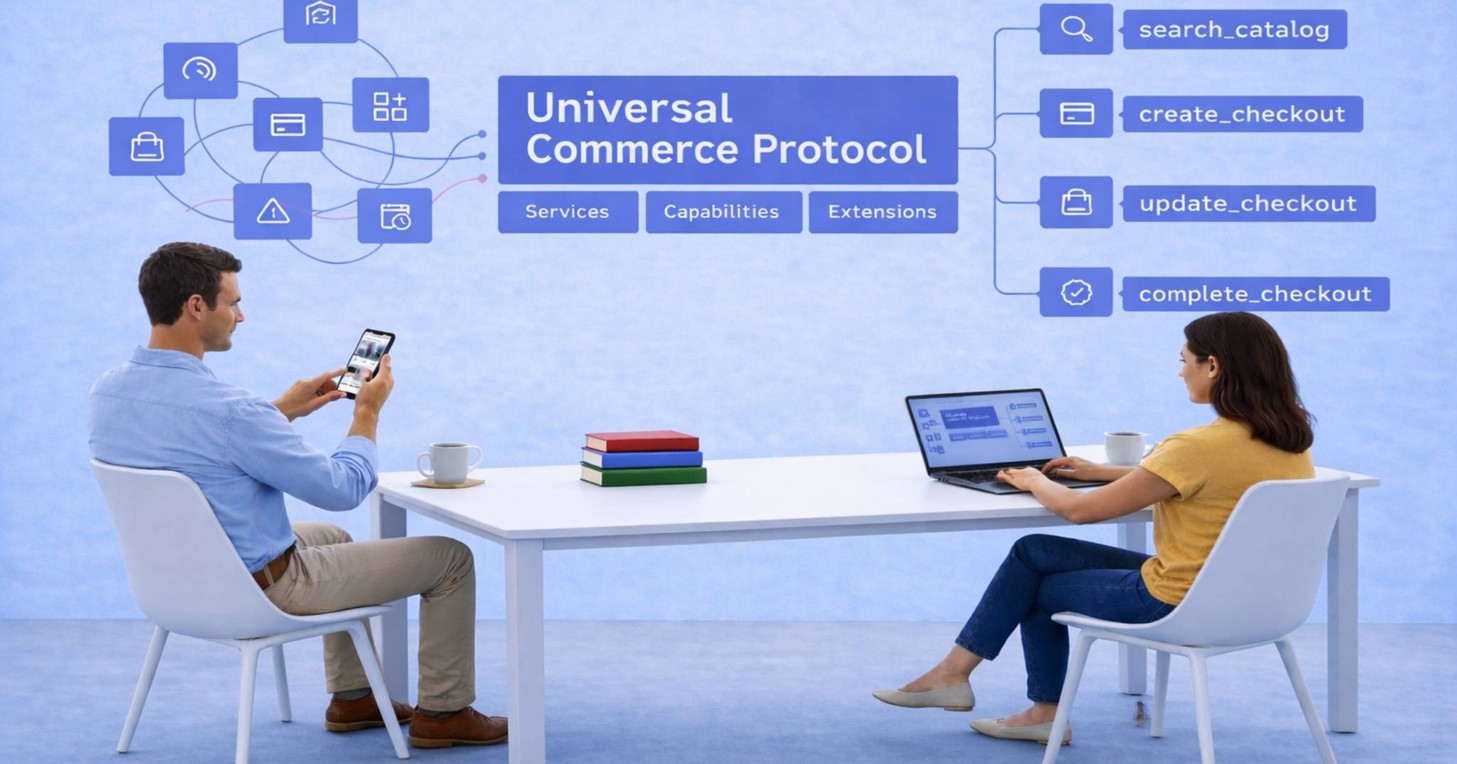

How UCP is standardizing commerce the way HTTP standardized the web, and why retailers can’t afford to wait
When HTTP emerged in the early 1990s, it solved a fundamental problem: how could different computers exchange information without custom integrations for every connection? That single standard unlocked the web as we know it. Today, commerce faces an identical challenge, and the solution has arrived with remarkable speed.
On January 11, 2026, at the National Retail Federation’s annual conference, Google unveiled the Universal Commerce Protocol alongside partners including Shopify, Etsy, Wayfair, Target, and Walmart. Endorsed by over 20 major players across retail and payments, from Visa and Mastercard to Stripe and American Express, UCP represents the industry’s collective answer to a problem that’s been festering for years: commerce is hopelessly fragmented.
UCP isn’t just fixing yesterday’s integration headaches. It’s building the infrastructure for tomorrow’s commerce reality, where AI agents don’t just recommend products, they complete entire transactions autonomously on behalf of consumers.
The Fragmentation Problem That UCP Solves
Modern commerce operates in silos that make seamless shopping nearly impossible. Shopify, Magento, and Salesforce Commerce Cloud each use different data models. Marketplaces, social commerce, point-of-sale systems, and D2C channels operate on disconnected flows. Headless commerce stacks offer power and flexibility but demand heavy customization for every integration. And AI agents, which are rapidly becoming how consumers discover and purchase products, have no standardized way to execute commerce transactions.
The result is what engineers call the “N x N integration problem.” Every AI platform needs custom integrations with every retailer, creating exponential complexity. A retailer wanting to sell across Google Search, ChatGPT, Alexa, and future AI assistants would need separate integrations for each, with different specifications, authentication methods, and data formats. For most retailers, this operational burden makes omnichannel AI commerce functionally impossible.
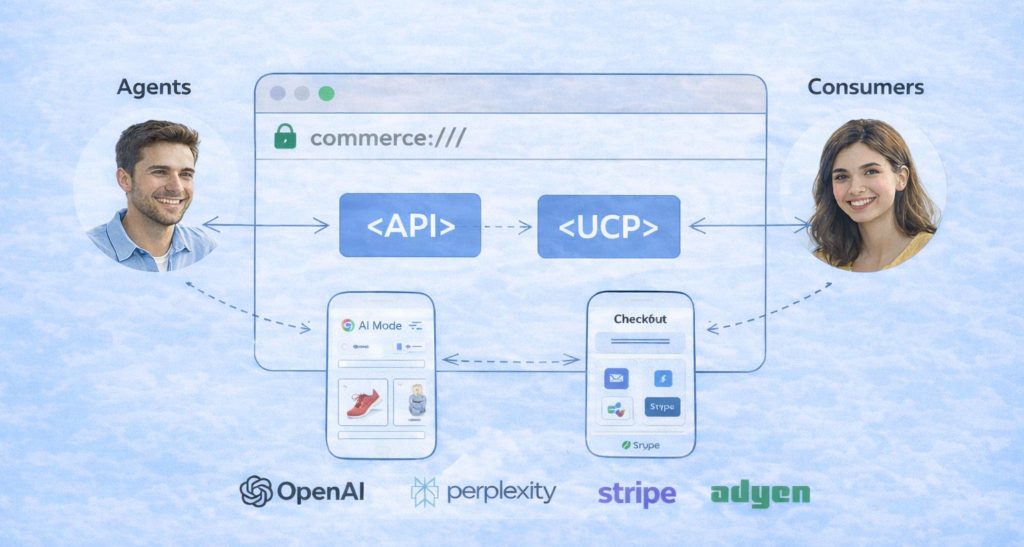
UCP proposes a universal contract so any system can talk commerce with any other system, eliminating the need for unique connections between every agent and every merchant.
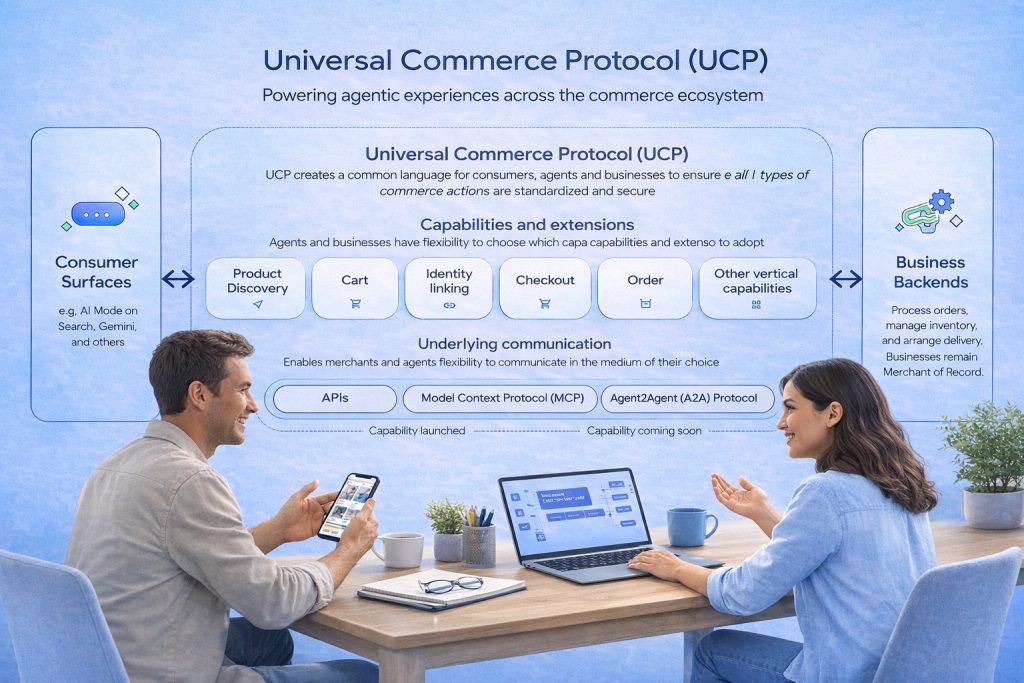
The Four Pillars of Universal Commerce Protocol
Understanding UCP requires grasping its architectural philosophy, which mirrors how other successful internet protocols achieved ubiquity.
Standardized Commerce Objects
UCP defines a shared schema for the fundamental building blocks of commerce: products, prices and promotions, carts and orders, payments, inventory levels, and fulfillment and returns. This is similar to how JSON standardized data exchange across the web, but UCP goes further by being commerce aware, it understands the specific logic of discounts, loyalty programs, subscription billing, and complex fulfilment scenarios.
Rather than forcing every retailer into a rigid structure, UCP uses an extensible architecture. Core commerce primitives remain stable and universal, while optional extensions allow merchants to support specialized capabilities like multi-item carts, loyalty program integration, delivery window selection, or subscription management. Merchants implement only what they need, and agents negotiate which capabilities both parties support during each transaction.
Channel Agnostic Transactions
Commerce should work identically whether it happens on a website, mobile app, marketplace, social platform, in store point POS, or through an AI assistant. Under UCP’s model, the channel becomes merely a presentation layer rather than owning the transaction logic itself.
This design choice has profound implications. A retailer implements UCP once, and immediately becomes accessible across any AI surface that supports the protocol, Google’s AI Mode in Search, the Gemini app, ChatGPT, Microsoft Copilot, and future AI platforms yet to launch. The merchant remains the seller of record, retaining full ownership of customer relationships and data, while the AI agent handles discovery, recommendation, and transaction facilitation.
Composable and Headless by Default
UCP aligns naturally with the composable commerce movement that’s reshaping how retailers build their technology stacks. It’s API-first by design, supporting REST APIs, Model Context Protocol (MCP), Agent2Agent (A2A), and Agent Payments Protocol (AP2). This makes UCP compatible with microservices architectures and event-driven systems, allowing retailers to swap tools and vendors without breaking their commerce flow.
The protocol provides two integration paths. Native checkout via APIs gives technically sophisticated retailers complete control over the transaction experience. Embedded checkout offers a fallback option for merchants with complex business rules that require customer interaction—acknowledging that real-world commerce edge cases won’t normalize overnight.
AI Ready Commerce
The primary driver behind UCP is agentic commerce, the shift to AI agents that autonomously discover products, compare prices, build shopping carts, and execute checkout with user permission. Market projections estimate agentic commerce could generate between $190 billion and $385 billion in U.S. retail sales, representing a fundamental shift in how consumers shop.
UCP gives AI agents a safe, predictable, and verifiable way to transact. Every authorization is backed by cryptographic proof of user consent, creating an accountability trail between merchants, credential providers, and payment services. This trust infrastructure is essential—consumers won’t delegate purchasing authority to AI agents without confidence that transactions are secure and verifiable.
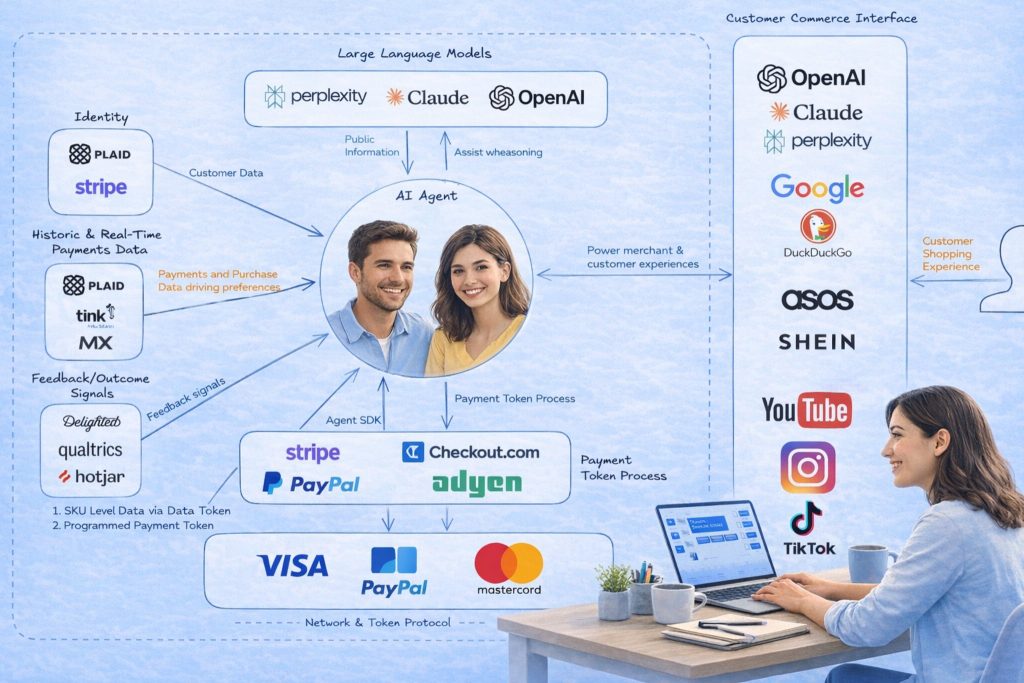
How UCP Works in Practice
The mechanics of UCP are elegantly simple, hiding enormous complexity beneath a clean interface.
When an AI agent initiates a transaction, it sends a UCP compliant request to the merchant’s backend. This request includes the agent’s capability profile, what features it supports, which extensions it understands, which payment methods it can handle. The merchant’s commerce engine interprets the request, compares capabilities, and responds with the negotiated result showing which features both parties can support.
Payment, inventory, and fulfillment systems respond in UCP format, allowing the transaction to complete without platform lock-in. The entire exchange follows a simple state machine: incomplete (missing required information), requires escalation (buyer input needed), or ready for complete (agent can finalize programmatically).
When a transaction requires human involvement, regulatory constraints, merchant policies, or capabilities an agent doesn’t yet support—the merchant includes a continuation URL in the response. The buyer follows this link and picks up exactly where the agent left off, with full context preserved.
Google has already implemented UCP to power a new checkout feature in AI Mode in Google Search and the Gemini app for eligible U.S. retailers, initially using Google Pay and saved Wallet credentials. Shopify merchants can manage these embedded experiences directly from Shopify Admin, while also being eligible for Google’s new Direct Offers pilot program that presents exclusive discounts directly in AI Mode.
Why Should UCP Matter for Retailers and Technology Leaders
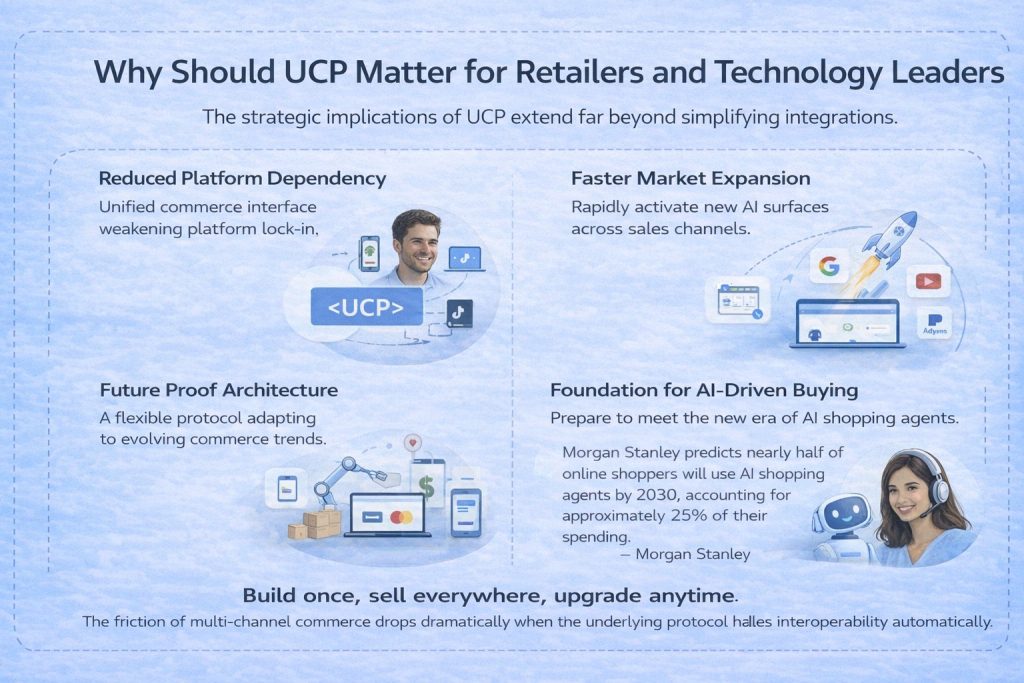
The strategic implications of UCP extend far beyond simplifying integrations. For growing brands and technology decision-makers, UCP represents several critical opportunities.
Reduced Platform Dependency: By standardizing the commerce interface, UCP weakens platform lock-in. Retailers can build their commerce logic once and expose it to any UCP compliant AI surface without rebuilding for each platform’s proprietary requirements.
Faster Market Expansion: Instead of months long integration projects for each new sales channel, UCP enables retailers to activate new AI surfaces in hours or days. As new AI assistants emerge, and they will, rapidly, retailers supporting UCP can be present from day one.
Future Proof Architecture: Commerce technology evolves constantly, with new payment methods, fulfilment options, and customer expectations emerging continuously. UCP’s extensible design allows the protocol itself to evolve as common patterns mature, without breaking existing implementations.
Foundation for AI-Driven Buying: Morgan Stanley predicts nearly half of online shoppers will use AI shopping agents by 2030, accounting for approximately 25% of their spending. Retailers without UCP support risk becoming invisible to this massive shift in consumer behavior.
For growing brands, this creates a compelling value proposition: build once, sell everywhere, upgrade anytime. The friction of multi-channel commerce drops dramatically when the underlying protocol handles interoperability automatically.
The Current State: Direction, Not Destination
It’s important to be clear about what UCP is and isn’t today. UCP is not yet a single official W3C style standard with formal governance and certification processes. It’s better understood as a direction the industry is rapidly converging toward, with Google and major commerce players providing the gravitational pull.
The ideas underlying UCP are already visible across the commerce landscape. Headless commerce APIs, commerce focused GraphQL layers, orchestration platforms connecting disparate systems, and early agentic checkout experiments all demonstrate the same principles UCP formalizes. What Google has done is accelerate this convergence by providing an open-source reference implementation and rallying industry support.
The protocol exists today under Apache 2 open source licensing on GitHub, with comprehensive documentation, SDKs (initially Python, with more languages coming), sample code, and reference implementations. Google invites developers, businesses, and platform architects to join in building the future of commerce through the open-source development community.
Major eCommerce platforms are already building native UCP support. Shopify’s integration makes UCP adoption automatic for millions of merchants using their platform. Other platforms will follow rapidly, driven by merchant demand for access to AI-powered sales channels.
What Retailers Should Do Now
The window for early mover advantage is open but narrowing quickly. Retailers should take several concrete steps immediately.
First, ensure your product catalog, inventory data, and business rules are clean and machine accessible. AI agents consuming your commerce data through UCP need accurate, structured information. Messy data that confuses algorithms means lost sales.
Second, decide where automation should stop and human intervention should begin. Map your customer journey to identify which transactions can complete autonomously and which require buyer input for regulatory, policy, or complexity reasons. UCP supports both paths, but you need clarity on your boundaries.
Third, instrument the full commerce journey to identify friction points. As agent driven transactions begin flowing through your systems, you need visibility into where agents struggle, where customers escalate to support, and which product categories convert well through AI interfaces versus requiring traditional browsing.
Fourth, join the UCP ecosystem actively. Review the open-source specification on GitHub, participate in discussions shaping protocol evolution, and consider contributing code or use cases that address your specific commerce scenarios.
Finally, treat agentic commerce as an operating model shift, not merely a new sales channel. The retailers who thrive will be those who fundamentally rethink customer acquisition, product discovery, and transaction completion for an AI-mediated world.
The HTTP Moment for Commerce
When Tim Berners Lee proposed HTTP in 1989, skeptics questioned whether the web needed yet another protocol. Within five years, HTTP had become foundational infrastructure powering the internet revolution. OAuth followed a similar path, becoming the universal standard for authentication despite initial fragmentation.
UCP stands at that same inflection point. The protocol that makes commerce truly interoperable, allowing any agent to transact with any merchant using a common language, will capture enormous value as agentic shopping becomes the default mode for hundreds of millions of consumers.
The fragmentation that has plagued commerce for decades is ending, not through top-down mandate but through voluntary adoption driven by clear economic incentives. Merchants want access to AI-powered discovery without managing dozens of custom integrations. AI platforms want seamless checkout without rebuilding commerce infrastructure. Consumers want to shop where they already spend time, in conversations with AI assistants.
UCP makes all three possible simultaneously. That’s why it will win.
The question for retailers isn’t whether to support UCP, it’s how quickly they can get ready. The merchants who show up early where AI agents live, keep their data honest and accessible, and deliver when an agent says “buy” will capture disproportionate share of the agentic commerce wave.
The revolution is here. Welcome to the agentic commerce era.
For technical implementation details, visit ucp.dev and review Google’s comprehensive integration guides at developers.google.com/merchant/ucp
About PracticeNext: We build custom, AI-native digital commerce infrastructure designed to quickly scale and accelerate your business growth.
















Pingback: The Future of eCommerce: How AI Agents Are Transforming Online Retail in 2026 - ThinkNext