
Your tech stack is beautiful. Shopify Plus. Headless architecture. AI-powered search. The consultants left three months ago with congratulations all around.
And it still takes three weeks to launch a landing page.
Your data lives in seventeen different spreadsheets. Your “Digital Flagship”, the one that cost seven figures, feels just as clunky to manage as the legacy monolith you replaced. Meanwhile, your competitors are shipping daily updates, running personalized campaigns, and moving with a fluidity that makes you look slow.
Here’s what nobody told you during the platform migration: you installed a Formula 1 engine in a minivan chassis.
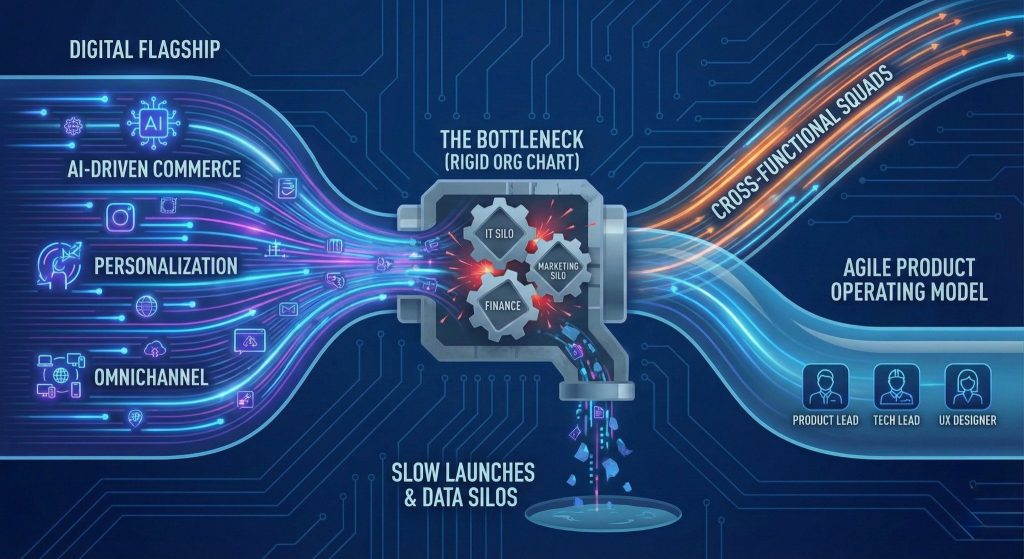
At PracticeNext, we build next-generation Digital Flagships. And we’ve learned something the hard way: the biggest barrier to ROI isn’t the software. It’s the wetware, the human operating system. You cannot run a fluid, AI-driven, composable commerce ecosystem with a rigid, siloed org chart designed in 2015. The technology is ready. Your organization isn’t.
The Hidden Cost of Business as Usual
Let me walk you through a Tuesday morning at your company.
Marketing wants to launch a flash sale campaign. The trend is hot right now, you saw it blowing up on social over the weekend. Strike while the iron’s hot.
eCommerce says the platform can’t handle the bundle logic you need. They’ll have to loop in IT. IT says sure, they can build it. Custom fix. Two sprints. Four weeks minimum.
By week four, the trend is dead. Your competitor already ran the same campaign three weeks ago. Your team is exhausted and demoralized. And you just paid the Silo Tax.
This isn’t about lazy teams or bad platforms. This is about organizational design that creates friction at every handoff. In an era when AI enables real-time personalization and dynamic pricing, that friction is fatal.
Your modern MACH architecture (Microservices, API-first, Cloud-native, Headless) is built for speed. But that speed is meaningless if your approval process is built for safety and slowness. You’re dragging a parachute behind a rocket.
The Mindset That’s Holding You Back
Here’s the deeper problem: most brands treat their eCommerce site like a construction project.
You have a start date. A launch date. A ribbon cutting ceremony. Then you enter “maintenance mode.” You patch things. You make minor updates. You wait for the next big redesign in eighteen months.
This is the physical store mindset. You build the store, open the doors, sweep the floors. It made sense when retail was physical.
But a Digital Flagship isn’t a store. It’s a software product. And software products require a fundamentally different approach.
Project Mindset asks: “Did we launch on time and on budget?”
Product Mindset asks: “Did the changes we shipped this week improve our Customer Lifetime Value?”
The difference is everything. According to McKinsey, companies that adopt a product-operating model deliver 60% greater total returns to shareholders than those stuck in project mode. Why? Because they iterate relentlessly. They don’t do one “big bang” launch per year. They do micro-optimizations every single day.
Your competitors aren’t smarter. They just stopped thinking about their digital presence as a project that ends.
Kill the Lonely eCommerce Manager
Let’s talk about org charts.
In most companies, there’s one overworked person with “eCommerce Manager” in their title. They’re supposed to bridge the gap between complex backend APIs, frontend UX, AI merchandising, data analytics, and brand storytelling.
It’s an impossible job. And it’s why nothing moves fast.
One person, no matter how talented, cannot own all those domains. They become a bottleneck by design. They spend their days in meetings, translating between departments that don’t speak the same language.
Marketing speaks in campaigns and brand voice. IT speaks in APIs and deployment cycles. Finance speaks in margin impact. The eCommerce Manager sits in the middle, trying to make everyone happy, shipping nothing quickly.
The solution isn’t to hire a superhero. The solution is to stop organizing around functional departments and start organizing around outcomes.
The Growth Squad
The most successful modern commerce brands have killed the org chart and replaced it with something fluid: cross-functional squads.
A Growth Squad is a small, autonomous unit focused on a specific metric. “Increase mobile conversion by 15%.” “Boost average order value by $12.” “Reduce cart abandonment on checkout page two.” That’s it. That’s their entire job.
And here’s the key: they contain everyone needed to execute without asking permission from other departments.
The anatomy of a modern Growth Squad:
The Product Lead (The Mini-CEO): This person owns the roadmap. They don’t report to IT or Marketing, they report to Revenue. Their only job is to prioritize features based on ROI. Is this change worth shipping? Will it move the metric? If yes, ship it. If no, kill it.
The Tech Lead (The Enabler): Not just a coder sitting in IT, but an architect who understands how to leverage your Shopify Plus or composable backend to solve business problems quickly. They’re embedded in the squad, not locked away in a separate dev team with a three-sprint backlog.
The UX/UI Designer: They sit in the squad too. Not in a separate creative agency. Not in a brand team. Right there, designing for utility and conversion in real-time. They ship, test, iterate. Daily.
The Data Analyst: This person closes the loop. They tell the squad on Tuesday whether the feature they launched on Monday actually worked. No waiting for quarterly reports. No debating what “success” means. The data decides.
When you align these people in a single pod, magic happens. The ticket queue disappears. The meetings evaporate. Collaboration becomes real-time because everyone’s incentive is aligned around the same outcome.
You stop managing functions. You start managing metrics.
The Missing Executive: Revenue Architect
Here’s the problem as you scale: someone needs to orchestrate all of this.
Your CMO owns brand and creative but doesn’t understand API architecture. Your CTO owns infrastructure and security but doesn’t think about merchandising strategy or content velocity. The gap between them is where good ideas go to die.
We’re seeing the emergence of a new hybrid role to fill this gap: the Revenue Architect.
This person sits between the CMO and CTO. They speak both languages fluently. They understand that “headless commerce” isn’t just a buzzword, it’s a structural decision that enables marketing to ship content at 10x velocity. They understand that “AI personalization” requires clean data pipelines, not just a Shopify plugin.
The Revenue Architect ensures your expensive tech stack actually serves the P&L. They prevent the common drift where IT builds cool features that Marketing doesn’t know exist, and Marketing dreams up campaigns that IT says are technically impossible.
They are the translator. The prioritizer. The person who kills projects that won’t move revenue and greenlights experiments that will.
If you don’t have this role, either explicitly or implicitly, your Digital Flagship will never reach its potential. You’ll keep having the same frustrating meeting where Marketing and IT talk past each other and nothing ships.
Your 90-Day Roadmap to a New Operating System
You’ve already invested in modern technology. Maybe you built with PracticeNext. Maybe you migrated to Shopify Plus. Maybe you went headless. Good. The platform isn’t the problem anymore.
Now comes the harder work: upgrading the organization that operates it.
Step 1: Audit Your Bottlenecks
Where does work actually stall? Don’t guess. Track it. Is it design approval? Dev QA? Data access? Legal review? Figure out where the Silo Tax is highest and start there.
Step 2: Pilot One Squad
Don’t restructure the entire company overnight. That’s a recipe for chaos. Pick one high value problem, something like “improve post purchase experience” or “increase email-to-purchase conversion” and form a cross-functional squad to solve it.
Give them 90 days. Give them autonomy. Give them a clear metric. Then get out of their way.
If it works, you’ll see the results immediately. Velocity increases. Morale improves. Revenue moves. Then you expand the model.
Step 3: Empower with Low Code
Give your marketing team the tools to execute 80% of their ideas without needing a developer. Drag and drop page builders. No code email sequence tools. Self-service content management within your headless setup.
Save your developers for the complex 20%, the custom integrations, the AI models, the infrastructure that actually requires engineering expertise.
When marketers can ship landing pages themselves, they stop waiting in the dev queue. When designers can A/B test layouts without filing tickets, they start optimizing daily instead of quarterly.
The Real Upgrade
The technology exists. The AI tools are here. Shopify Plus, composable commerce, headless architectures, they’re more powerful than ever.
But a Digital Flagship is only as fast as the team driving it.
If you want to move at the speed of AI, you can’t organize like it’s 2015. The old model, where eCommerce reports to Retail, IT reports to Operations, and Marketing lives on a different floor, was designed for stability in a slow-moving world.
That world is gone.
Your competitors are forming squads. They’re empowering autonomy. They’re treating digital as a product that ships daily, not a project that launches annually. And they’re eating market share while you’re stuck in approval meetings.
Break the silos. Form the squads. Hire the Revenue Architect. Treat your digital presence as a living, breathing organism that needs to evolve every single day.
The platform is ready. The question is: are you?