
Executive Summery
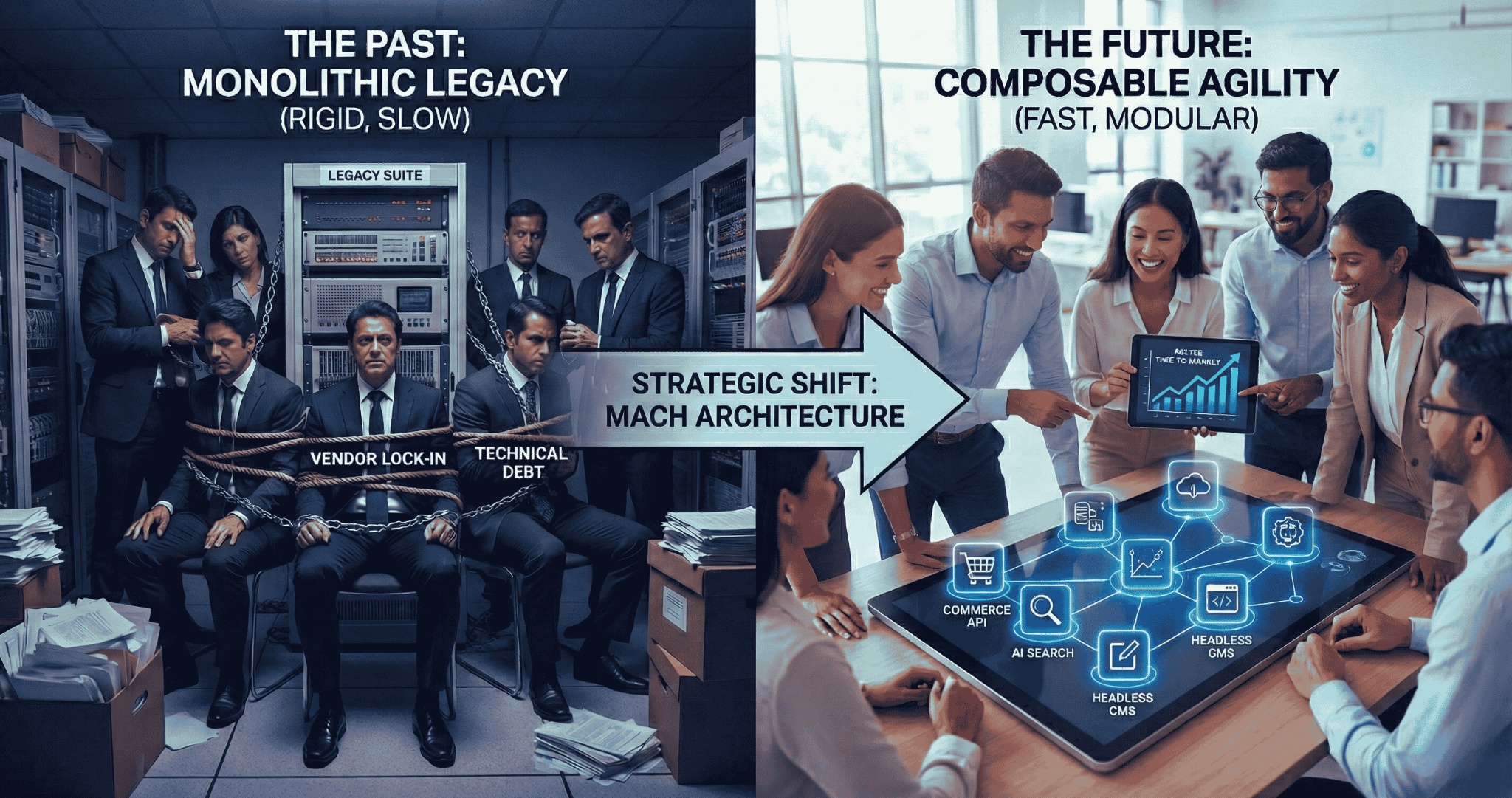
The traditional approach to eCommerce platforms is rapidly becoming obsolete. As digital commerce evolves at lightning speed, retailers are discovering that rigid, all-in-one platforms can no longer keep pace with changing consumer expectations and market dynamics. Enter composable commerce, a revolutionary architecture that’s reshaping how businesses build and scale their digital operations.
The global composable applications market is projected to reach $31.5 billion by 2034, expanding at a compound annual growth rate of 17.2%. This explosive growth reflects a fundamental shift in enterprise strategy: 70% of retailers now identify composability as a top priority, driven by the need to escape vendor lock in and dramatically accelerate time to market. In a composable ecosystem, businesses no longer purchase monolithic platforms, instead, they curate best of breed solutions tailored to their specific needs.
Understanding the Composable Commerce Revolution
Why Traditional Platforms Are Failing Modern Retailers
Legacy eCommerce platforms, including older iterations of Oracle ATG and SAP Hybris, were designed for a different era. These monolithic systems bundle every function, from product catalog management to checkout processing, into a single, tightly integrated platform. While this approach once offered simplicity, it now creates significant bottlenecks.
Consider a common scenario: modifying a checkout flow in a traditional platform might require a complete system redeployment, involving weeks of testing and risk mitigation. A single change ripples through the entire architecture, creating dependencies that slow innovation to a crawl.
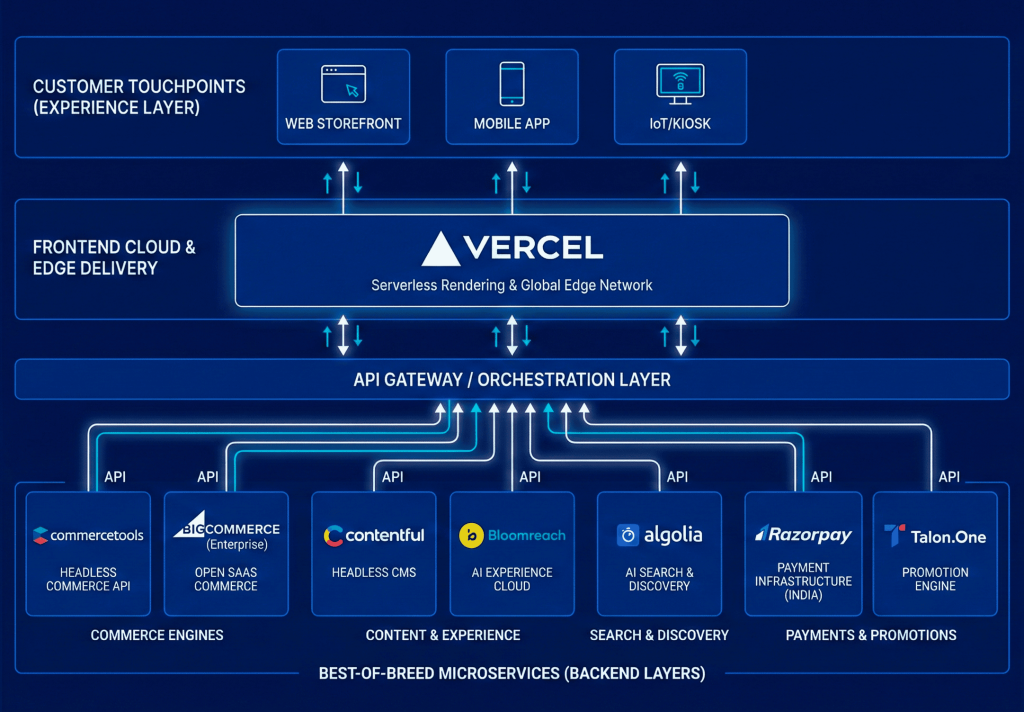
Composable commerce fundamentally reimagines this approach by decoupling systems into independent, specialized components. Each microservice operates autonomously, communicating through standardized APIs. This architecture allows retailers to swap out individual components, such as a search or payment gateway, without disrupting core business operations.
The Compelling Business Case for Decomposition
For C-suite executives evaluating composable commerce, the value proposition extends far beyond technical architecture. Consider these strategic advantages:
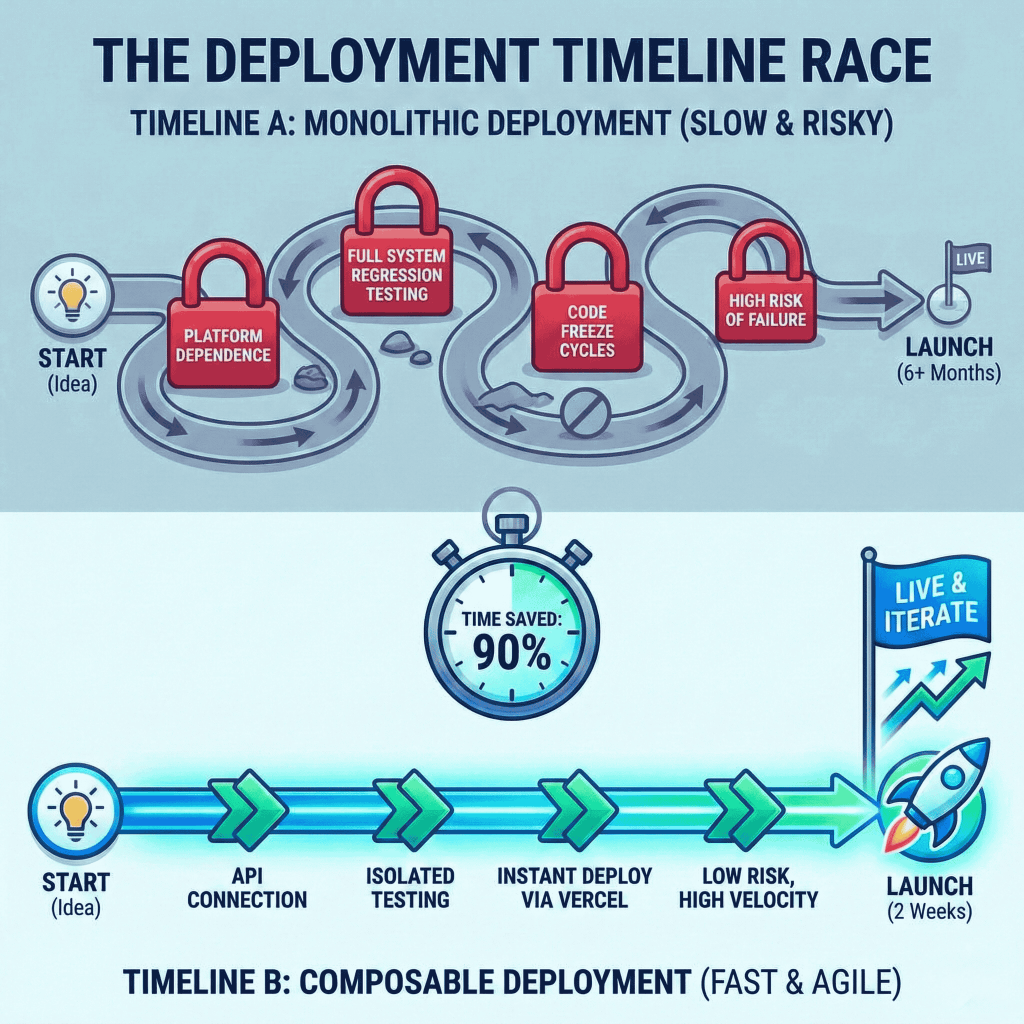
Speed to Market: New features and capabilities launch in weeks rather than months. Marketing teams can test regional campaigns without waiting for IT approval cycles, while product teams rapidly iterate based on customer feedback.
Cost Efficiency: Organizations report up to 30% reduction in total cost of ownership (TCO) by eliminating bundled “shelfware,” unused features they’re forced to license in all-in-one platforms. With composable commerce, businesses pay only for the components they actively use.
Operational Resilience: Modern composable architectures typically achieve 99.99% uptime. When a single microservice experiences issues, perhaps the customer reviews module, it fails independently without crashing critical functions like checkout processing.
Competitive Agility: The ability to rapidly adopt emerging technologies provides sustainable competitive advantage. When a superior search algorithm or payment provider enters the market, composable architectures enable quick integration without wholesale platform migration.
The Top 10 Best of Breed Tools Building the Composable Future
A robust composable architecture functions as an orchestrated ecosystem rather than a single platform. The following ten market leaders represent the specialized tools that, when combined strategically, deliver enterprise grade commerce capabilities.
Category 1: Commerce Engines; The Foundation Layer
1. commercetools: The Pure-Play Pioneer
Widely recognized as the gold standard for enterprise composable commerce, commercetools literally invented the term “headless commerce.” The platform provides strictly backend APIs for cart management, order processing, and product information management, leaving frontend presentation entirely to developers.
Best suited for large enterprises like Audi and AT&T with mature engineering teams, commercetools offers unparalleled flexibility. Their “Composable AI” infrastructure allows seamless integration with different AI models for dynamic pricing, demand forecasting, and inventory optimization.
2. BigCommerce Enterprise: The Pragmatic Hybrid
BigCommerce occupies a unique position with its “Open SaaS” model. While providing the ease and stability of a hosted platform, it exposes 95% of its functionality via APIs, making it an excellent headless backend that’s faster to implement than pure microservices architectures.
This approach particularly appeals to mid to large brands seeking composable benefits without the substantial DevOps burden of managing numerous independent microservices.
3. Elastic Path: The Complex Product Specialist
Elastic Path has carved out a specialty in “Commerce Intelligence” and managing complex product catalogs, think bundling physical goods with digital subscriptions or configuring industrial equipment with thousands of SKU variations. Their “Pre-Composed Solutions” enable faster launches by providing customizable templates.
This platform excels for B2B manufacturers and brands wrestling with sophisticated bundling requirements.
4. Shopify Plus with Hydrogen: The Reliability Leader
Though traditionally viewed as a monolithic platform, Shopify has aggressively pivoted toward headless architecture through its Hydrogen and Oxygen frameworks. Many enterprises now use Shopify purely as a checkout and order engine while building completely custom frontends, a popular “composite” strategy.
Brands like Kylie Cosmetics and Gymshark choose this approach when prioritizing reliability and massive flash-sale scalability over infinite backend customization options.
Category 2: Content and Experience; The Brand Voice
5. Contentful: Pioneering the Headless CMS
Contentful revolutionized content management by treating content as structured data rather than web pages. This approach enables updating a product description once and instantly pushing it across mobile apps, websites, smartwatch applications, and in-store kiosks.
For executives, this eliminates the inefficient “copy paste” workflow between regional sites while ensuring brand consistency across all customer touchpoints.
6. Bloomreach: AI-Driven Experience Orchestration
Bloomreach combines headless CMS capabilities with powerful AI search and merchandising through its Loomi engine. This integration bridges the traditional gap between content (marketing narratives) and commerce (products), personalizing experiences in real-time based on user behavior and preferences.
Puma leveraged Bloomreach to transform their site search, dramatically reducing customer journey friction and improving conversion rates.
Category 3: Search and Discovery; The Intelligence Layer
7. Algolia: Millisecond Search at Scale
Algolia powers instant search and discovery for companies including Lacoste and Slack, delivering results in milliseconds. Its AI-powered “NeuralSearch” understands user intent contextually, when customers type “cheap red dress,” the system instantly interprets parameters for price thresholds, color attributes, and category filters.
The ROI case is compelling: optimized search functionality can increase conversion rates by 30-60%, directly impacting bottom-line revenue.
Category 4: Orchestration and Infrastructure; The Integration Layer
8. Vercel: The Frontend Performance Cloud
Vercel serves as the hosting environment where composable websites actually operate. It hosts frontend applications while seamlessly connecting to backend APIs from commercetools, Contentful, and other services. The platform’s Edge Network serves content from servers geographically closest to customers, minimizing latency.
For executives focused on performance metrics, Vercel directly impacts Core Web Vitals, the Google SEO scores that correlate directly with revenue performance and search visibility.
9. Talon.One: The Promotion Intelligence Engine
Legacy platforms struggle with complex, multi-variable promotions—scenarios like “Buy a shirt, receive 50% off a hat, but only for VIP members in Germany on Tuesdays.” Talon.One provides a dedicated microservice exclusively for promotions and loyalty program management.
This specialization proves invaluable for global brands simultaneously running region specific campaigns with different rules and restrictions.
10. Stripe: The Payment Infrastructure Standard
In composable architecture, payments function as just another API integration. Stripe has become the de facto standard for handling global payments, fraud detection through Stripe Radar, and subscription logic without custom development.
The strategic value becomes apparent when expanding into new markets, enabling payment methods like Alipay or Klarna requires just a few clicks rather than months of integration work.
Note: While Stripe is technically present in India, it remains in an “invite-only” mode with restricted onboarding for new businesses due to regulatory complexities. Here are the top three replacements that align with the MACH (Microservices, API-first, Cloud-native, Headless) philosophy.
1. The “Drop-in” Replacement: Razorpay
Best For: Companies wanting the closest experience to Stripe’s developer ergonomics. Razorpay is widely considered the “Stripe of India.” It mirrors Stripe’s philosophy of clean, RESTful APIs and robust documentation, making it the default choice for headless builds.
- Composable Fit:
- Fully Headless UI: Unlike older gateways that force a redirect to their page, Razorpay offers a “Custom Checkout” SDK. You can build your own UI in React/Vue (hosted on Vercel) and simply hit Razorpay’s API to process the charge securely.
- Modular Suite: Just like Stripe, they offer separate microservices for Subscriptions, Invoices, and Payment Links that can be decoupled from the core gateway.
- International Support: It supports 100+ currencies and international cards, which is critical for Indian exports.
- CXO Value: It has the highest success rates for Indian payment modes (UPI, Netbanking) which are notoriously fickle on global gateways.
2. The Global Enterprise Choice: Adyen
Best For: Brands with a global footprint (e.g., India + US + Europe) looking to unify data. Adyen officially launched its local acquiring solution in India recently (securing its Payment Aggregator license). In the global composable market, Adyen is a giant.
- Composable Fit:
- Unified Commerce: Adyen’s “endless aisle” capability allows you to connect your online headless store with physical POS terminals in Indian retail outlets via a single API.
- Fraud Protection: Their “RevenueProtect” AI is superior for high-volume enterprise transactions.
- CXO Value: If you use Adyen globally, you can now use it in India too. This eliminates the need to maintain “Stripe for US” and “Razorpay for India,” unifying your financial reconciliation into one dashboard.
3. The Marketplace Specialist: Cashfree
Best For: Aggregators and Marketplaces (e.g., Swiggy, Zomato models). If your composable application involves splitting payments between vendors (e.g., taking $100 from a customer, keeping $10, and sending $90 to a vendor), Cashfree is often superior to Razorpay.
On-Demand Clearing: Excellent for “Just-in-Time” models where inventory isn’t held by you.
Composable Fit
Payouts API: Their “Payouts” microservice is industry-leading. You can programmatically trigger instant settlements to vendors via API.
Composable AI: Intelligence as a Service

Artificial intelligence in composable environments doesn’t exist as a separate tool, it’s a capability injected into specific modules where it delivers maximum value:
Generative Merchandising: Platforms like Bloomreach and Algolia use AI to dynamically arrange product grids based on local weather patterns, trending social media topics, or real-time inventory levels.
Predictive Inventory Management: AI forecasting models connect to order management microservices to predict stockouts before they occur, triggering automatic reorder workflows.
Dynamic Content Localization: Generative AI integrated into Contentful can automatically translate and culturally adapt product descriptions for 20 different markets instantly, maintaining brand voice while respecting local nuances.
As one industry expert notes: “The power of Composable AI lies in avoiding vendor lock-in to generic AI features. Organizations can deploy the best AI model for search from one vendor and the best recommendation engine from another, creating truly optimized experiences.”
Real World Transformation Stories
IKEA’s Omnichannel Unification
IKEA faced the challenge of creating consistent experiences across thousands of physical stores and digital touchpoints globally. By migrating to a serverless, composable architecture, they gained the ability to launch features like “Shop & Go” in-app scanning in specific test markets before global rollout, eliminating risky “big bang” deployments.
LEGO’s Traffic Surge Solution
Highly anticipated LEGO set launches created traffic spikes that effectively simulated DDoS attacks, crashing their legacy monolith. After migrating to headless architecture using commercetools and Next.js, the new platform handles extreme traffic surges effortlessly while enabling immersive, content-rich storytelling that connects directly to purchase actions.
Sephora’s Personalization Mastery
Sephora’s legacy platforms couldn’t compute hyper-personalized recommendations quickly enough to meet customer expectations. Their best-of-breed stack now synchronizes in-store purchase data with online profiles in real-time, delivering a seamless “beauty profile” experience that follows customers across all touchpoints.
Strategic Implementation: The Strangler Fig Pattern
Transitioning to composable architecture represents a journey rather than a single event. The recommended “Strangler Fig” Pattern minimizes risk while maximizing learning:
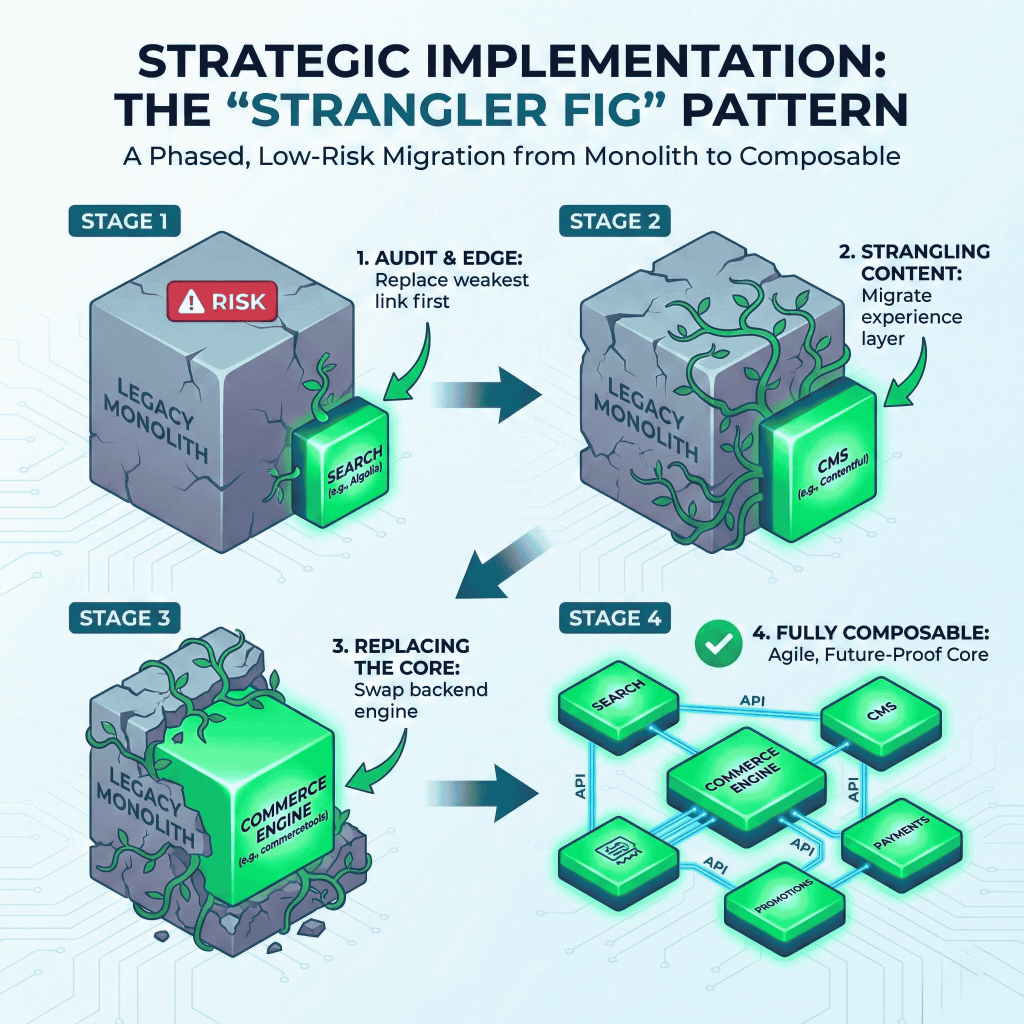
- Audit Current Pain Points: Identify the weakest component in your existing platform. Is search performance suffering? Is checkout creating friction?
- Replace Single Components: Keep the monolith operational while “strangling off” one function—perhaps replacing native search with Algolia.
- Iterate Systematically: Once the first component succeeds, move to the next priority—often the CMS layer with Contentful.
- Execute Final Migration: After frontend and key services migrate successfully, replace the core backend commerce engine.
The Composable Imperative
Composable commerce has transcended “bleeding edge” status to become the enterprise standard for operational resilience and competitive agility. By strategically adopting tools like commercetools, Contentful, and Vercel, forward thinking organizations build capabilities that don’t merely react to market changes, they anticipate and shape them.
The question facing retail leadership is no longer whether to adopt composable architecture, but how quickly they can execute the transition while competitors reap the benefits of superior speed, efficiency, and customer experience.