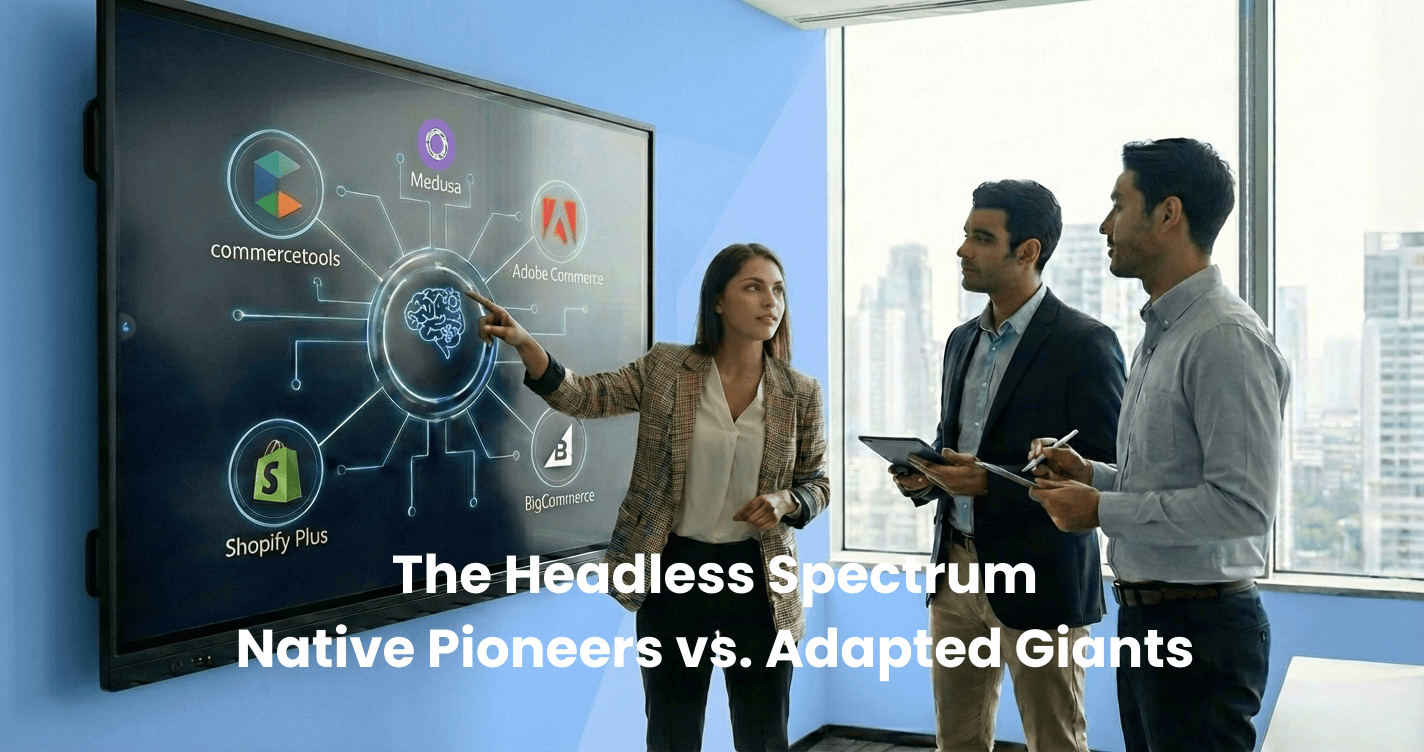

Why architectural purity versus operational safety matters more than feature lists
The decision to go headless is no longer about whether to separate your frontend from your backend. That question has been settled. The real question facing digital leaders today is fundamentally different: do you want architectural purity or operational safety?
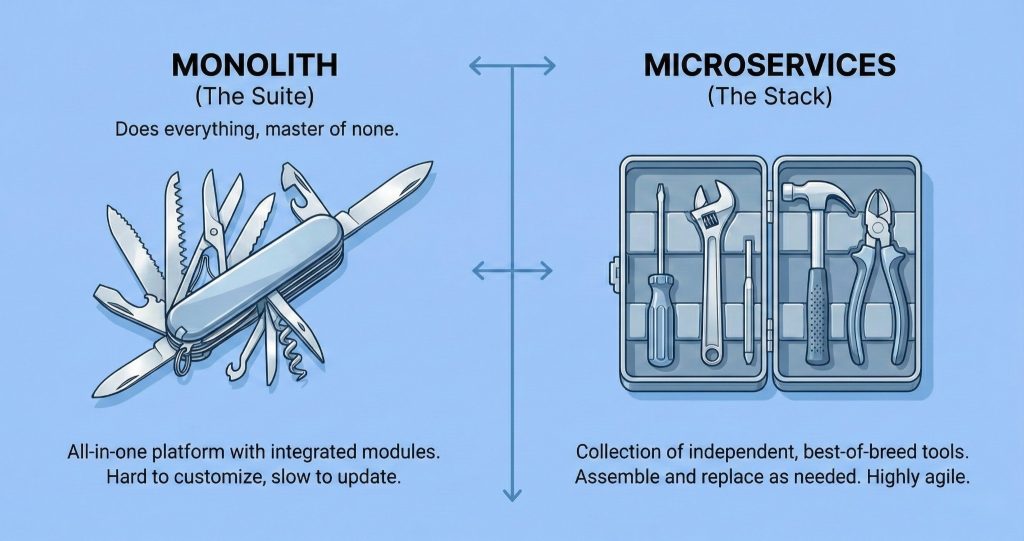
The market has split into distinct evolutionary paths. On one side are the Native Headless platforms, born as APIs, enforcing strict micro services philosophy from day one. On the other are the Adapted Monoliths, established enterprise suites that have retrofitted API layers while maintaining their comprehensive feature sets.
Neither approach is inherently superior. The right choice depends on your organization’s technical maturity, risk tolerance, and honest assessment of what headless actually needs to accomplish. Let’s examine the five platforms that define this spectrum.
The Native Micro service: commercetools
The Purebred
commercetools represents the industry benchmark for true headless. There is no frontend, no pre-built pages, and no assumptions. It’s purely a collection of over 300 independent API endpoints, Cart, Inventory, Pricing, Product, that you assemble like modular building blocks.
The native advantage is zero bloat. You don’t pay for a legacy CMS or monolithic database you’re avoiding. It scales infinitely because every component is isolated and independently deployable. When traffic spikes 10x, you scale only the services experiencing load.
But here’s the reality: commercetools is strictly a builder’s platform. There is no “out of the box” experience. If you need a feature, you build it, integrate a third-party service, or hire specialized agencies. Your first checkout transaction might take three months of development.
This makes commercetools ideal for tech first enterprises in automotive, complex B2B, or telecommunications organizations that view their commerce stack as a competitive product rather than a utility. These companies have 20+ person engineering teams and treat custom commerce logic as intellectual property.
If you’re asking “when can we launch?” rather than “how can we differentiate?”, this isn’t your platform.
The Adapted Monoliths: Adobe Commerce and Salesforce
The Renovated Mansions
Adobe Commerce (formerly Magento) and Salesforce Commerce Cloud defined enterprise commerce for over a decade. To stay relevant, they’ve aggressively adopted headless capabilities, Adobe offers PWA Studio and GraphQL APIs, Salesforce provides Composable Storefront. Both let you build React frontends while their massive monolithic cores run underneath.
The adapted angle is compelling for risk averse organizations. You get modern, fast React frontends while retaining comprehensive ecosystems, unified support, and “all-in-one” modules for every edge case. Your compliance team sleeps better with platforms hardened by enterprise deployments across regulated industries.
But critics call this “fake headless,” and they have a point. You’re paying substantial license fees for massive feature suites, the old frontend engine, built-in page builder, monolithic admin, that you’re actively bypassing. You carry the technical debt of the monolith while trying to achieve micro services agility. Upgrades remain complex because you’re still upgrading an entire monolithic application.
Hosting and operational costs don’t disappear because you’re rendering the frontend elsewhere. You’re paying for architectural flexibility while maintaining architectural rigidity underneath.
These platforms excel for traditional organizations needing headless speed for customers but monolithic safety for back-office teams. If you have existing Salesforce CRM or Adobe Marketing Cloud investments, integration simplifies considerably, potentially justifying the architectural compromises.
The Opinionated Hybrid: Shopify Plus with Hydrogen

Shopify dominates by making things easy, and Hydrogen extends this into headless territory. It’s a monolith that’s learned to act like a micro service when convenient, giving you frontend freedom while keeping backend decisions firmly under Shopify’s control.
The hybrid advantage is undeniable speed to market. You get the world’s best converting checkout, rock solid admin, and Shop Pay integration immediately. You don’t architect backends, configure payment processors, or worry about PCI compliance. Just design your frontend using Hydrogen and focus on brand differentiation.
Tradeoffs appear when requirements diverge from Shopify’s opinionated data models. API rate limits constrain high-traffic implementations. If you want products with five layers of nested variants or checkout flows that differ from Shopify’s assumptions, their APIs will block you. You’re customizing within carefully controlled boundaries, not working with un opinionated building blocks.
This makes Shopify Plus ideal for high-growth D2C brands prioritizing brand experience over complex business logic. Brands like Glossier and Allbirds don’t need exotic commerce workflows, they need beautiful, fast storefronts that convert efficiently. Shopify delivers exactly that while handling operational complexity they’d rather not manage.
If your competitive advantage comes from supply chain innovation, custom pricing algorithms, or complex B2B workflows, these golden handcuffs feel restrictive fast.
The Middle Path: BigCommerce
The Open SaaS
BigCommerce positions itself between Shopify’s rigid simplicity and commercetools’ overwhelming flexibility. It’s hosted SaaS that handles infrastructure, but with over 90% API coverage, it functions almost entirely as a headless backend engine when needed.
The “open” angle manifests practically. Unlike Shopify, BigCommerce allows multiple distinct storefronts running off one backend. They don’t penalize third-party payment gateways with transaction fees. The platform handles B2B complexity, customer groups, custom catalogs, quote workflows, better than Shopify without requiring commercetools’ custom development work.
BigCommerce still carries monolithic DNA. It’s not infinitely flexible like pure microservices platforms. The admin interface reflects years of accumulated features creating their own complexity. You’re getting a monolith that plays very nicely with others rather than true composability.
This makes BigCommerce compelling for mid-market hybrid B2B/B2C operations. You need more flexibility than Shopify provides but lack the budget or technical team for fully composable architecture. The platform gives you headless capabilities when needed while providing functional monolithic admin for teams preferring traditional management interfaces.
It’s the pragmatic choice for organizations understanding their limitations honestly, preferring to work within capable system boundaries rather than build custom solutions for every edge case.
The Developer Toolkit: Medusa
The Code Owner
Medusa represents the open source antithesis to enterprise SaaS. It’s a collection of Node.js commerce modules you host and control completely. Think “Shopify for developers,”core commerce logic exists, but you own the code, data, and deployment.
The ownership advantage is liberating for the right organization. No monthly license fees scaling with revenue, no API rate limits throttling traffic, and no “black box” logic preventing you from understanding your own system. If you need unusual workflows—auctions, rentals, marketplace dynamics—you can literally rewrite the source code.
But operational responsibility follows. “You build it, you run it” isn’t philosophy, it’s daily reality. Security patches, database scaling, infrastructure optimization, and maintaining dependency compatibility all become your responsibility. You’re not paying subscription fees, but you’re definitely paying in engineering time and operational complexity.
Medusa works brilliantly for startups and digital native agencies building highly custom business models that standard SaaS APIs fundamentally can’t support. If your entire value proposition depends on commerce workflows that don’t exist in established platforms, owning your stack becomes strategically necessary.
For organizations viewing commerce platforms as commodity infrastructure that should just work reliably, self hosting’s operational burden rarely justifies the flexibility gained.
The Strategic Framework
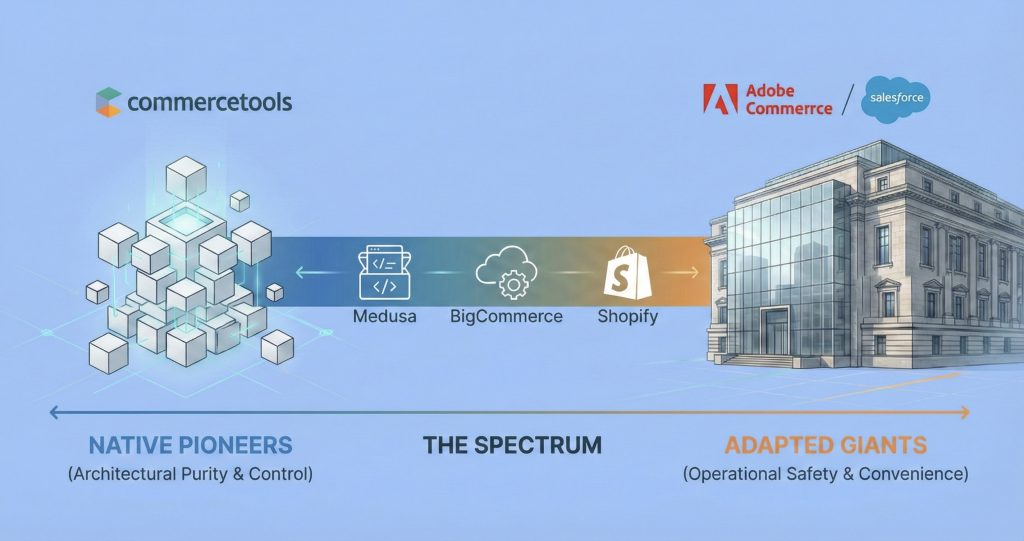
The real decision isn’t which platform has better APIs or more features. It’s which platform philosophy aligns with your organization’s actual capabilities and honest priorities.
Choose the Adapted Monoliths (Adobe, Salesforce) if you prioritize stability and governance over architectural purity. You have compliance requirements, integration dependencies with existing enterprise systems, and teams needing comprehensive features out of the box. You’re willing to pay premium licensing to reduce operational risk and maintain long-term vendor support.
Choose the Native Pioneers (commercetools) if you prioritize agility and scale with engineering talent to support it. You view commerce technology as a competitive differentiator worth continuous investment. Your technical team can build and maintain custom integrations. You need the ability to optimize or replace individual components without replatforming entirely.
Choose the Hybrid Path (Shopify Plus, BigCommerce) if your goal is efficiency and total cost of ownership, getting 80% of headless benefits with 20% of the complexity. You want frontend flexibility but backend reliability. Your competitive advantage comes from brand, marketing, or operations rather than exotic commerce technology.
The worst mistake is choosing a platform because it’s technically impressive rather than organizationally appropriate. A fully composable microservices architecture won’t save you if your team can’t maintain it. An adapted monolith won’t constrain you if its capabilities match your requirements.
Be honest about your technical maturity, realistic about your operational capacity, and strategic about where technology actually creates competitive advantage for your specific business. The right platform amplifies your strengths. The wrong one exposes your weaknesses at scale.
Choose accordingly.
About PracticeNext: We build custom, AI-native digital commerce infrastructure designed to quickly scale and accelerate your business growth.