

Google’s origins trace back to Stanford University in 1995, when two students crossed paths under unlikely circumstances. Larry Page, who was exploring graduate programs, met Sergey Brin during a campus tour. From their university dormitories, the duo developed a novel search technology that evaluated webpage significance by analyzing their link connections across the internet. Their initial project bore the name Backrub.
The venture soon underwent a rebranding to Google, a welcome change from its predecessor. This new name drew inspiration from “googol,” the mathematical term representing a 1 with one hundred zeros trailing behind it. The choice reflected the founders’ ambitious vision: creating a system to systematically organize global information and ensure its availability to everyone.
This defined the last two decades of digital marketing as a simple rule: location was everything. We fought for pixels on a Search Engine Results Page (SERP). We reverse engineered algorithms, bought links, and stuffed metadata to ensure that when a user queried Google, our blue link sat at the top of the pile.
That geography has collapsed.
We are currently watching the dismantling of the “search” industry and the birth of the “answer” economy. The era of the list is over; the era of synthesis has begun.
From Indexing to Inference
The old model of the internet was a library card catalog. You asked a question, and Google pointed you to the shelf where the answer might be, aka – the 10 blue links. You had to go get the book yourself. This model sustained an $80 billion industry built on the premise of referral.
Generative Engine Optimization (GEO) operates on a fundamentally different premise: retrieval and synthesis.
When a user asks Claude, Gemini, or Perplexity a question, they aren’t looking for a list of websites. They are looking for a conclusion. The AI doesn’t act as a librarian; it acts as an analyst. It reads the books for you and presents a summary. In this new dynamic, “ranking” is a defunct metric. You either contribute to the answer, or you are invisible.
The Conversational Shift
The most jarring change isn’t technical; it’s behavioral. We have spent decades training users to speak “robot.” We typed “best running shoes flat feet 2025” because we knew that’s how the machine understood us.
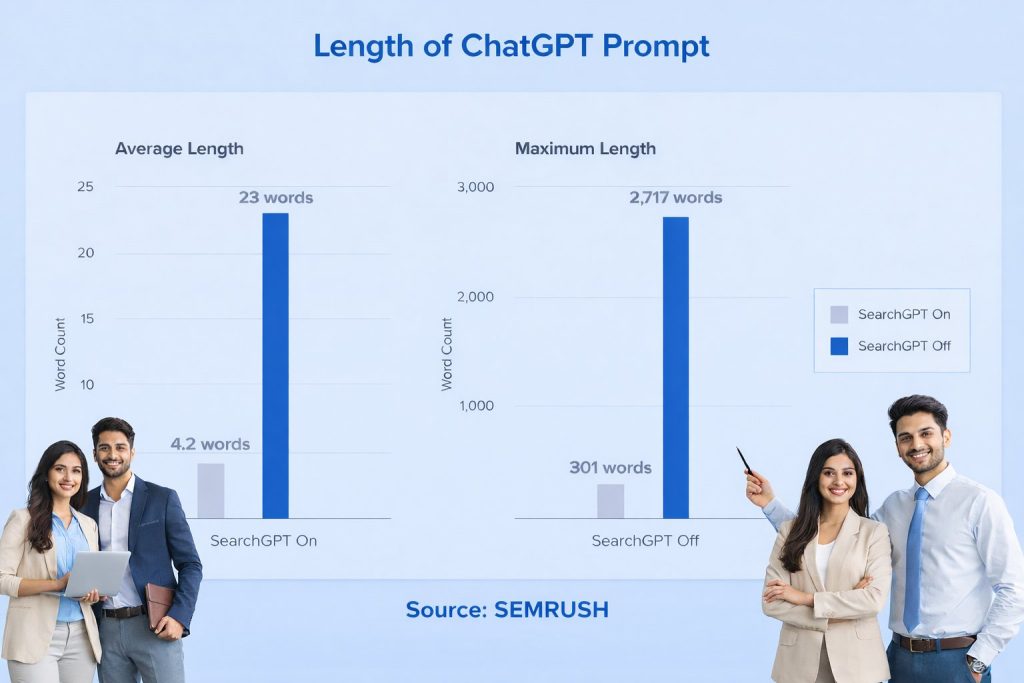
That friction is gone. According SEMRUSH, Queries have exploded in length and complexity, averaging 23 words now. Users are no longer issuing commands; they are engaging in Socratic dialogue. Sessions are deeper, lasting minutes rather than seconds, involving multiple follow-up questions.
This breaks the traditional keyword model. You cannot optimize for a keyword when the user is inputting a paragraph of context. The machine isn’t matching strings of text anymore; it is parsing intent. It remembers previous questions. It reasons. It personalizes.
Optimizing for Logic, Not Algorithms
If traditional SEO was about convincing a machine that you were popular (backlinks), GEO is about convincing a machine that you are authoritative (logic).
Large Language Models (LLMs) are unpredictable, but they are consistently biased toward structure and clarity. They struggle with fluff. To be cited in an AI-generated answer, content must be easy for the model to parse and extract.
The new optimization tactics are less about meta-tags and more about information architecture:
- Direct Answers: LLMs prefer content that gets to the point.
- Logical Hierarchy: Clear headers and bullet points help the model understand the relationship between ideas.
- Citation Markers: Phrases that signal a summary or a definitive fact (e.g., “The data suggests…”) act as hooks for the AI to grab.
The goal is no longer to get a click. The goal is to be the source material the AI uses to construct its truth.
The Business Model Crisis
This shift exposes a massive rift in the economic infrastructure of the web.
Google’s empire was built on a symbiotic (if strained) relationship with publishers: Google scraped their content, and in return, sent them traffic which could be monetized via ads.
The subscription based models of OpenAI or Anthropic break this deal. They scrape content to provide answers, but they don’t send traffic back. The user stays in the chat interface. This is the “Zero-Click” future marketers have feared, and it is no longer theoretical.
The metric of success is shifting from Traffic Volume to Brand Share of Voice. In a world where the search engine provides the answer directly, the only win available is ensuring your brand is mentioned as the solution.
The blue link isn’t just moving down the page. It’s disappearing. The question now isn’t “where do I rank?” but rather, “am I part of the conversation?”
About PracticeNext: PracticeNext provides comprehensive AI Brand Visibility and SEO service that help business move beyond keywords and be the Answer















Pingback: From CTR to Citation Share: The New KPI of AI-Powered Search I PracticeNext
Pingback: How Generative AI is Reshaping Consumer Behavior and Brand Strategy
Pingback: The Shift from Search to Synthesis: If AI is the New Front Door, Most Brands are Not Even on the Street - ThinkNext
Pingback: From Search Ranking to Generative Engine Optimization I ThinkNext