
Executive Summary
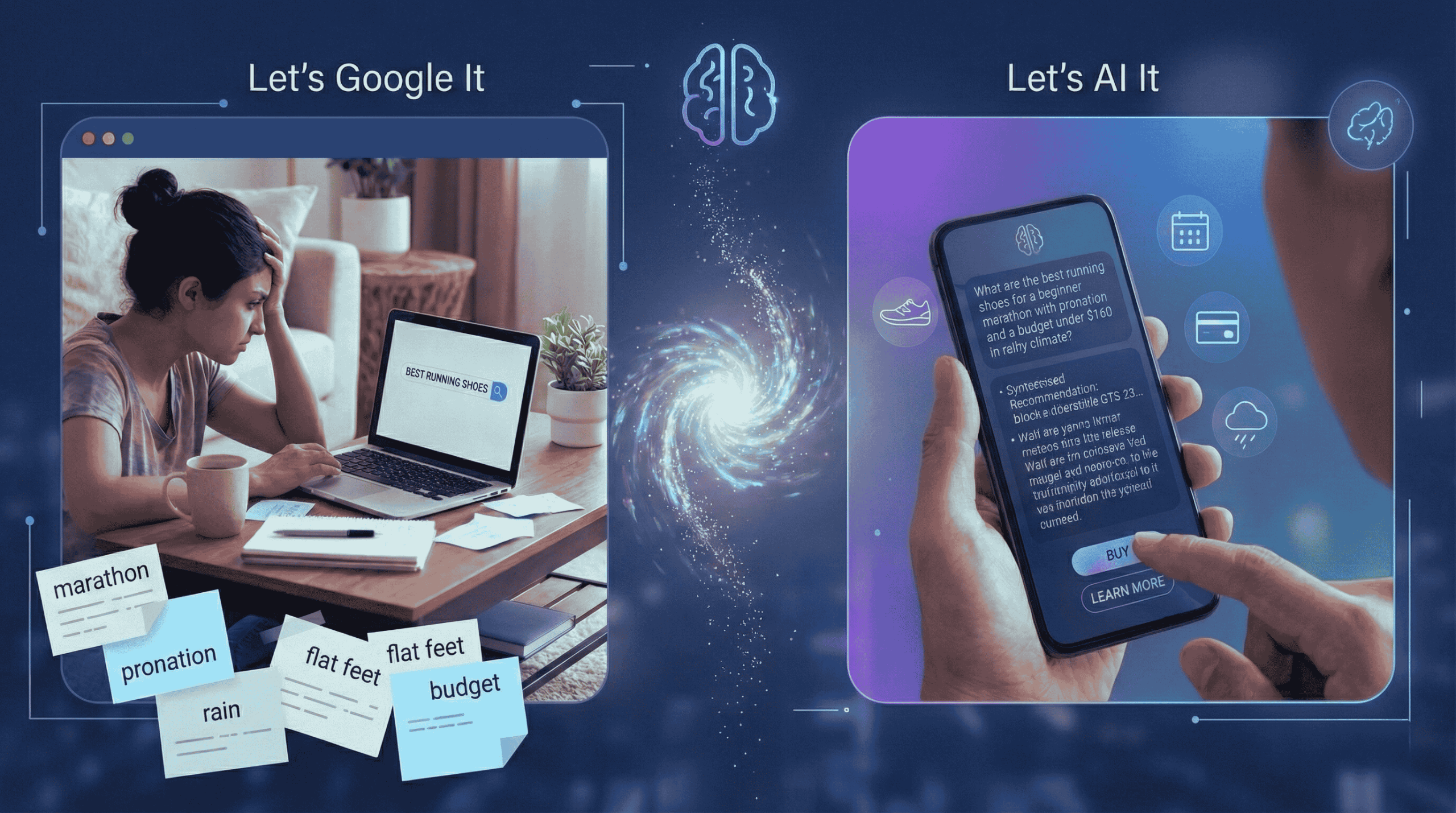
The digital discovery landscape is undergoing its most significant transformation since the birth of search engines. “Googling it” is rapidly giving way to “AI-ing it,” a fundamental shift from keyword-based retrieval to intent-driven, entity-aware discovery powered by generative AI. Key implications:
- 60%+ of searches now result in zero clicks as AI directly synthesizes answers rather than linking to sources
- Traditional keyword optimization is obsolete; brands must become the definitive answer, not just rank for terms
- Early adopters like Nike, Allrecipes, and Expedia are already reaping rewards through conversational interfaces and personalized experiences
- The cost of inaction is existential: diminished visibility, lost brand authority, and irrelevance in AI-mediated customer journeys
- The window to adapt is narrowing as AI models increasingly rely on existing, well-structured semantic data
Organizations that fail to pivot from keyword strategies to entity-based, intent-driven content frameworks risk permanent marginalization in the emerging discovery ecosystem.
The Paradigm Shift: Understanding Intent Over Keywords
For two decades, search engine optimization meant one thing: matching keywords. Users typed terms, algorithms matched those terms to indexed pages, and success was measured in rankings and click throughs. This model is collapsing.
Modern AI-powered discovery doesn’t merely match words, it interprets meaning. Large language models understand the intent behind queries, recognize entities (people, places, products, concepts), and synthesize information across sources to deliver direct answers. The question is no longer “which page contains these keywords?” but rather “what answer best satisfies this user’s underlying need?”
This transition represents more than technological evolution. It’s a fundamental restructuring of how information flows between creators and consumers, with profound implications for brands, publishers, and the entire digital economy.
The Evidence: Data Demonstrating the Shift
The migration from keyword search to semantic discovery isn’t speculative, it’s documented, measured, and accelerating.
The Novelty Problem
Google’s 2019 revelation remains telling: 15% of daily searches are queries the platform has never encountered before. With billions of searches performed daily, this represents hundreds of millions of novel questions asked every 24 hours. No keyword strategy can anticipate this variability. Only semantic understanding, grasping the meaning and intent behind unprecedented phrasings, can serve these queries effectively.
The Conversational Shift
Voice assistants and generative AI interfaces have fundamentally altered query structure. According to Statista (2023), nearly 50% of all searches now exceed four words, with users increasingly framing queries as natural language questions rather than keyword fragments. Compare:
- Old paradigm: “pizza delivery Chicago”
- New paradigm: “What pizza places near Lincoln Park deliver gluten free options after 10 PM?”
The latter isn’t a keyword string, it’s a complex request involving location entities, dietary constraints, temporal factors, and service requirements.
The Zero-Click Reality
Perhaps most striking is SparkToro’s ongoing analysis showing that over 60% of Google searches result in zero external clicks. Users receive their answers directly from search results pages, AI Overviews, or integrated knowledge panels. As generative AI capabilities expand, this figure is projected to exceed 70% by 2026.
The implication is stark: traffic as a metric is dying. Being found no longer guarantees being seen. Brands must transition from competing for clicks to competing for citation, being the source AI systems trust and reference when synthesizing answers.
The Traffic Decline
Similarweb’s 2024 data reveals a 22% decline in organic search traffic to news websites in 2023 alone, a trend accelerating with wider AI Overview deployment. Publishers optimized exclusively for traditional search are watching referral traffic evaporate as AI platforms aggregate and reframe their content without sending users to original sources.
How Leading Brands Are Adapting
Forward thinking organizations aren’t waiting for the transition to complete, they’re actively reshaping their digital strategies around semantic discovery and intent fulfillment.
Nike: From Product Listings to Conversational Commerce
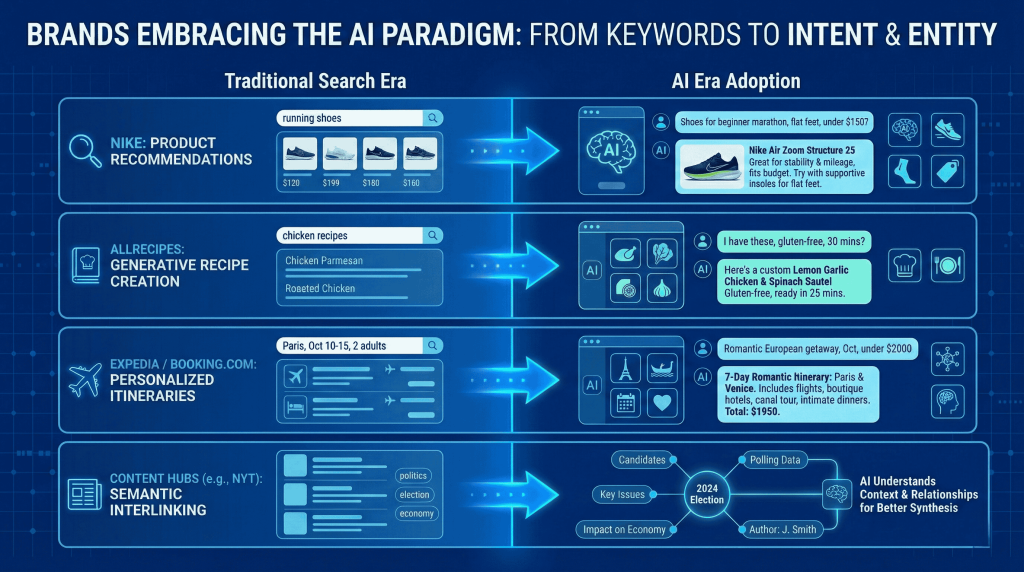
Nike’s AI-driven product finders no longer present static catalogs. Instead, they engage in diagnostic conversations:
- “What surfaces do you typically run on?”
- “Do you overpronate or supinate?”
- “What’s your weekly mileage?”
By understanding entity relationships (running surface + pronation type + mileage = specific shoe requirements), Nike delivers hyper personalized recommendations that function as expert advice rather than filtered search results. They’ve transformed from a product vendor to a trusted athletic advisor.
Allrecipes: Dynamic Creation Over Static Search
Rather than optimizing for “chicken recipes” or “pasta dishes,” Allrecipes’ AI allows users to input ingredients, dietary restrictions, cooking time constraints, and skill levels, then generates custom recipes. This represents a wholesale shift from information retrieval to information creation, positioning the platform as an interactive culinary partner rather than a digital cookbook.
Expedia and Booking.com: Itinerary Intelligence
Travel platforms are deploying generative AI to transform vague desires into comprehensive plans. A prompt like “romantic European weekend under $2,000 in October” triggers entity recognition (Europe, romance, October, budget constraint) and intent analysis (weekend getaway, specific mood) to generate complete itineraries, flights, hotels, restaurants, activities, rather than merely listing options for user assembly.
The New York Times: Semantic Knowledge Graphs
Leading publishers are constructing deep semantic relationships between articles, authors, topics, and entities. This goes far beyond keyword tagging. By explicitly mapping how concepts interconnect, they ensure AI systems can understand context and cite their content appropriately when synthesizing answers on complex topics.
The Cost of Inaction: Why Delay Is Existential
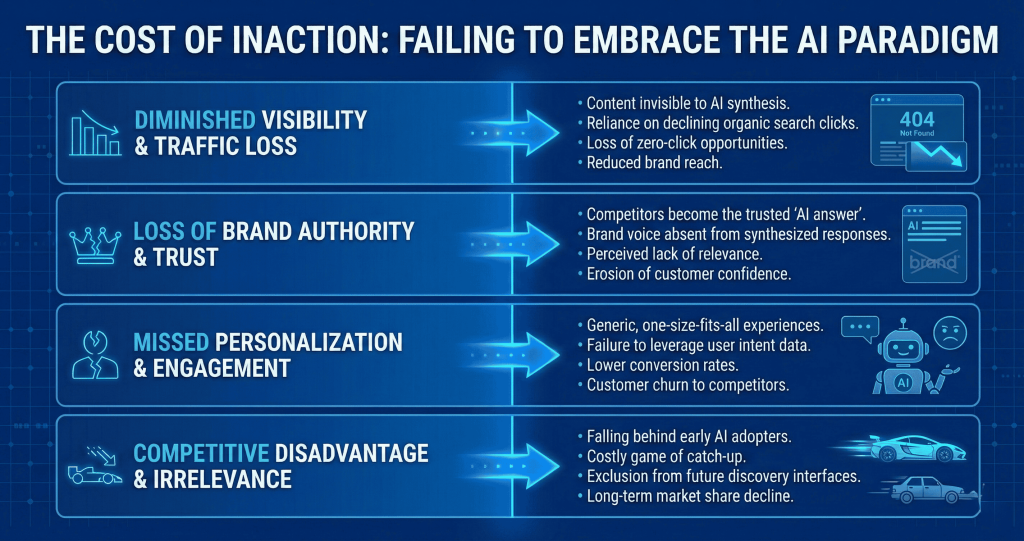
Organizations treating the AI discovery shift as a future concern are already falling behind. The consequences of delayed adaptation are compounding:
1. Invisibility in AI-Mediated Discovery
Content structured for keyword matching is opaque to semantic understanding. If AI systems cannot parse your content’s meaning, extract relevant entities, or understand contextual relationships, your brand simply doesn’t exist in AI-powered discovery experiences. You’re not competing poorly, you’re not competing at all.
2. Erosion of Brand Authority
When users “AI it,” they trust the model to surface the best answer. If competitors consistently appear as cited sources while your brand is absent, you lose authority in your own domain. Trust accrues to those present in the conversation.
3. Personalization Vacuum
AI excels at tailoring information to individual contexts and needs. Brands lacking semantic infrastructure cannot leverage these capabilities, forcing them to deliver generic experiences while competitors offer precisely calibrated interactions.
4. Exclusion from Early Customer Journeys
Purchase decisions increasingly begin with AI-assisted research. If your brand cannot engage users through conversational interfaces, AI assistants, or synthesized answers during the discovery phase, you enter consideration only after preferences have already formed, if at all.
5. Compounding Competitive Disadvantage
AI models train on existing data. Organizations building semantic content libraries, entity relationships, and intent-optimized information architectures today are establishing themselves as authoritative sources for tomorrow’s AI systems. Late entrants face the dual challenge of catching up while early adopters continue advancing.
Conclusion: Embracing the Semantic Future
The transition from “Let’s Google it” to “Let’s AI it” is not incremental, it’s transformational. Success in this new paradigm requires fundamental strategic reorientation:
- From keywords to entities: Structure content around concepts, relationships, and real-world objects
- From ranking to answering: Optimize for being the definitive source, not merely appearing in results
- From static pages to dynamic intelligence: Build systems that understand and respond to intent
- From traffic metrics to authority signals: Measure citation, trust, and integration into AI-synthesized responses
The brands that thrive in this semantic revolution won’t be those with the best keyword density or backlink profiles. They’ll be organizations that AI systems recognize as authoritative, understandable, and contextually relevant, the trusted sources in a world where information is intelligently curated rather than manually discovered.
The cost of maintaining keyword era strategies isn’t just declining traffic, it’s fundamental irrelevance in the future of human knowledge access. The time to adapt isn’t approaching; it’s here.
You may also like
About PracticeNext: PracticeNext provides comprehensive AI Brand Visibility and SEO service that help business move beyond keywords and be the Answer