
Executive Summary
The digital marketing landscape has fundamentally shifted. Click-Through Rate (CTR), the dominant success metric for two decades, is being displaced by Citation Share, how frequently AI models reference your brand as the authoritative answer. With over 50% of searches now ending without a click, and Gartner predicting a 25% decline in organic website traffic by 2026, eCommerce leaders must pivot from optimizing for clicks to optimizing for AI citations. This shift demands focus on E-E-A-T principles (Experience, Expertise, Authoritativeness, Trustworthiness), structured data implementation, and original knowledge creation. Success in this era means becoming the source AI engines cite, not just the destination users visit.
The Paradigm Shift: From Blue Links to AI Synthesis
For two decades, digital commerce operated on a simple equation: Higher Rankings = More Clicks = More Revenue. Marketing teams optimized meta descriptions, obsessed over blue links, and measured success through website traffic volume.
Today’s reality is starkly different. Search Generative Experience (SGE), Perplexity, and SearchGPT don’t just point users to answers, they synthesize and deliver them directly. The AI engine itself has become the answer.
According to Gartner’s 2024 research, organic search traffic to brand websites will decrease by 25% by 2026 due to generative AI adoption. Users aren’t searching less; they’re simply getting answers without leaving the search interface.
When AI engines synthesize responses through Retrieval Augmented Generation (RAG), they cite primary sources. If your brand earns that citation, you’ve achieved what we call the “Mental Click,” establishing authority in the LLM’s knowledge base even without a site visit.
Why Citation Share Trumps CTR
- Zero-Click Dominance: Over half of all searches now conclude without a click. Citation Share ensures brand presence regardless of traffic.
- The Trust Halo Effect: AI-generated citations carry third-party validation that surpasses paid advertising or standard organic listings.
- LLM Training Reinforcement: Frequent real-time citations strengthen your brand’s “Entity” status, increasing the probability of inclusion in next-generation AI models like GPT-5 and Claude 4.
The GEO Strategic Framework: Mastering E-E-A-T
AI models function as probability engines, citing sources with the highest likelihood of accuracy and authority. Winning Citation Share requires mastering four pillars:
Experience & Expertise: The Information Gain Factor
AI models are trained on existing web content. Rehashed information provides no citation value—the AI already possesses that knowledge.
Actionable Strategy:
Publish original research, proprietary data, and first-hand case studies. Backlinko research shows original research receives 74% more backlinks and citations than generic how-to content. AI models prioritize unique data points as “anchor facts” for credible responses.
Authoritativeness: Building Brand Entity Recognition
GEO optimization extends beyond individual pages to the entity behind them. AI engines evaluate: “Who is making this claim, and do they have authority on this topic?”
Actionable Strategy:
Maintain consistent presence across high-authority validation hubs—LinkedIn, Reddit, industry wikis, and peer-reviewed platforms.
Case Study:
A mid-market D2C electronics brand pivoted from generic “Top 10 Headphones” content to technical white papers on acoustic engineering for active noise cancellation. Despite a 10% drop in raw organic traffic, their Perplexity and ChatGPT-4o citations increased 400% within six months, driving a 22% surge in branded search volume.
Trustworthiness: Technical Credibility and Machine Readability
If AI cannot parse your data, it cannot cite it. Your site’s technical infrastructure is as critical as content quality.
Actionable Strategy:
- Implement comprehensive Schema Markup (Organization, Product, FAQ, Author)
- Optimize site architecture for Vector Search compatibility
- Ensure content is easily “embeddable” into AI knowledge bases
Schema markup functions as a translator, explicitly communicating facts and expert verification to AI crawlers.
Retrieval-Augmented Generation (RAG): The Citation Mechanism
Modern AI performs live web searches to ground responses in current information. During RAG-based searches, AI prioritizes sources with demonstrated credibility across multiple high-quality contexts.
Citation Share is holistic, encompassing your website, social media presence, press mentions, and community contributions. Consistent cross platform authority signals drive citation probability.
Leveraging AI to Win at GEO
Data-Backed Content Synthesis
Analyze thousands of search results for target queries to identify content gaps. If competitors focus exclusively on price but ignore sustainability metrics or post-purchase lifecycle, fill that void with proprietary data. AI models gravitate toward unique information that completes the knowledge puzzle.
Synthetic Persona Testing
Before publishing, use LLMs to simulate AI engine summarization. Prompt: “Based on this text, what are the three key citations you would provide for [Topic]?” If your brand isn’t among the top three, your content lacks sufficient fact density or citable hooks.
Sentiment Share Monitoring
Traditional SEO tools track rankings. AEO tools track sentiment and mention frequency within LLM responses, revealing true Citation Share percentages compared to competitors.
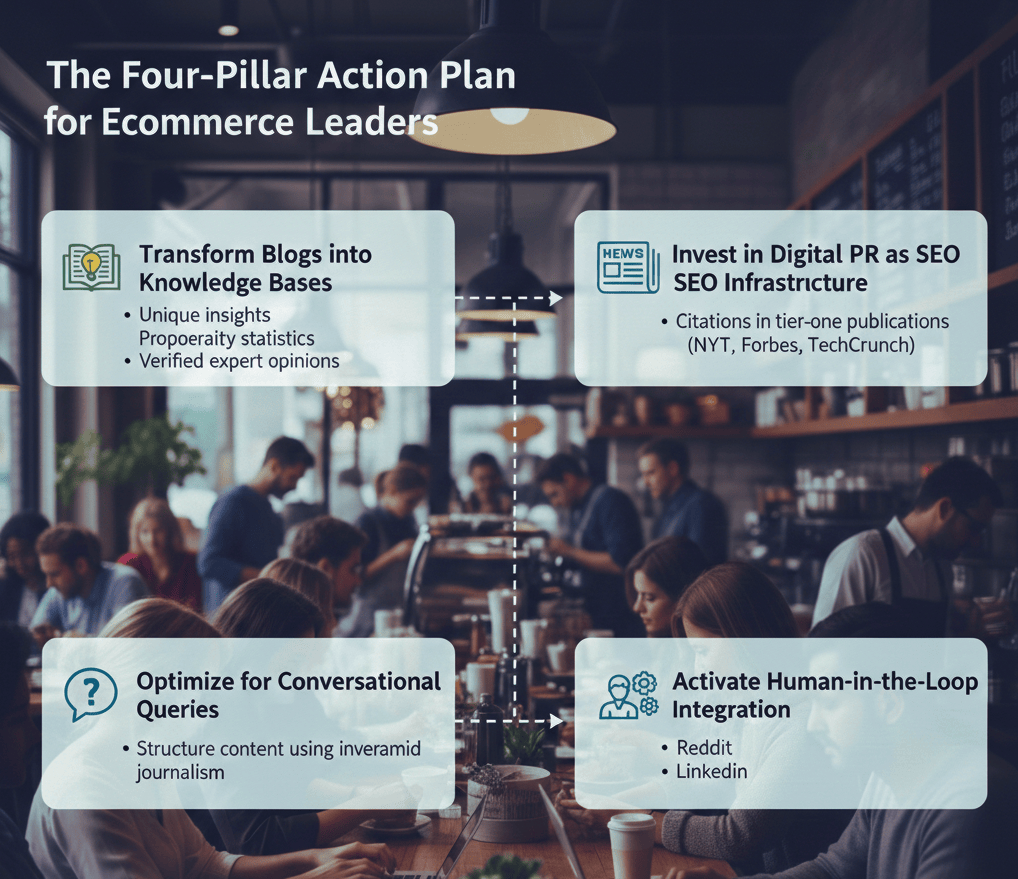
The Four-Pillar Action Plan for eCommerce Leaders
1. Transform Blogs into Knowledge Bases
Every publication must contain unique insights, proprietary statistics, or verified expert opinions. Content without differentiation earns no citations.
2. Invest in Digital PR as SEO Infrastructure
Citations in tier-one publications (NYT, Forbes, TechCrunch) serve as “truth anchors” for AI models. One authoritative news citation outweighs thousands of low-quality backlinks.
3. Optimize for Conversational Queries
Structure content using inverted pyramid journalism—place citable conclusions first. Format headings as direct answers to Who/What/Why questions users ask AI assistants.
4. Activate Human-in-the-Loop Integration
AI models increasingly weight human-first platforms (Reddit, Quora, LinkedIn) to avoid AI-generated content loops. Ensure subject matter experts actively participate on these platforms—their social proof significantly influences AEO.
The New Success Dashboard
Traditional metrics are insufficient for Citation Share tracking. Your 2026 dashboard should monitor:
- Brand Mention Frequency: Citation volume in generative responses
- Share of Model (SoM): Percentage of category answers including your brand
- Branded Search Volume: Direct traffic growth as Citation Share increases
- Assisted Conversion Value: Users mentioning AI recommendations in post-purchase surveys
Conclusion: The Era of the Cited
The shift from CTR to Citation Share represents a philosophical transformation from chasing algorithms to becoming the authoritative source.
In AI-powered search, your website functions as a data source for the world’s most powerful intelligence engines. By prioritizing E-E-A-T, implementing GEO tactics, and maximizing Citation Share, you ensure that when AI speaks, it speaks your brand’s name.
The click may be vanishing, but the influence of the cited brand is just beginning.
Is your brand cite-worthy in the eyes of AI? At PracticeNext, we specialize in AEO and GEO strategies that move the needle where it matters most. Let’s build your brand’s authority for the next era of search.
About PracticeNext: PracticeNext provides comprehensive AI Brand Visibility and SEO service that help business move beyond keywords and be the Answer