
Your SEO strategy is working perfectly. You’re ranking on page one. Traffic is flowing. Conversions are up. And none of it will matter in three years.
The digital playbook that dominated for two decades—optimize for the algorithm, win the Google SERP, win the customer, is becoming obsolete before our eyes. The culprit isn’t a new competitor or a Google update. It’s something far more fundamental: the way people find information is changing at the core.
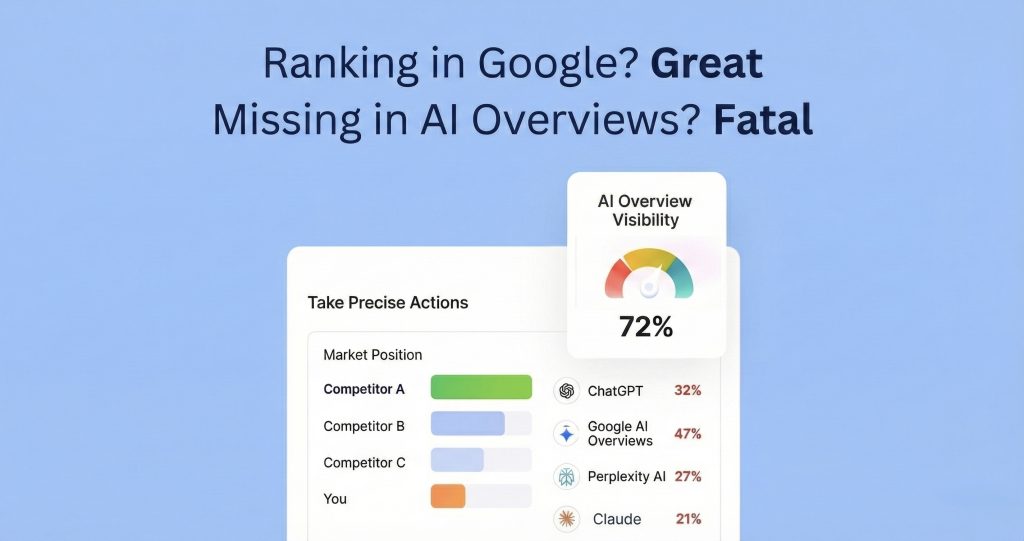
Large Language Models (LLM) like ChatGPT and Claude aren’t just new tools. They’re new behaviours. We’re witnessing a wholesale shift from “search and click” to “ask and synthesize.” And in this new world, being ranked #1 on Google means nothing if an AI answered the question without ever sending anyone to your website.
The brands that survive won’t be the ones with the best backlink profiles. They’ll be the ones that become so authoritative, so omnipresent across the digital ecosystem, that AI models can’t answer relevant questions without mentioning them.
Here’s how to become that brand.
The Death of the Click: What the Data Actually Shows
Let’s dispense with the predictions and look at what’s already happening.
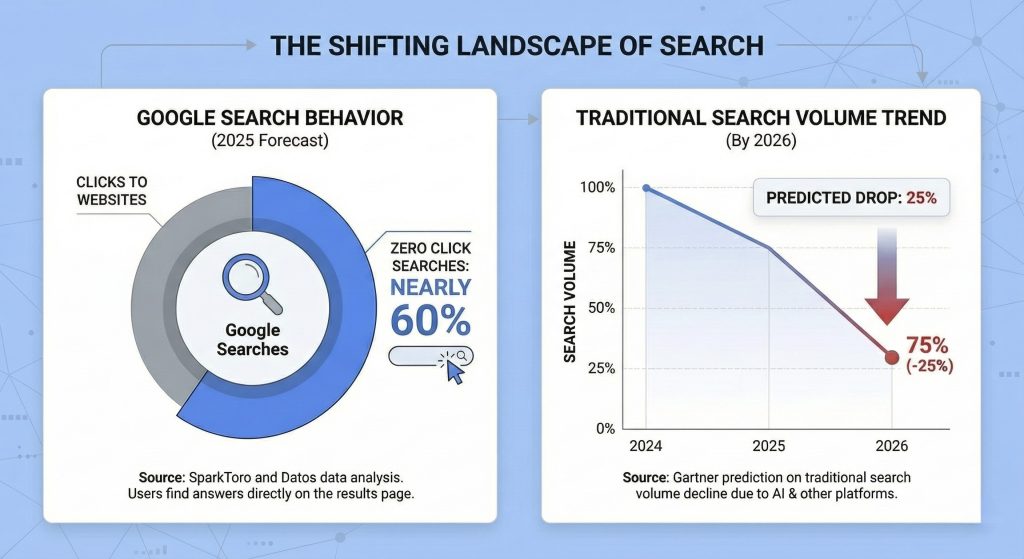
The click is disappearing. SparkToro and Datos reported that nearly 60% of Google searches in 2025 ended without a single click to another website. Google simply answered the question itself through featured snippets, knowledge panels, and maps. Your website never entered the equation.
Now add AI Overviews into the mix. Gartner predicts traditional search engine volume will plummet by 25% by 2026, with market share bleeding to AI chatbots and virtual agents. If your strategy depends on people clicking through to your site, you’re competing for a shrinking slice of a shrinking pie.
Trust is fragmenting. The 2024 Edelman Trust Barometer reveals continued erosion in trust toward media and institutions. Meanwhile, trust in peers and technical experts remains high. For AI models, which are fundamentally designed to synthesize consensus from authoritative sources, this matters enormously. Thin, keyword-stuffed content created purely for SEO won’t make the cut. AI models favor genuine expertise and community validation.
Discovery is everywhere now. Younger demographics have already left the building. GWI data shows Gen Z and Millennials increasingly bypass Google entirely, using TikTok, Instagram, and Reddit as primary search engines. And here’s the kicker: AI models are multimodal. They’re training on video transcripts, podcast audio, social media threads. If your brand doesn’t exist in these spaces, you don’t exist in the training data that shapes how future AI models understand your industry.
From Keywords to Entities: The Mental Model Shift
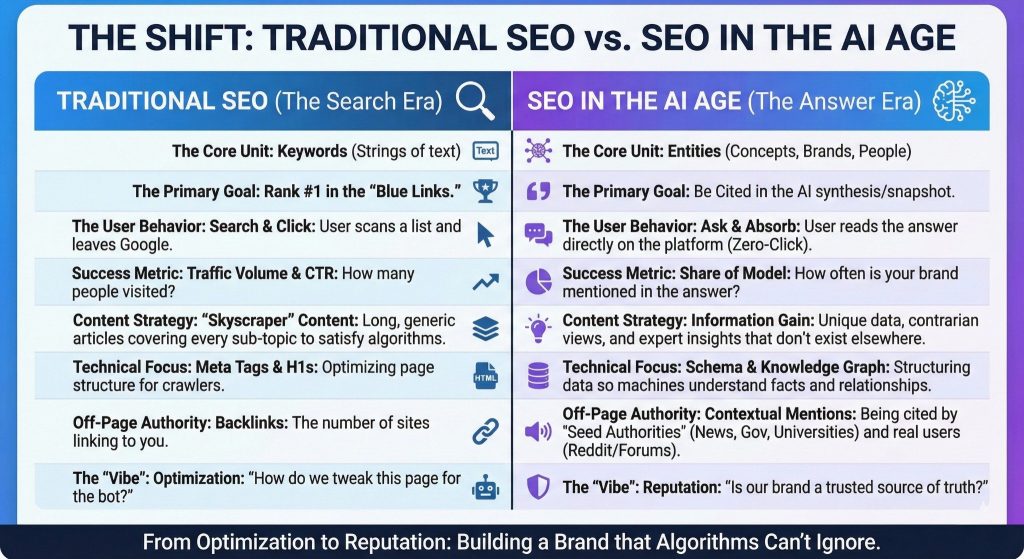
Stop thinking about keywords. Start thinking about entities. To Google and to LLMs, an entity is a distinct, definable thing, a person, place, organization, concept, that has relationships with other things. Google’s Knowledge Graph is built entirely on this concept.
When someone asks ChatGPT “What are the best CRM systems for small businesses?”, the AI doesn’t crawl through yesterday’s SERP rankings. It searches its training data for entities, brands like HubSpot, Salesforce, Zoho, that have the strongest semantic associations with “best,” “CRM,” and “small business” across reputable sources.
Your goal is simple but not easy: become an entity so strong that AI models cannot answer relevant questions in your space without referencing you.
Not because you gamed an algorithm. Because you actually became that important.
The Four Phase Roadmap to Entity Authority
Phase 1: Make Yourself Unmistakable
AI models need to know exactly who you are and what you do. Ambiguity is your enemy.
Deploy robust Schema markup. This isn’t optional anymore. Use Organization schema to explicitly define your brand name, alternate names, logo, social profiles, and key leadership. You’re directly feeding the Knowledge Graph, and incomplete data creates gaps in how AI understands you.
Treat your “About Us” page like a Wikipedia entry. Include your complete history, mission, awards, leadership team, and what makes you uniquely qualified in your space. This page is the anchor for your entity definition. Most brands phone this in. Don’t.
Obsess over NAP consistency. Name, Address, Phone number must be identical everywhere, every directory, review site, social platform. It’s not just local SEO hygiene. It’s a signal of entity legitimacy. Inconsistency tells AI models you’re not really established.
Phase 2: Dominate the Dark Spaces
“Dark Social” private DMs, Slack communities, Discord servers, WhatsApp groups, are where enormous amounts of brand discussion happens invisibly. Your analytics software can’t see it. But it matters more than almost anything you can measure.
Build communities you actually own. Reallocate budget from generic ads to creating high value gathering spaces. A thriving Discord server for B2C customers. An exclusive Slack group for B2B clients. These become sources of genuine advocacy.
Create resources worth sharing privately. When an industry influencer shares your research report in their private Slack channel, that’s social proof that eventually surfaces in public web data. Think original research, definitive guides, genuinely useful tools.
Encourage authentic human advocacy. Your employees should participate in relevant third party communities, Reddit, specialized forums, as real people, not corporate accounts. When actual humans organically recommend your brand in discussions, it creates social signals that AI training data captures.
Phase 3: Get Cited by Sources That Matter
LLMs weigh information from highly credible domains, universities, major news outlets, government sites, industry leaders, more heavily than anything else. Your goal is to be mentioned by these sources repeatedly.
Practice data journalism. Conduct original surveys. Analyze proprietary data. Create newsworthy stories and pitch them to tier-one journalists. A single mention in The Wall Street Journal does more for your entity authority than a thousand blog posts.
Position your leadership as expert sources. Use platforms like Qwoted and HARO strategically to connect your C-suite with journalists covering your sector. When your CEO is quoted in major publications defining industry trends, you’re building entity authority that AI models recognize.
Dominate the podcast circuit. Get your leadership on respected industry podcasts. The combination of audio content and transcripts creates rich, indexable material that associates your brand with deep expertise in specific niches.
Phase 4: Build Across Modalities and Personality
Text–only strategies are dead. And bland corporate voices will drown in the sea of AI-generated content.
Go video-first. YouTube is the second largest search engine. TikTok is a primary discovery engine. AI models are increasingly multimodal. Video content, properly transcribed is indexable, preferred by users, and signals you’re a living, active entity.
Make your brand voice unmistakable. In a world flooding with generic AI-generated text, a distinctive human voice becomes incredibly valuable. Take risks with your tone. Be opinionated. Be distinct. A strong personality is harder for AI to summarize without attribution, which means you get mentioned by name.
The Proof: Brands Already Winning Beyond the SERP
HubSpot: From SEO Target to Industry Oracle
HubSpot created the term “Inbound Marketing,” then watched it become generic as competitors flooded SERPs targeting their keywords. They could have doubled down on traditional SEO tactics. Instead, they became a media company.
They built the HubSpot Podcast Network, acquiring and growing shows like My First Million. They invested in original research like their State of Marketing Reports. They created genuinely useful free tools like Website Grader.
The result? HubSpot doesn’t just rank for marketing terms. They define them. Ask any AI about modern marketing strategies and HubSpot will be cited, not because they gamed rankings, but because their entity authority across podcasts, research, and tools is overwhelming.
Airbnb: When the Brand Becomes the Category
Airbnb was burning cash on Google performance marketing as travel aggregators dominated SERPs. Every click was expensive and getting less effective. In 2021-2022, they made a radical move: they permanently shifted budget away from performance marketing toward brand building and PR.
They launched major brand campaigns. They created distinctive categories like “OMG!” listings that generated PR buzz. They ensured “Airbnb” entered common vocabulary as synonymous with “short-term rental.”
The results were striking. Even after cutting performance spend, 90% of their traffic remained direct or unpaid. Users weren’t searching for “vacation rentals.” They were searching for the entity: Airbnb.
The Real Game Ahead
The AI age isn’t killing brand visibility. It’s forcing it to grow up.
For twenty years, you could hack your way to the top. Game the algorithm. Stuff the keywords. Build the backlinks. Those tactics delivered traffic, so they felt like strategy.
They weren’t strategy. They were exploitation of a temporary inefficiency in information discovery.
That inefficiency is closing. AI models don’t have a page two. They don’t have ten blue links. They have synthesis. And synthesis favors actual authority over optimization tricks.
The brand teams still obsessing over rank position in 2026 will be optimizing for an audience that no longer exists. The winners will be brands that built something real: an entity so trusted, so omnipresent across the entire digital ecosystem, that both humans and AI models cannot afford to ignore it.
This isn’t a tactic. It’s a transformation. And it starts now.
You may also like this













Pingback: The Link Economy is Dead. Welcome to the Citation Age - ThinkNext