

Commerce is decentralizing. The brands that win are the ones who stop fighting it.
For twenty years, the eCommerce playbook was beautifully simple: run ads, drive traffic to your website, convert on your domain. Clean. Linear. Measurable.
That model is breaking right in front of us, and most brands are still pretending it isn’t happening.
The era of forcing customers to “click the link in bio” is over. The storefront isn’t a place anymore, it’s everywhere your customers already are. And if you’re still treating social platforms as billboards that funnel traffic back to your .com, you’re adding friction at exactly the moment when friction kills sales.
The Uncomfortable Truth About Where Commerce Actually Happens
Global social commerce sales were valued at $1.3 trillion in 2023 and are projected to soar to $8.5 trillion by 2030, growing at a compound annual rate of 26.2%. By 2028, social commerce is expected to exceed one trillion dollars annually in the U.S. alone.
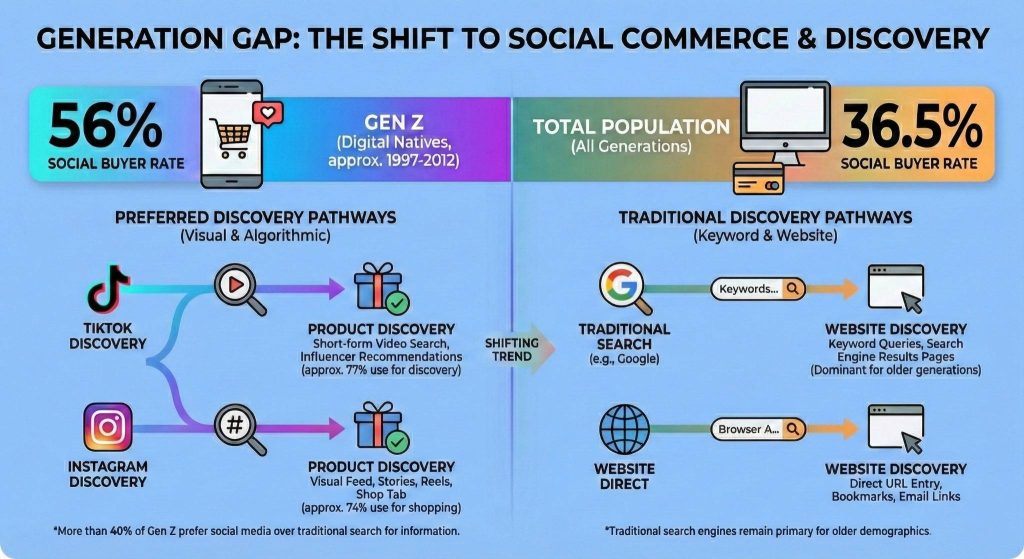
But here’s the statistic that should fundamentally change how you think about your commerce strategy: 60% of Gen Z shoppers discover products through TikTok, Instagram, or YouTube before visiting an online store. Discovery now starts on social platforms, not search engines or brand websites.
More revealing: More than half of Gen Z bought something on social media platforms in 2024, positioning them as the generation with the most consumers buying on social media, edging millennials by eight percentage points. And by 2026, Millennials are expected to account for 33% of global social commerce spending, making them the largest demographic in this market, followed closely by Gen Z shoppers at 29%.
These aren’t experimental behaviors. This is how an entire generation shops by default.
Why Every Click Is a Conversion Risk
Purchase journeys aren’t linear anymore, they’re distributed. A customer discovers your product in a TikTok video, evaluates it through Instagram reviews, asks questions via WhatsApp, and completes the purchase… where? If your answer is “they have to go to my website,” you’ve already lost a significant portion of potential sales.
82% of consumers use social media for product research, with platform preferences varying by generation. 55% of Gen Z favor TikTok while 52% of Millennials prefer Facebook for product discovery. The data is unambiguous: customers are making buying decisions in environments you don’t control.
The strategic blunder most brands make is treating these platforms as traffic sources rather than transaction venues. Every time you force a customer to leave Instagram to buy on your website, you’re introducing friction. Every additional click is a bounce risk. Every platform transition is an opportunity for distraction, second-guessing, or abandonment.
On mobile devices, cart abandonment increases to approximately 85%, making mobile checkout the most common drop-off point in the purchase journey. When you add the friction of leaving a social app, opening a browser, navigating your site, and completing checkout on a small screen, you’re compounding these already catastrophic abandonment rates.
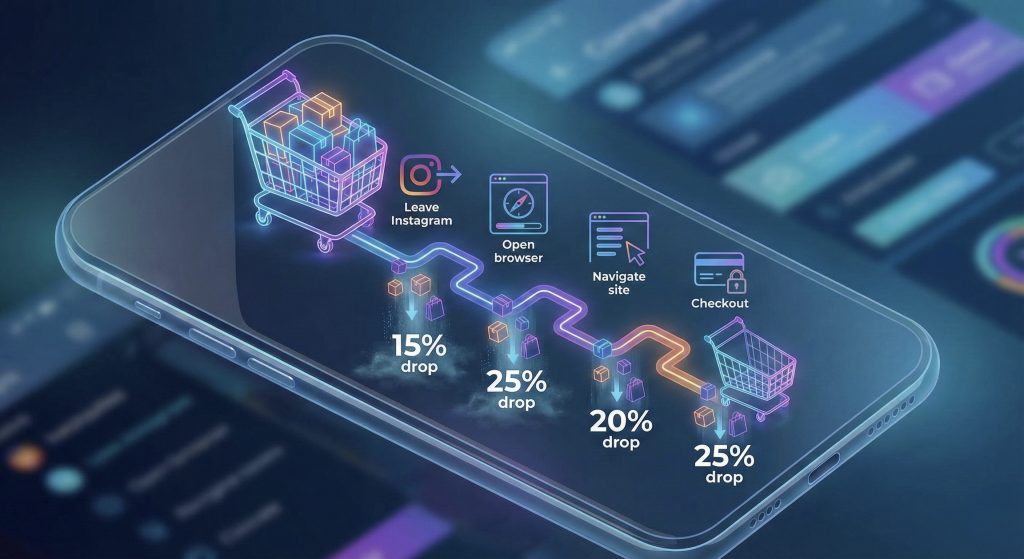
The uncomfortable reality: if customers want to buy on Instagram, and you make them leave Instagram to complete the purchase, you’re actively working against your own conversion goals.
The Fundamental Architecture Shift
This isn’t about adding another sales channel. It’s about completely reimagining what your website does in your commerce ecosystem.
Brand website needs to shift from being the “only place to sell” to becoming the “single source of truth,” the central nervous system powering commerce everywhere it happens. The website becomes the backend brain managing unified inventory so you never oversell across channels, centralizing customer data to create a single view regardless of where purchases occur, and enforcing business logic for pricing, promotions, and complex rules consistently across every touchpoint.
The “storefronts” become social feeds, marketplaces, messaging apps, voice assistants, and any other surface where your customers spend time. Your website powers them all, but customers never need to visit it to complete a transaction.
This is the shift from centralized commerce to distributed commerce. From single-channel optimization to omnichannel orchestration. From website-first to customer-first architecture.
How Headless Commerce Makes This Operational
The technical implementation of distributed commerce requires headless architecture, decoupling your backend commerce logic from frontend presentation layers. This isn’t a nice-to-have technical upgrade. It’s the infrastructure that makes selling everywhere actually possible.
92% of US brands have adopted modular, API-driven systems that enable independent scaling and faster innovation cycles. The headless commerce market is growing at roughly 22.4% annually, with these models rapidly becoming mainstream foundation for digitally minded enterprises.
Here’s what headless actually enables: You build your commerce core once, product catalog, inventory management, pricing engine, order processing, customer data. Then you expose that functionality through APIs that any frontend can consume. Instagram Shop, TikTok Shopping, your mobile app, in-store kiosks, voice commerce through Alexa, and yes, your traditional website all pull from the same backend.
When a customer buys through TikTok Shop, the inventory decrements across all channels instantly. When you update a price, it changes everywhere simultaneously. When a customer contacts support, agents see their complete purchase history regardless of which channel they used.
Product information created once automatically distributes across websites, mobile apps, in-store kiosks, and social storefronts, with inventory updates propagating instantly across every channel.
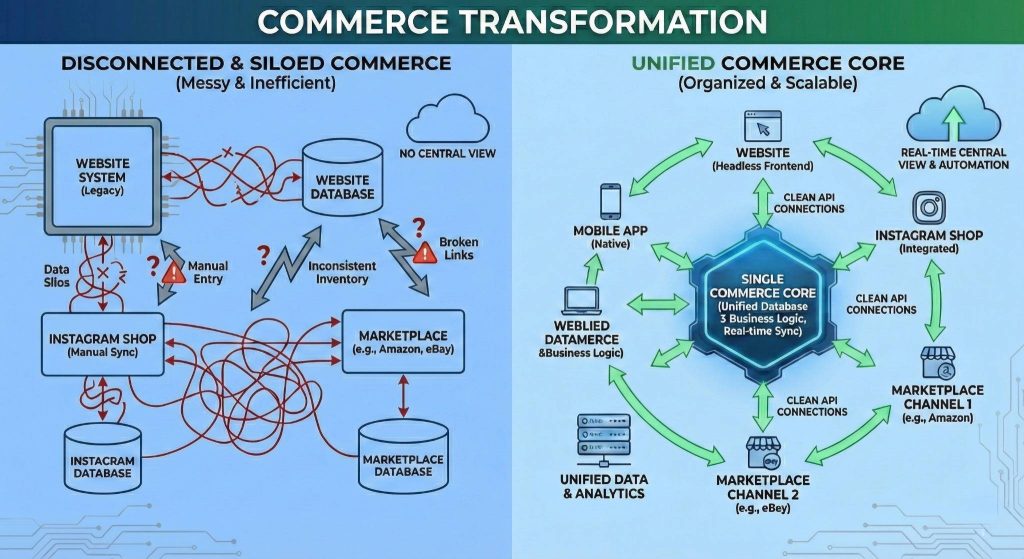
The alternative, managing separate systems for each sales channel, manually syncing inventory, reconciling customer data across platforms, doesn’t scale. It creates operational chaos that limits how many channels you can realistically manage and introduces errors that damage customer trust.
The Strategic Implications for Brand Leaders
This architectural shift has profound strategic implications that extend beyond technology decisions.
Your competitive moat is shifting. Historically, brands competed on website experience, checkout optimization, and owned channel marketing. Those capabilities are table stakes now. The new competitive advantage is omnipresence, the ability to meet customers wherever they are with consistent experiences and reliable fulfilment.
Gen Z’s social media buyer rate is 56.0% versus 36.5% for the total population, and nearly 70% of Gen Z have made a purchase because something showed up in their social media feed. If you’re not selling where they’re already browsing, you’re invisible to the fastest growing segment of commerce.
Customer acquisition costs are being arbitraged. Brands that force traffic back to their websites pay twice, once for the discovery ad, and again with conversion loss from the transition friction. Brands that enable native checkout on social platforms pay once and convert at substantially higher rates because they eliminate the context switch.
Data ownership becomes more complex but more valuable. When transactions happen on third-party platforms, you need infrastructure that captures and unifies customer data across sources. Your headless commerce core becomes the system of record that maintains the complete customer relationship regardless of transaction venue.
Speed to market becomes the primary operational metric. Content created once can be distributed across unlimited channels when your architecture supports it. Brands with headless infrastructure can activate new sales channels in days rather than months. When the next platform emerges, and it will, you’re present from day one rather than scrambling to catch up.
The Brutal Question Every Brand Must Answer
Are your social channels revenue generating stores, or glorified billboards?
If you’re spending significant budget on social advertising but treating those platforms as traffic sources rather than transaction venues, you’re optimizing for the wrong outcome. You’re measuring CTR when you should be measuring conversion rates. You’re focused on website sessions when you should be focused on completed purchases regardless of location.
The metrics that mattered in the centralized era—site traffic, session duration, pages per visit—are becoming less relevant. The new metrics are transaction success across all channels, customer lifetime value regardless of purchase channel, inventory accuracy across the ecosystem, and speed to activate new commerce surfaces.
What This Actually Looks Like
Start by auditing their current architecture to identify where commerce logic lives and what dependencies exist between systems. Then we decouple the commerce core—extracting product catalog, inventory management, order processing, and customer data into API-accessible services that any frontend can consume.
Next comes channel activation. We connect social commerce platforms, marketplace integrations, mobile applications, and traditional web properties to the unified backend. Each channel gets optimized for its native context while pulling from the same source of truth.
Finally, we implement unified analytics and orchestration, giving teams visibility into performance across all channels and ensuring business rules execute consistently regardless of where transactions occur.
The result is operational leverage. Instead of managing five different systems poorly, you manage one commerce core excellently and spin up new storefronts without rebuilding infrastructure.
The Fork in the Road
We’re at an inflection point. One path leads to incremental optimization of the old model, better website conversion rates, slightly improved mobile experiences, marginal gains on advertising efficiency. It’s comfortable because it’s familiar, but it’s a path toward irrelevance.
The other path requires accepting that commerce has fundamentally decentralized and your architecture needs to match this reality. It demands investment in infrastructure that might not deliver immediate ROI but positions you to compete in the market that’s actually emerging rather than the one you’re comfortable operating in.
The brands choosing the second path aren’t necessarily bigger or better capitalized. They’re the ones willing to acknowledge that the customer behaviors driving $8.5 trillion in social commerce by 2030 aren’t anomalies, they’re the new default.
They understand that more than half of Gen Z and Millennials have purchased on social media in recent months, far outpacing older generations. They recognize that video commerce accounts for over 40% of total social commerce activity, with live shopping and short-form video driving impulse purchasing.
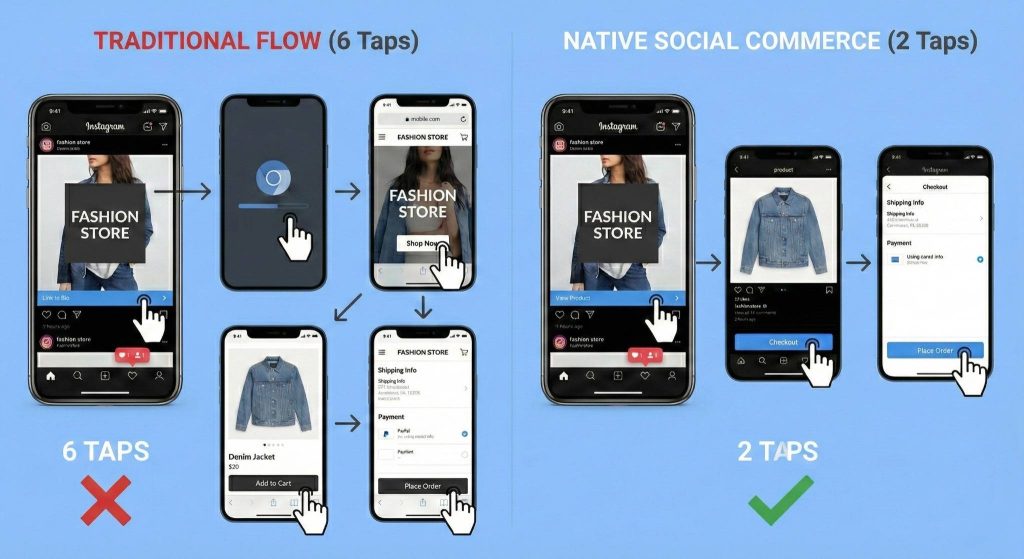
They’ve stopped asking customers to come to them and started meeting customers where they already are.
The Implementation Question
The question isn’t whether distributed commerce is coming, it’s here. Instagram’s native shopping functionality reaches 1.4 billion people, with 44% of users shopping on the platform every week. TikTok Shop’s sales are expected to comprise nearly a quarter of all US social commerce sales by 2027.
The question is whether your architecture can support it. Can you activate a new sales channel in a week rather than six months? Can you maintain inventory accuracy across eight different transaction venues? Can you provide customer service agents with a unified view of purchases regardless of where they occurred?
If the answer is no, you’re not ready for distributed commerce. And distributed commerce is happening whether you’re ready or not.
The storefront is everywhere now. Brand website is the engine, not the destination. The sooner you architect for this reality, the better positioned you’ll be when the next platform emerges, the next generation of shoppers arrives, and the next evolution of commerce makes today’s channels look quaint.
Stop forcing customers to click the link in bio. Meet them where they are. Build infrastructure that makes that operationally possible.
That’s how you win in distributed commerce.
PracticeNext helps brands architect and implement headless commerce infrastructure that makes distributed commerce operational. If your current technology limits where you can sell, let’s talk about removing those constraints.