

Executive Summary: The AI Shopping Revolution
Generative AI has become a trusted shopping companion, with usage growing 35% between February and November 2025. Over 60% of consumers now trust AI recommendations, and among daily users, AI ranks as the most influential purchase touch point, surpassing search engines and social media.
The technology’s appeal lies not in convenience but in confidence. Consumers use AI across all categories, from electronics to groceries, to compare options, navigate tradeoffs, and validate decisions. Most non users express willingness to adopt, signaling massive growth potential.
Critical Action Required: Brands must immediately optimize for AI visibility or risk becoming invisible in this influential channel. This requires answermengine optimization (AEO/GEO), ensuring consistency across all touch points, and measuring presence in AI-generated responses rather than just clicks.
Early movers can establish favorable positioning before competitive dynamics solidify. Delay means surrendering market share to more agile competitors.
The Trust Factor: Why Consumers Prefer AI Over Traditional Channels
What makes this transformation particularly striking isn’t merely the adoption rate, it’s the quality of trust consumers place in AI-generated recommendations. Over 60% of surveyed consumers express high trust in GenAI results, a remarkable figure when compared to growing skepticism toward traditional advertising and sponsored content. This represents a fundamental shift in the consumer psychology of information gathering.
Consider the contrast: traditional digital shopping requires consumers to navigate a minefield of sponsored listings, influencer promotions, and algorithm manipulated search results. Generative AI, by comparison, offers what feels like an unfiltered conversation with a knowledgeable expert. As one consumer articulated, the technology “takes out all the guesswork of scrolling through ads and opinions and gives you the direct answer.”
This perception of objectivity, whether fully accurate or not, gives AI a competitive advantage over established touch points. Among daily GenAI users, AI assistants and chat tools have become the most influential touchpoint in the entire purchase journey, surpassing even traditional search engines and social media platforms.
Beyond Convenience: The Confidence Imperative
The most compelling insight from BCG’s research isn’t about efficiency or time saving, it’s about confidence. Consumers repeatedly emphasized that GenAI helps them feel more certain about their purchase decisions. This psychological dimension separates AI from other digital tools that merely facilitate transactions.
The technology excels in three specific scenarios where consumer anxiety runs highest: comparing similar products with subtle differences, navigating complex tradeoffs between features and price, and validating whether they’re getting the best available deal. In each case, AI acts less like a search engine and more like a personal consultant who can explain nuances, contextualize options, and adapt recommendations to individual circumstances.
This personalization extends beyond simple product matching. The technology demonstrates an ability to help consumers clarify what they actually want, a metacognitive function that traditional retail touch points rarely provide. One user described this succinctly: “AI helps me explore my own mindset and figure out what I want exactly, because sometimes I’m not even sure.”
The Category Expansion: From Electronics to Olive Oil
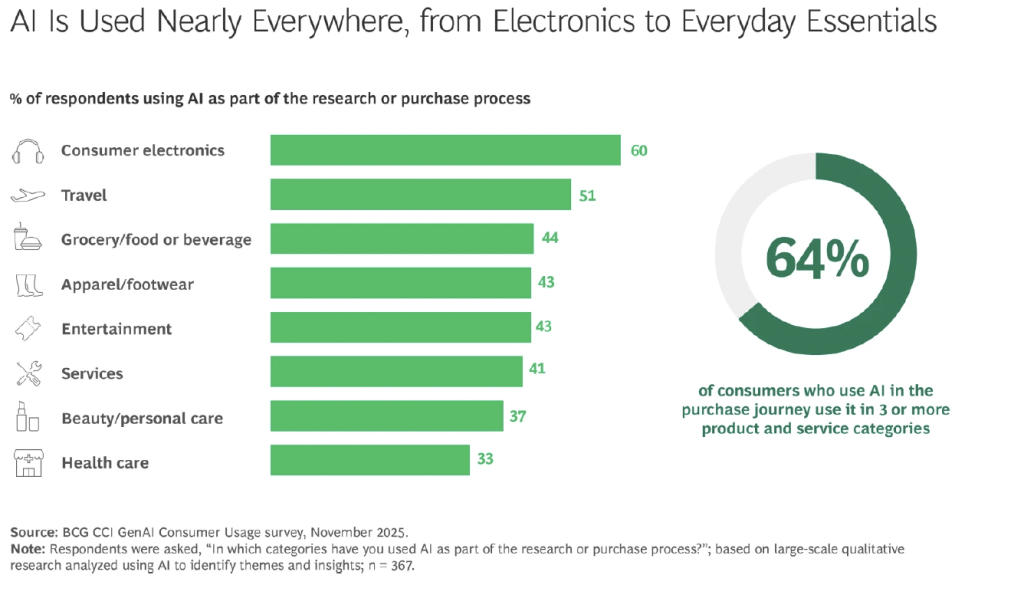
Perhaps the most significant finding in BCG’s research is the breadth of product categories where consumers now deploy AI assistance. While GenAI adoption for high-consideration purchases like smartphones and laptops seems logical, the technology has penetrated deeply into routine, low-stakes purchases.
Consumers are using AI to evaluate olive oil quality, compare coffee maker options, and optimize grocery selections. This democratization of AI-assisted shopping across price points and purchase frequencies means virtually every brand, not just premium or technology focused companies must consider how they appear in AI-generated recommendations.
The research identified shopping related usage as the third most popular application of GenAI overall, trailing only workplace productivity and general personal assistance. This ranking underscores that shopping isn’t a niche use case, it’s become a core function of how consumers interact with generative AI tools.
The Latent Demand: Non Users Ready to Convert
Even more telling than current adoption rates is the receptiveness among non-users. The majority of consumers who haven’t yet incorporated AI into their shopping routines expressed openness to doing so. Their hesitation stems not from resistance but from simple unfamiliarity: “The only reason I haven’t used it in purchase decisions, really, is just that I haven’t ventured there yet. I am willing to try it.”
This latent demand suggests we’re in the early stages of a much larger transformation. As AI tools become more deeply embedded in daily routines, 66% of current users engage with GenAI at least weekly, the application to shopping will likely become increasingly automatic. The pathway from awareness to adoption to habitual use is compressing rapidly.
The Strategic Imperative for Brands
For brands and retailers, this shift demands more than incremental adjustments to digital marketing strategies. It requires a fundamental rethinking of how product information is structured, where it lives, and how it can be accessed by AI systems.
The challenge is multifaceted. Large language models pull brand information from disparate sources: company websites, social media channels, third-party reviews, and news coverage. Ensuring consistency, accuracy, and favorable positioning across this fragmented ecosystem requires coordinated effort across multiple organizational functions.
Traditional search engine optimization (SEO) proves insufficient in this new environment. Brands must now optimize for “answer engines” developing content that AI systems can extract, synthesize, and present as clear, trustworthy responses to consumer queries. This means moving beyond keyword strategies toward creating structured, modular content that directly addresses the questions consumers actually ask.
Several forward thinking companies have already begun adapting. Walmart’s partnership with ChatGPT enables instant checkout without leaving the chat interface. Instacart’s AI builds grocery carts from meal ideas in seconds. Lowe’s virtual assistant helps customers plan projects and select appropriate products. These integrations represent AI evolving from an information source to a transaction facilitator a development that will only accelerate.
The Multi Touchpoint Reality
Critically, AI doesn’t exist in isolation within the consumer journey. Modern shopping pathways are inherently non linear, with consumers fluidly moving between social media, traditional search, brand websites, physical stores, and AI conversations. One consumer described seeing an in-store clearance offer, immediately consulting ChatGPT via Siri to verify pricing and read reviews, then deciding to purchase on the spot.
This interconnected reality means brands cannot simply “optimize for AI” in isolation. They must ensure consistency across every touchpoint, what BCG’s research terms the “three C’s”: consistency of facts and brand presentation, completeness so shoppers can validate AI recommendations, and continuity so the narrative remains coherent across channels.
The implication is clear: brands need unified content strategies that work across both traditional and AI-mediated touchpoints simultaneously. A disconnect between what AI says about a product and what appears on the brand’s website or in-store display doesn’t just create confusion, it actively undermines the consumer confidence that makes AI so appealing in the first place.
Measuring What Matters
Traditional metrics of digital marketing success, click-through rates, page views, conversion funnels—become less relevant when AI systems mediate the discovery process. Brands must develop new measurement frameworks focused on presence and preference within AI-generated responses.
This means monitoring how frequently products appear in AI answers to priority consumer queries, assessing the accuracy and favorability of those representations, and comparing AI influence against other touch points in the purchase journey. Emerging analytics tools now allow brands to track their visibility across multiple AI models, providing insight into representation quality and improvement opportunities.
The metric that matters most may be the simplest: helpfulness. Does your brand show up when consumers ask AI for guidance in your category? When it does appear, does the information provided actually help consumers make confident decisions? These questions should drive strategic priorities.
The Urgency of Action
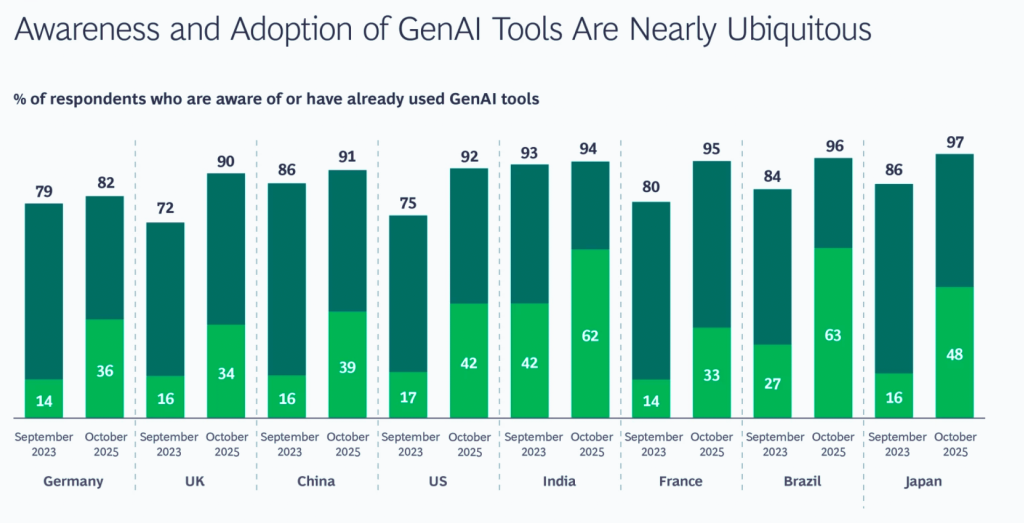
The pace of change in AI-mediated shopping creates urgency for brand action. ChatGPT reached 100 million users in just two months, a feat that took Facebook over four years and Instagram two and a half years. In some markets, half of all consumers now use GenAI regularly.
Brands that delay adaptation risk becoming invisible in an increasingly influential channel. Those that act quickly can establish favorable positioning before competitive dynamics fully solidify. The window for early mover advantage remains open, but it’s closing rapidly.
The transformation underway isn’t about AI replacing human judgment in shopping decisions. Rather, it’s about AI becoming a trusted partner in that process, one that helps consumers navigate complexity, validate instincts, and feel confident in their choices. For brands, the question isn’t whether to engage with this shift, but how quickly and how strategically they can do so.
The retailers and manufacturers that thrive in this new environment will be those that recognize AI not as a technological challenge to overcome but as a consumer behavior shift to embrace, one that demands clarity of value proposition, consistency of message, and genuine helpfulness at every touchpoint where decisions get made.