
When Speed Meets Intelligence: Why Your CMS Choice Will Define Your Competitive Future
Your marketing team just pitched a brilliant campaign for Republic Day. Your engineering team says it’ll take eight weeks to implement because it requires backend changes. By the time it launches, the moment has passed, and your competitor, who moved faster, has already captured the market’s attention.
Sound familiar?
For C-suite executives leading mid-sized eCommerce and D2C brands, this scenario represents more than frustration, it’s a structural disadvantage. You’re competing against giants like Amazon with their unlimited R&D budgets, yet you’re constrained by monolithic platforms that were designed for a simpler era. These coupled systems that once seemed like solid foundations have become architectural straitjackets, preventing the very agility you need to compete.
The market shifted toward headless commerce years ago, decoupling the customer facing experience from backend operations. But here’s what many CXOs miss: headless alone is no longer the differentiator. It’s become table stakes in modern commerce.
The new battleground? AI-augmented headless architecture, where architectural freedom meets machine intelligence to create something previously impossible: the ability to personalize at scale, automate content creation without sacrificing quality, and make data-driven merchandising decisions in real-time.
This guide cuts through the noise to help you make one of your most critical infrastructure decisions: selecting the headless CMS platform that will anchor your competitive advantage for the next five years.
The Mid-Market Squeeze: Why You Can’t Afford to Wait
Mid-size companies, those generating between $5M and $50M in revenue, occupy dangerous territory. You’ve outgrown Shopify’s templates, but enterprise platforms like Adobe Experience Manager feel like bringing a tank to a street race: powerful but impossibly slow and expensive.
Traditional “coupled” platforms create absurd inefficiencies. Want to change a landing page headline? In many legacy systems, that simple marketing request ripples through your entire technology stack, potentially requiring backend deployments that could affect your checkout flow. One small change becomes a cross-departmental project with testing requirements that would make NASA blush.
This architectural rigidity doesn’t just slow you down, it actively kills marketing agility and competitive responsiveness.
Headless commerce solves this fundamental problem by separating the “head” (customer facing interfaces: websites, mobile apps, kiosks, voice assistants) from the “body” (backend systems: inventory, payments, order management). They communicate through APIs, creating a clean separation of concerns that unlocks extraordinary flexibility.
For CXOs, this translates into three immediate competitive advantages. First, true omnichannel execution, your content lives in one place but displays consistently across your website, iOS app, in-store displays, and social commerce channels. Second, dramatically faster time-to-market because marketing teams can launch campaigns and test new experiences without waiting for backend engineering cycles. Third, you escape vendor lock-in forever, composing a best of breed MACH stack (Microservices, API-first, Cloud-native, Headless) where you choose the best search solution, the best payments provider, and the best CMS for your specific needs.
Why AI Changes Everything: From Speed to Precision
If headless architecture is the engine that provides speed, artificial intelligence is the precision guided fuel that transforms potential into performance.
Here’s the crucial insight: a headless CMS doesn’t manage inventory, it manages content. Product descriptions, imagery, videos, blog posts, marketing copy, all treated as structured data accessible via APIs. This content-as-data approach creates the perfect substrate for AI integration. The combination creates three transformative capabilities that simply weren’t possible before.
Moving beyond “dumb” personalization. Traditional personalization shows you products based on what similar customers bought. AI-powered headless systems generate unique landing pages, hero images, and product bundles in real-time based on predicted intent, browsing patterns, and contextual signals. The CMS provides raw content; AI reassembles it dynamically for each visitor. It’s the difference between a recommendation engine and a personal shopping assistant.
Automating the content supply chain. Consider a D2C brand launching 50 new SKUs next season. Writing unique, SEO-optimized descriptions for each represents a bottleneck that delays launches and dilutes quality. AI-integrated CMS platforms generate initial drafts, translate them into twenty languages, create image alt-tags, and adjust tone for different channels—all requiring human approval rather than creation. You shift from authoring to directing.
Intelligent asset management that actually works. Mid-size brands accumulate thousands of digital assets without good organizational systems. AI within your CMS automatically analyzes product photos, tags them with searchable attributes (seasonal, style, color, use case), intelligently crops them for different devices and platforms, and even ensures brand consistency across your visual library. What was once a part-time job becomes automatic.
The Top 5 Platforms: A Strategic Analysis
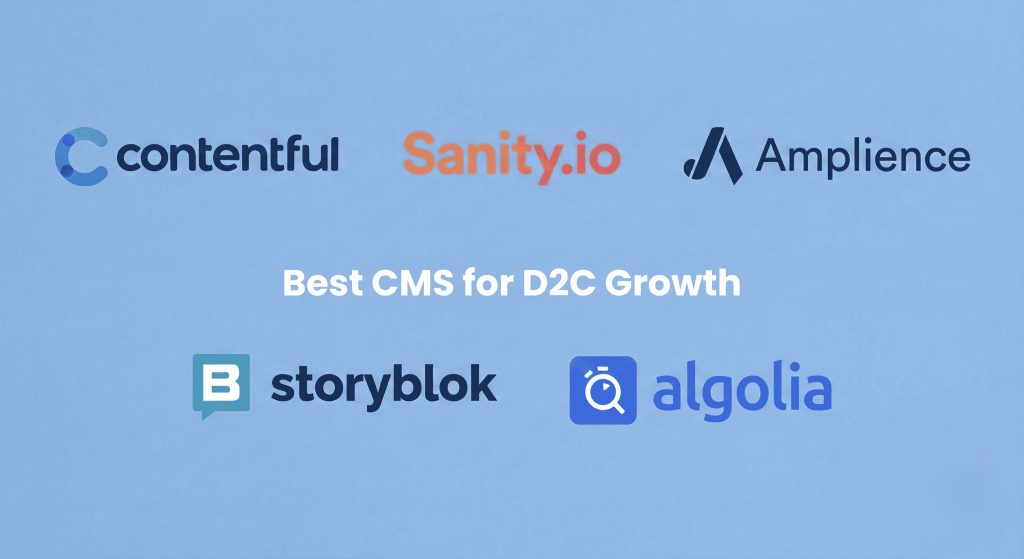
We evaluated these platforms against three criteria crucial to mid-market success: true API-first architecture, mature AI integration roadmaps, and total cost of ownership appropriate for scaling D2C brands rather than Fortune 100 enterprises.
1. Contentful — The Composable Architecture Standard
Contentful has become the default choice for companies transitioning to composable (MACH) architecture, and for good reason. It’s not simply a CMS—it’s content infrastructure that treats your content as a foundational business asset.
The platform forces you to structure content cleanly through its “content modeling” approach, which initially feels restrictive but pays enormous dividends. This structure makes content infinitely reusable across any channel web, mobile app, smartwatch, in-store kiosks—without reformatting or republishing. For developers, it offers unmatched flexibility and the strongest ecosystem of integrations in the market.
Contentful has moved aggressively into AI through its App Framework and Marketplace. Built-in ChatGPT integrations allow marketers to generate SEO metadata, rewrite product descriptions for different brand voices, or translate content without leaving the editing interface. Integrations with DALL-E and Midjourney enable rapid prototyping of campaign imagery directly within the CMS workflow.
Best suited for mid-to-large D2C brands with capable engineering teams who want maximum flexibility and a future-proof foundation. If you’re building for scale and have the technical resources to leverage its full potential, Contentful offers the most comprehensive long term platform.
2. Sanity.io — Where Structure Meets Velocity
Sanity has captured significant market share by treating content as structured data that can be piped anywhere, filtered perfectly, and delivered at exceptional speed. Developers love it for its flexibility; recent improvements have made it equally appealing to marketing teams who initially found it intimidating.
The platform uses a unique query language (GROQ) that allows front-ends to request exactly the data they need, nothing more, nothing less. This precision results in blazingly fast page loads, a crucial factor in eCommerce conversion rates where every 100ms of delay costs revenue. Real-time collaboration features function like Google Docs for content and code, dramatically accelerating editorial workflows.
Sanity’s AI integration focuses on practical editorial support. Their AI Assist doesn’t just generate generic text, it generates content structured specifically for your unique content model, populating the exact fields your business logic requires. Because Sanity is highly customizable, engineering teams can build bespoke AI pipelines. For example, automatically sending new product images to external AI services to generate lifestyle background scenes, then saving them back to the CMS without human intervention.
Best suited for brands that view technology as a competitive advantage and want highly customized editorial workflows. If you have strong technical talent and want to differentiate through unique customer experiences, Sanity provides the creative freedom to build exactly what you envision.
3. Amplience — The Retail-Native Platform
Unlike generalist CMS platforms adapted for commerce, Amplience was purpose-built for retail and B2C. It combines headless CMS with enterprise grade Digital Asset Management in a single platform, eliminating the integration headaches most brands face.
Amplience excels at high velocity visual commerce, shoppable lookbooks, dynamic product carousels, complex seasonal merchandising schedules. It integrates tightly with commerce engines like commercetools and BigCommerce, understanding the specific workflows and content types that retail organizations actually need.
The platform’s AI capabilities focus on what matters most in retail: merchandising effectiveness and visual media optimization. Content Intelligence features analyze which specific pieces of content drive conversions, bridging the traditional gap between content marketing and sales performance data. Generative AI integrations help merchandisers create product variants dynamically—showing the same sofa in minimalist, bohemian, or industrial settings based on customer preference signals.
Best suited for fashion, apparel, lifestyle, and home goods D2C brands where high quality visual media directly drives purchase decisions. If your conversion funnel depends on aspirational imagery and frequent seasonal content updates, Amplience speaks your language natively.
4. Storyblok — The Marketer’s Gateway to Headless
Many headless platforms terrify marketing teams who lose the familiar visual preview of traditional site builders. Storyblok solves this friction with a unique Visual Editor that overlays intuitive editing controls on top of a fully headless architecture.
The platform delivers API-first benefits while allowing non, technical marketers to click webpage elements and edit them in real-time with immediate visual feedback. This dramatically reduces the adoption barriers that sink headless initiatives in mid-size organizations with leaner technical teams.
Storyblok has integrated AI tools directly into this visual editing environment. Marketers use in-context AI prompts to generate text blocks, translate content, or adjust tone without leaving their preview mode. Built-in AI image tagging streamlines product asset management without requiring separate DAM systems or constant IT support.
Best suited for mid-size companies where marketing teams demand visual control and ease of use, while technical teams want to minimize ongoing maintenance requests. If organizational buy-in from non-technical stakeholders is critical to your headless adoption, Storyblok provides the smoothest transition path.
5. Algolia — The Critical “Dark Horse” Component
While not a traditional CMS, Algolia deserves strategic consideration because it’s often the most critical headless component you’ll add alongside your CMS. In modern D2C commerce, search isn’t a utility, it’s your most productive salesperson.
A headless CMS stores content; Algolia makes it findable with extraordinary intelligence. The platform indexes product and content data via API and delivers search results with sub-50ms latency globally.
Algolia’s AI maturity arguably exceeds every platform on this list. Vector search understands user intent, not just keywords. when someone types “cheap summer kicks,” AI recognizes this as a query for affordable sandals and sneakers even if the word “kicks” appears nowhere in product descriptions. Dynamic re-ranking analyzes user behavior in real-time, continuously reordering results to maximize conversion probability during that specific session.
Best suited for any D2C brand with catalogs exceeding 100 SKUs where search performance directly correlates to revenue. If customers use your search bar, investing in Algolia-level search intelligence typically shows ROI within quarters, not years.
Real-World Impact: The AI-Headless Advantage in Action
Consider two scenarios that illustrate the transformative potential of this architecture.
The Global Apparel Expansion: A mid-size fashion brand decides to expand into three new European markets. Translating 2,000 product descriptions and maintaining localized blogs through traditional workflows would cost six figures and take months. Using Contentful as their headless hub, they integrate an AI translation service via API. When products are created in English, the AI automatically generates localized drafts for Germany, France, and Italy, adjusting colloquialisms and cultural references appropriately. Human editors review and approve rather than create from scratch. Result: time-to-market cut by 70%, costs reduced by 60%.
The Visual Merchandising Revolution: A home goods D2C struggles with high consideration products like custom furniture that require inspirational content. Standard product shots don’t convey lifestyle appeal. Using Amplience for combined CMS and DAM, they integrate generative AI to transform studio product shots into lifestyle images, the same sofa appearing in minimalist, bohemian, industrial, and coastal environments. AI analytics then serve the environment that best matches each visitor’s browsing history. Result: add-to-cart rates increased 18% through hyper-relevant visual merchandising, and content creation costs dropped 40%.
The Strategic Decision: Building Your Self-Optimizing Engine
Moving to headless commerce represents a significant architectural decision requiring C-level sponsorship and organizational commitment. This isn’t merely an IT upgrade—it’s a fundamental shift to an agile operational model that affects marketing, merchandising, engineering, and customer experience teams.
By selecting a headless CMS with a robust, forward looking AI strategy, you’re doing more than decoupling your front and back ends. You’re building a self-learning, self-optimizing content engine capable of delivering the right message to the right customer at a scale that human teams alone cannot achieve.
In the mid-market D2C race, where you lack the unlimited resources of enterprise giants but face their competitive pressure daily, this combination of architectural flexibility and machine intelligence represents your best opportunity to close the gap. The question isn’t whether to make this transition market forces will eventually demand it. The question is whether you’ll lead the transition or scramble to catch up when your competitors pull ahead.
The platforms outlined here represent proven foundations for that future. Your choice among them depends on your specific organizational strengths, technical capabilities, and strategic priorities. But the decision to build on this foundation? That’s no longer optional for mid-market leaders who intend to compete in the decade ahead.