
A practical guide for merchants and technologists choosing their commerce foundation
Choosing between Shopify Plus and Adobe Commerce (formerly Magento) is one of the most consequential platform decisions you’ll make. Both power large, complex businesses generating hundreds of millions in revenue. But they approach commerce from fundamentally different philosophies, and picking the wrong one creates years of technical debt and operational friction.
This isn’t a feature comparison. It’s a strategic analysis of platform tradeoffs mapped to real business needs, technical capabilities, and growth trajectories.
The Core Philosophy Split
Before diving into specifics, understand the fundamental difference in how these platforms think about commerce.
Shopify Plus operates as a SaaS-first platform. Shopify owns the infrastructure, checkout, PCI compliance scope, and upgrades. You operate stores through an admin interface and APIs while Shopify handles core commerce components centrally. The model assumes you’d rather focus on growth than managing servers.
Adobe Commerce is self-hosted or managed through Adobe Commerce Cloud. You own the application stack and deploy to infrastructure you control, or pay Adobe to manage it for you. The open source core (Magento Open Source) plus enterprise features gives you complete architectural control. The model assumes you have specific requirements that demand customization.
This philosophical split cascades through every other decision. SaaS means less operational burden, faster iteration, and fewer security headaches. Self hosted means control and flexibility, but significantly more operational complexity and long-term maintenance responsibility.
Time to Market: Speed vs. Specificity
Shopify Plus is built for velocity. Launches happen fast using themes, Hydrogen (Shopify’s React-based framework), and an extensive app library. Developers work primarily with REST and GraphQL APIs, often building headless frontends for advanced experiences while letting Shopify handle checkout and payments. Most brands launch in weeks, not months.
Adobe Commerce trades speed for specificity. Setup takes longer due to custom hosting, environment provisioning, and extension configuration. The PHP centered architecture offers robust extension points for bespoke requirements, but comes with a steeper learning curve. Implementations typically measure in months.
The strategic question: Do you need to launch quickly and iterate marketing experiences frequently, or do you need deeply customized server-side logic that can’t be achieved through standard patterns? The former points to Shopify Plus. The latter often makes Adobe Commerce necessary despite the longer timeline.
Extensibility: Composition vs. Customization
Both platforms are extensible, but through radically different mechanisms.
Shopify Plus favors composition through apps. The marketplace offers thousands of SaaS integrations that plug in via APIs and frontend script tags, adding functionality in hours rather than weeks. Checkout extensibility comes through Shopify Functions and Apps. Headless support through Hydrogen gives you frontend freedom while preserving commerce reliability.
The constraint is that you’re working within Shopify’s architectural boundaries. Apps integrate with what Shopify exposes through APIs. You can’t fundamentally alter core transaction logic or data models.
Adobe Commerce favors customization through code. You have freedom to change core behaviors, workflows, data models, and the entire checkout process. The extension marketplace and community modules provide starting points, but the real power is the ability to build exactly what your business requires without platform constraints. Integrating custom middleware and legacy enterprise systems doesn’t require “bending” the platform it’s designed for it.
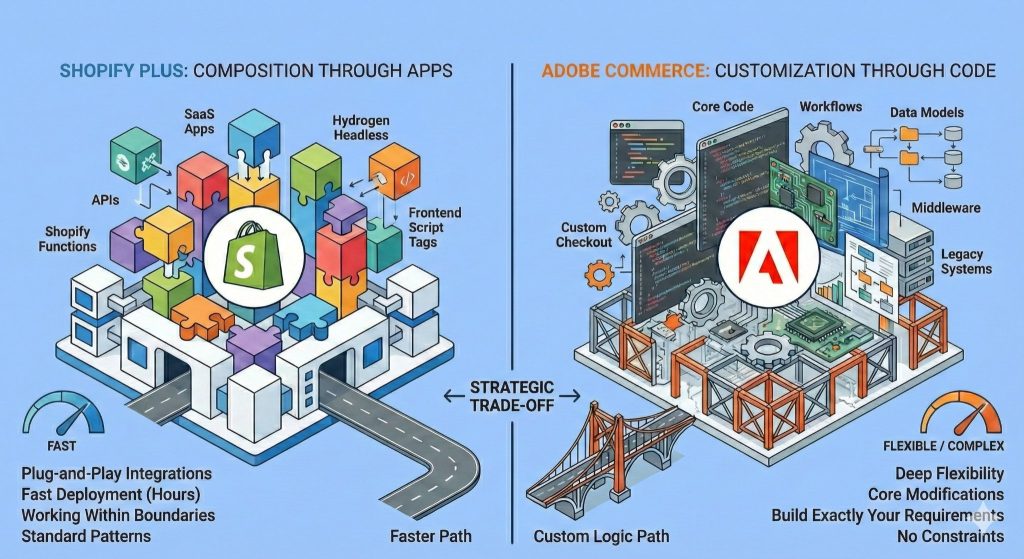
The strategic trade: If your feature needs map to existing apps or standard commerce patterns, Shopify Plus is dramatically faster. If you require custom transaction logic, unique pricing engines, or deep integration with proprietary systems, Adobe Commerce provides the necessary flexibility.
Checkout, Payments, and Compliance
This is where philosophical differences become concrete operational realities.
Shopify Plus delivers a highly optimized checkout out of the box. Shop Pay, multi-currency support, and fraud tools are battle-tested across billions of transactions. PCI compliance burden is minimal if you use Shopify Payments. Checkout customization is possible but intentionally constrained, Shopify protects this surface for security and conversion optimization.
For most merchants, this is a massive advantage. Checkout is complex, regulated, and critical. Letting Shopify handle it means one less system to secure, maintain, and optimize.
Adobe Commerce gives you complete checkout control. You can entirely replace or deeply customize the checkout flow. This flexibility is essential for businesses with complex payment routing, multi-step authorization processes, or alternative checkout experiences not available in standard platforms. The tradeoff is that PCI compliance becomes your responsibility unless you use a managed service, and checkout optimization requires dedicated engineering attention.
The decision point is straightforward: If checkout optimization and low compliance overhead matter more than customization, Shopify Plus wins. If your business model demands a checkout experience that doesn’t fit standard patterns, Adobe Commerce provides the necessary freedom.
B2B, Multi-Store, and International Commerce
Enterprise complexity reveals platform strengths and limitations.
Shopify Plus handles multi-store, multi-currency, and international domains well. B2B capabilities exist through apps and Shopify’s native wholesale channel. For many businesses with multi-market needs, this is sufficient. However, deep B2B features like complex approval workflows, custom catalogs per customer segment, or sophisticated quote management often require creative architecture and multiple app integrations.
Adobe Commerce was built for enterprise complexity. Company accounts, quote systems, shared catalogs, and rich multi-store capabilities are native platform features, not afterthoughts. The system handles many tailored storefronts, complex price lists, and large account hierarchies without architectural gymnastics.
If you’re running complex B2B commerce with many storefronts and customer-specific pricing logic, Adobe Commerce provides a better foundation. For multi-market D2C with straightforward B2B needs, Shopify Plus is often adequate and significantly simpler to operate.
Performance, Scaling, and Operations
Here’s where the SaaS versus self-hosted distinction has the most practical impact.
Shopify Plus scales automatically. Traffic spikes from successful campaigns or viral moments don’t require emergency infrastructure calls. The global CDN and infrastructure are Shopify’s problem, not yours. Uptime SLAs are consistent and predictable. Your operational burden for scaling is essentially zero.
Adobe Commerce performance depends entirely on your hosting, CDN strategy, and caching architecture. Proper scaling requires infrastructure expertise and DevOps investment. You have complete control over performance optimization—tuning every layer from database queries to edge caching—but you also have complete responsibility for getting it right.
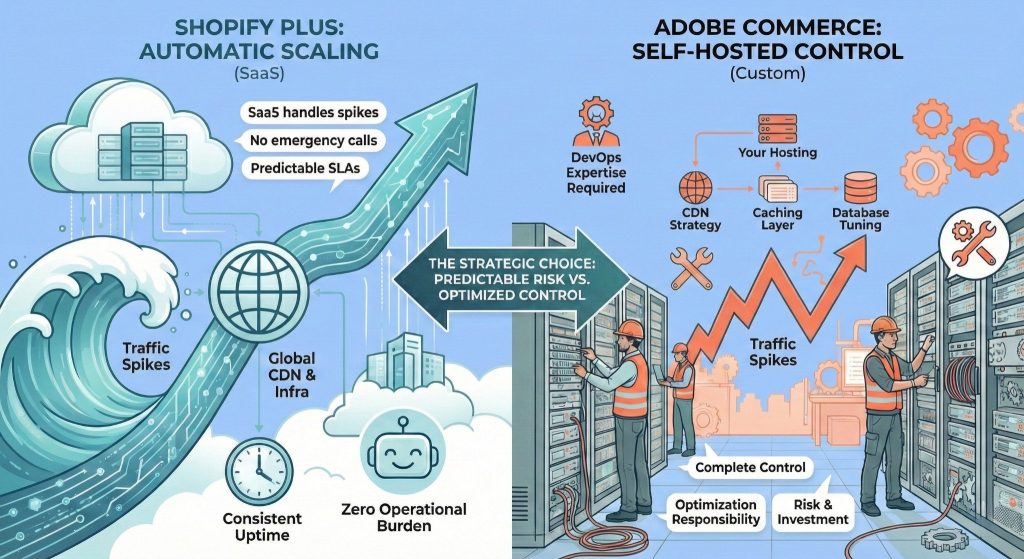
The strategic choice: If you expect unpredictable traffic spikes or massive seasonal campaigns and prefer not to manage infrastructure, Shopify Plus dramatically reduces risk. If you have in-house infrastructure expertise and want to optimize performance at every architectural layer, Adobe Commerce lets you build exactly what you need.
Total Cost of Ownership
Pricing models reveal hidden costs that dwarf initial license fees.
Shopify Plus uses predictable subscription pricing, monthly or annual fees that scale with revenue. Apps add recurring costs. Transaction fees depend on your payment provider unless you use Shopify Payments. Critically, staffing and operational expenses for hosting, security, and maintenance are minimal because Shopify handles infrastructure.
Adobe Commerce has variable, often unpredictable costs. There’s licensing for Adobe Commerce (or zero for open-source Magento), plus hosting infrastructure, DevOps staffing, ongoing maintenance, security patches, and significantly higher upfront implementation costs. These ongoing expenses can exceed initial projections, but the license cost alone doesn’t tell the full story.
For many merchants, Shopify’s SaaS model delivers lower total cost of ownership and faster ROI. Adobe Commerce becomes cost-effective primarily when you heavily customize and amortize substantial engineering investment across large, complex revenue streams. If you’re not doing hundreds of millions in revenue with unique requirements, Adobe Commerce’s higher operational cost is harder to justify.
Here is an excellent read on cost of ownership.
Migration and Vendor Lock-In
Exit strategies matter more than most teams acknowledge when choosing platforms.
Shopify Plus is easier to start with, but some proprietary aspects—particularly checkout and specific APIs—make migrating away non-trivial. Data export is supported, but you’re rebuilding significant functionality if you leave. However, the headless architecture option (custom frontend with Shopify checkout) provides some mitigation.
Adobe Commerce, being self-hosted and open-source at its core, offers more direct portability between hosting providers and vendors. You own the codebase and data model completely. That said, replatforming from any mature commerce system is always a significant undertaking regardless of architecture.
The Practical Decision Framework
Ask yourself these questions and weigh the answers honestly:
Do you need to launch quickly and minimize operational overhead? Shopify Plus eliminates infrastructure management and accelerates time-to-market dramatically.
Will your business require complex B2B workflows, deep account hierarchies, or highly customized checkout flows? Adobe Commerce provides the necessary architectural flexibility without fighting the platform.
Do you have internal engineering and DevOps capacity to manage a self-hosted platform? If not, Adobe Commerce’s operational burden becomes a critical risk factor.
Is predictable pricing and reduced PCI compliance overhead important? Shopify Plus delivers both through its SaaS model.
Are you building a highly differentiated frontend experience but want robust hosted checkout? Shopify Plus headless (Hydrogen + Shopify Checkout) offers a compelling middle ground.
Do you need complete ownership of data models and extreme extensibility? Adobe Commerce gives you architectural control that Shopify fundamentally can’t match.
Hybrid Patterns Worth Considering
The decision isn’t always binary. Sophisticated merchants often use hybrid approaches:
Headless Shopify combines custom frontend experiences with Shopify’s battle-tested checkout and admin. You get unique UX without managing payment infrastructure.
Dual-platform architecture runs Shopify for D2C storefronts and Adobe Commerce for complex B2B backends, using middleware to unify product catalogs and order management. This is operationally complex but leverages each platform’s strengths.
Proof-of-concept validation builds one critical flow or geographic market on your chosen platform before committing fully. This validates performance and operational assumptions with real data.
Common Pitfalls to Avoid
Teams repeatedly make the same mistakes regardless of platform choice.
On Shopify Plus, underestimating how app and script performance impacts page load times is common. Audit apps quarterly and remove unused integrations that slow your storefront.
On Adobe Commerce, under-budgeting for ongoing operations and security is endemic. You own upgrades, patching, and infrastructure scaling. These aren’t optional costs—they’re continuous operational requirements.
Most critically, forcing a platform to do things it wasn’t designed for creates technical debt that compounds over time. Don’t try to turn Shopify into a full ERP system. Don’t use Adobe Commerce for straightforward D2C commerce that doesn’t need customization. When platform limitations appear, consider middleware or hybrid patterns instead of architectural workarounds.
The Bottom Line
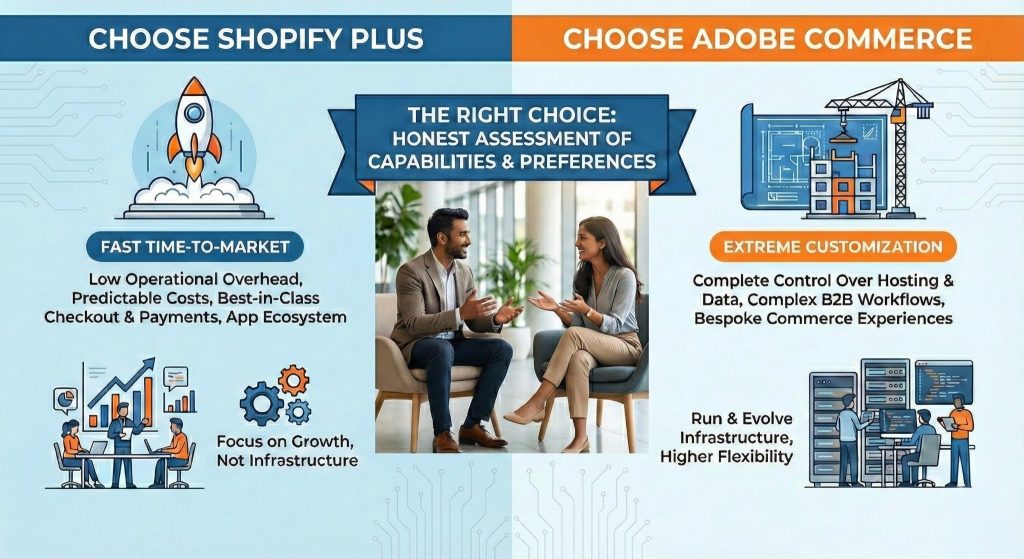
Choose Shopify Plus if you want fast time-to-market, low operational overhead, predictable costs, best-in-class commerce primitives for checkout and payments, and an ecosystem of apps solving common problems. It’s ideal when your team prefers focusing on growth rather than infrastructure.
Choose Adobe Commerce if you require extreme customization of business logic, complete control over hosting and data architecture, complex B2B workflows out of the box, or bespoke commerce experiences that can’t be achieved through standard integration patterns. It’s for teams that can run and evolve infrastructure while accepting higher operational costs for greater flexibility.
The right choice depends less on feature checklists and more on honest assessment of your technical capabilities, business requirements, and operational preferences. Both platforms power billion-dollar businesses successfully. The question is which philosophy matches how your organization actually works.
Choose the platform that amplifies your strengths rather than exposing your weaknesses. That’s how you turn a technology decision into a competitive advantage.