
Shopify has introduced Agentic Storefronts, a groundbreaking feature that enables brands, including luxury labels to sell directly within AI chat platforms like ChatGPT, Perplexity, and Microsoft Copilot. By transforming AI assistants into shoppable storefronts connected to Shopify’s checkout system, the company is positioning itself at the forefront of what industry analysts predict could become a $100+ billion opportunity in the U.S. alone by 2030.
How Agentic Storefronts Work
Agentic Storefronts syndicate a brand’s Shopify catalog directly into AI conversations. When shoppers ask an AI assistant for product recommendations, the agent accesses live product data, including availability, pricing and can complete purchases without the customer leaving the chat interface.
Rather than requiring brands to build custom integrations with each AI platform, Shopify merchants can activate individual AI channels from a centralized dashboard. This matters considerably given Shopify’s scale: merchants processed approximately $292 billion in gross merchandise volume (GMV) in 2024, crossing $1 trillion in cumulative platform GMV. Even a modest shift of orders into AI-native channels could represent tens of billions in annual volume.
Key Features and Brand Controls
The platform offers brands unified control over their AI presence through three core capabilities:
Platform management: Brands can enable or disable AI platforms,such as ChatGPT, Perplexity, or Microsoft Copilot from a single dashboard, critical as AI-enabled retail software is projected to exceed $100 billion globally by the early 2030s.
Real-time synchronization: Product data, pricing, and availability sync automatically from Shopify catalogs, ensuring AI agents work with current information when recommending or selling items.
Brand narrative control: Merchants can centrally manage policy, FAQ, and narrative content to influence how AI describes their brand, handles customer service questions, and maintains brand voice increasingly important as nearly half of online shoppers are expected to use AI shopping agents by 2030.
Strategic Implications for Luxury Brands
The stakes are particularly high for luxury commerce. The global luxury e-commerce market is estimated at $80-90 billion in 2025, with projections reaching $170-300+ billion over the next decade. If AI agents influence even 15-20% of luxury online purchases in line with broader e-commerce projections, that translates to tens of billions of dollars in luxury GMV being algorithmically mediated—making control over brand representation in AI systems strategically critical.
Shopify has already demonstrated it can support the complex requirements of luxury brands, including international pricing, multi-region architecture, and elevated user experiences for high-end fashion and lifestyle labels. Agentic Storefronts extend this capability, allowing luxury brands to meet affluent customers in AI-first shopping journeys without rebuilding their technology stack.
The Scale of Agentic Commerce
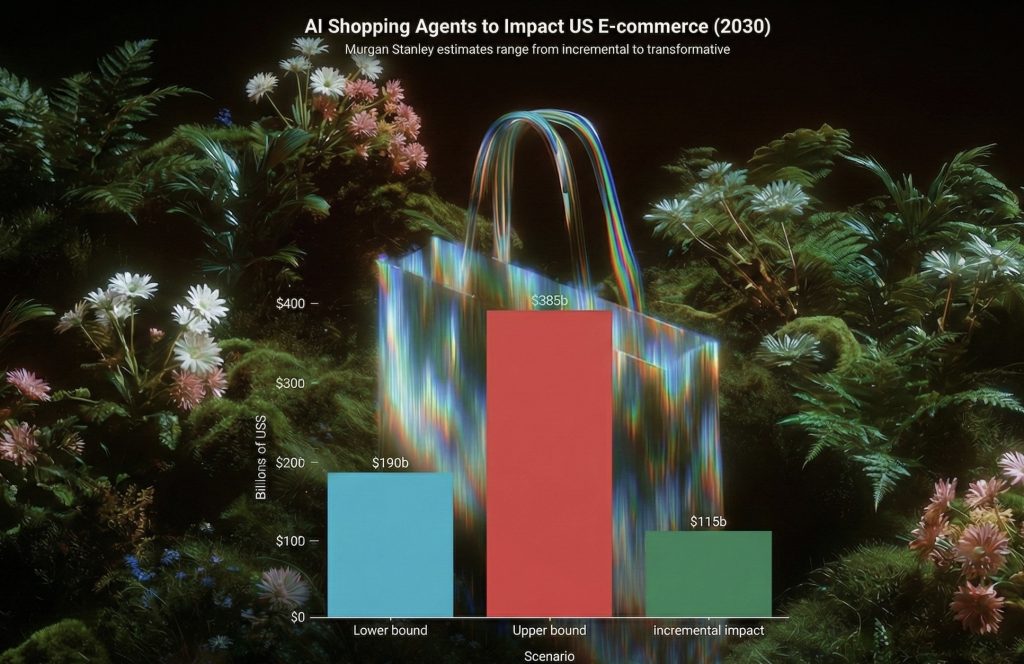
Morgan Stanley scenarios project that by 2030, AI shopping agents could mediate between $190 billion (lower bound) and $385 billion (upper bound) of annual U.S. eCommerce spending, with separate analyses suggesting $115 billion in additional incremental volume beyond baseline projections.
Emerging markets present equally compelling opportunities. In India, where the luxury goods market is projected to grow from $10 billion in 2024 to $18 billion by 2033, conservative estimates suggest AI agents could influence $55-75 billion in overall eCommerce GMV by 2030, with several billion dollars specifically in luxury and premium categories.
The Middle East shows even more aggressive adoption potential, with AI agents expected to influence 20-25% of eCommerce GMV in leading markets—translating to roughly $17-21 billion annually—driven by national AI strategies and mobile-first shopping behaviors in Gulf markets that rank among the fastest-growing luxury destinations globally.
Conclusion
Agentic Storefronts represents Shopify’s strategic bet on a fundamental shift in how consumers discover and purchase products. As AI assistants increasingly mediate shopping decisions, the ability to seamlessly integrate commerce into conversational interfaces moves from competitive advantage to competitive necessity. For luxury brands in particular, maintaining control over how their products are presented and sold in these AI-native environments will be essential to preserving brand equity while capturing growth in what promises to be one of the most significant transformations in retail since the advent of e-commerce itself. By democratizing access to this technology through a unified platform, Shopify is positioning both itself and its merchants to capture meaningful share of what could become a multi-hundred-billion-dollar global market within the next five years.