
Executive Summary
The competitive landscape for digital experience has fundamentally shifted. Organizations leveraging AI-driven design workflows report 3.7x ROI on every dollar invested, with 66% documenting $500-$2,000 in monthly savings per employee. Market leaders like JPMorgan Chase have reduced UI production time by 85%, while CarMax compressed 11 years of design work into 4 months. For Chief Experience Officers, the strategic imperative is clear: master prompt engineering or cede ground to competitors who already have. This isn’t about automating designers, it’s about scaling design intelligence to deliver hyper-personalized interfaces at enterprise scale.
From Experimentation to Industrial-Grade AI Design
The question facing CXOs in 2026 is no longer “Can AI design?” but “How fast can we scale our design intelligence?” The transition from experimental generative UI to industrial-grade agentic UI represents the defining competitive advantage of this decade.
As AI’s time horizon has accelerated, doubling every 4 months compared to every 7 months previously, interfaces have evolved from static assets into living, context aware layers that assemble themselves in real-time based on user intent.
The End of Traditional Design Bottlenecks
For years, design velocity constrained product innovation. High-fidelity prototypes required weeks; A/B testing stretched into months. Today, prompt engineering has matured from experimental hack into sophisticated discipline, enabling design teams to bypass traditional wireframing entirely.
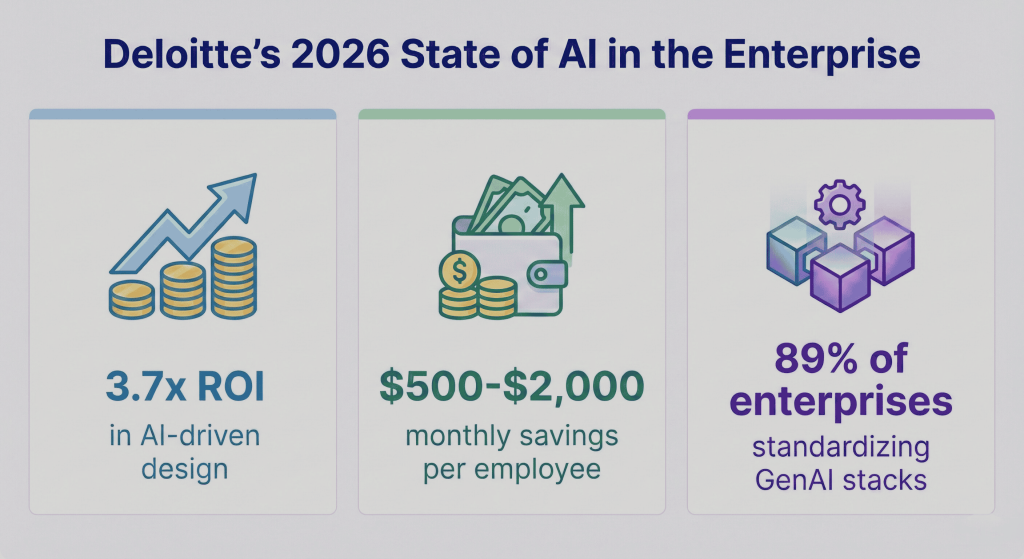
According to Deloitte’s 2026 State of AI in the Enterprise, organizations with deeply integrated AI design workflows achieve measurable competitive advantages:
- 3.7x ROI for every dollar invested in AI-driven design
- 66% of organizations document $500-$2,000 monthly savings per employee
- 89% of enterprises now standardizing around unified GenAI stacks
Why Design Teams Must Master Prompting
Prompting in 2026 transcends “make it pretty” requests. Modern practice centers on multi-modal intent—simultaneously orchestrating text, image, code, and behavioral data.
The New Design Capabilities
Predictive UI: Generate interfaces that adapt to users’ emotional states and cognitive load through context-aware prompting.
Systemic Consistency: Automate adherence to complex Enterprise Design Systems across 1,000+ screens in seconds, eliminating manual design debt.
The Strategic Framework: The Prompting Stack
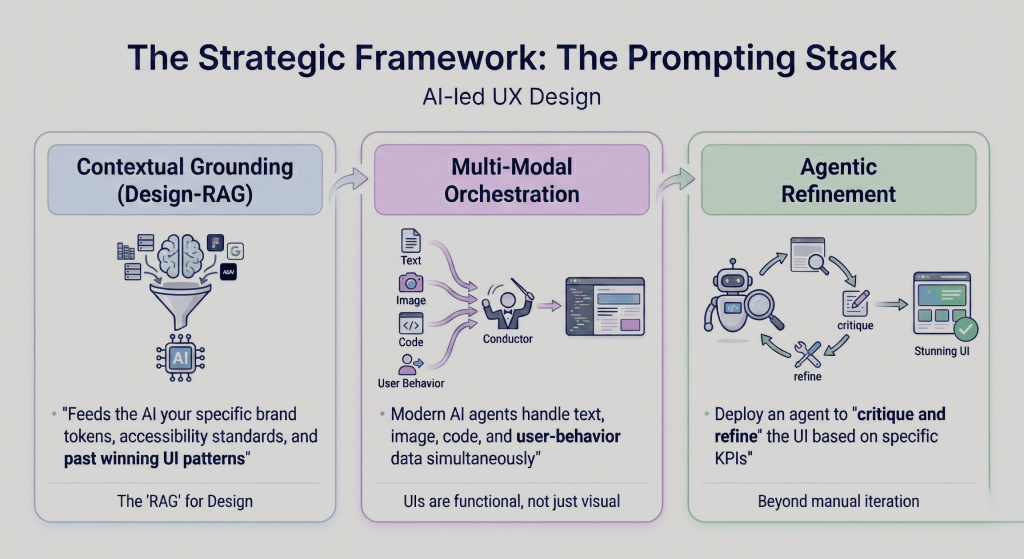
Achieving brand aligned, high-performing UIs requires moving beyond simple zero-shot prompting. The current industry standard employs a three-tier architectural approach:
Contextual Grounding (Design-RAG)
Just as large language models use Retrieval-Augmented Generation to pull factual information, 2026 design prompts use Design-RAG to feed AI your specific brand tokens, accessibility standards, and proven UI patterns.
CXO Insight: You’re not just using public models—you’re grounding AI in your company’s intellectual property and design legacy.
Multi-Modal Orchestration
Modern UIs blend visual, functional, and interactive elements. A “stunning” interface in 2026 includes React/Next.js code, microcopy, and interaction logic, all from a single prompt.
Example: Ingest a whiteboard sketch and output a fully functional, responsive dashboard meeting WCAG 3.0 accessibility standards.
Agentic Refinement
The most significant shift involves deploying AI agents to critique and refine UIs based on specific KPIs—for instance, “Increase conversion by 4% while maintaining minimalist aesthetic,” rather than manual designer iteration.
Real-World Impact at Scale
Early adopters are realizing substantial competitive advantages:
| Company | Initiative | Outcome |
|---|---|---|
| JPMorgan Chase | AI-driven Dashboard Synthesis | Reduced UI production time for internal tools by 85% |
| CarMax | Generative Content & UI | Completed 11 years of manual work in 4 months |
| Walmart | AI-optimized Supply Chain UI | Saved $75M deploying real-time adaptive interfaces |
Source: PwC 2026 AI Business Predictions / IDC CEO Research
Ensuring Brand Integrity and Trust
As a CXO, your primary concerns with AI-generated UI likely center on brand dilution or hallucination, where AI generates impossible or broken components. The solution: Human-in-the-loop (HITL) governance.
The Governance Layer
Experience-Led Oversight: Senior designers transition from creators to curators and policy setters, elevating their strategic impact.
Audit Trails: Every AI-generated component must be traceable to its originating prompt and design system version.
Safety Guardrails: Implement adversarial prompting to ensure UIs cannot be manipulated into displaying inappropriate content or leaking data.
Implementation: Transitioning to Prompt-First Design
Adopting a prompt-first design culture requires more than new tools, it demands fundamental shifts in talent strategy and organizational structure.
Three Critical Steps
Standardize the Stack: Move beyond fragmented pilots. 89% of enterprises now standardize around unified GenAI stacks to escape “Pilot Purgatory.”
Up-skill for Logic, Not Just Aesthetics: 2026 designers need computational thinking and systemic logic alongside visual excellence.
Deploy AI Studios: Create centralized hubs providing reusable prompt templates and agent blueprints across the organization.
Intent-Driven UI as Competitive Advantage
In 2026, the most stunning UIs aren’t those that look best, they’re the ones that work best for individual users in specific micro-moments. Prompt engineering enables brands to achieve hyper-personalization at previously impossible scale.
The competitive advantage has fundamentally shifted: from who employs the best designers to who orchestrates the best AI design ecosystem. For CXOs, the mandate is clear, invest in prompt engineering capabilities now, or watch competitors capture the experience-driven growth that defines the next decade.
You may also like