
Executive Summary
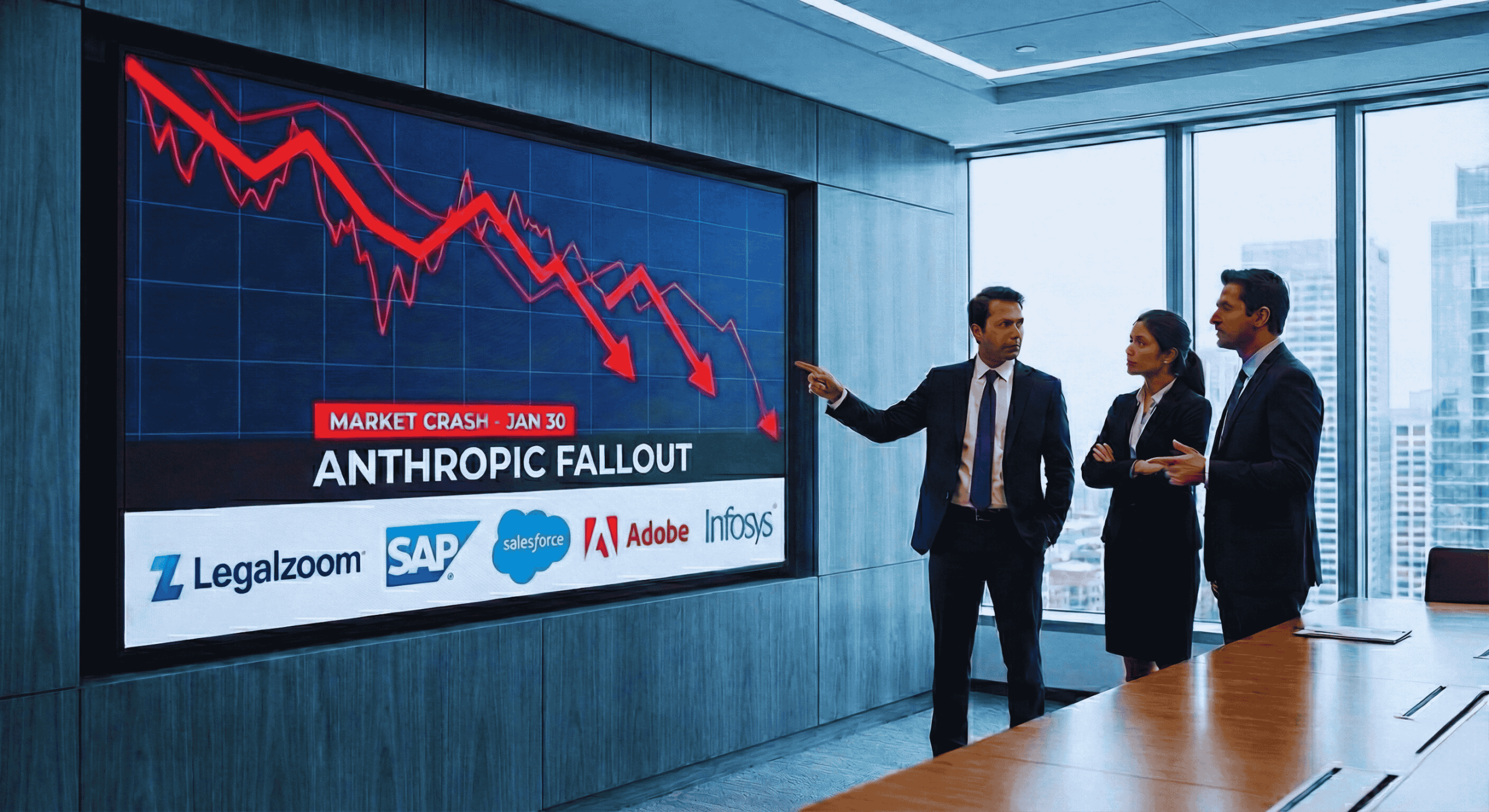
On January 30, 2026, the software industry experienced a stunning $285 billion market crash dubbed the “SaaSpocalypse” after Anthropic launched 11 open-source plugins for Claude Cowork. While investors panicked, eCommerce operators should celebrate: agentic AI is eliminating the expensive manual labor that connects fragmented software tools, shifting the industry from seat-based subscriptions to outcome based compute. This means faster operations, lower costs, and the end of tedious data entry work.
The Day Wall Street Panicked
Friday, January 30, 2026, delivered a seismic shock to the technology sector. Roughly $285 billion in market capitalization vanished from major software-as-a-service (SaaS) and legal-tech companies in a single trading session, according to market analysts who immediately coined the term “SaaSpocalypse.”
The trigger wasn’t a failed earnings report or macroeconomic turbulence. It was a product launch. Anthropic released a suite of 11 open source plugins for Claude Cowork, their new “agentic” assistant designed to run locally on macOS.
Wall Street’s panic was justified. Investors realized that the glue holding the modern enterprise software stack together, endless seats, subscriptions, and disconnected tools, was about to be dissolved by AI agents capable of executing work autonomously.
But while investors fled, smart eCommerce leaders recognized opportunity. The SaaSpocalypse signals the end of fragmented, manual labor intensive online retail management and the beginning of what industry observers are calling “Agentic Commerce.”
From Chatter to Operator: Understanding the Fundamental Shift
Until January 2026, generative AI functioned primarily as a “chatter.” Merchants would open a browser based chat window, paste product specifications, request an SEO optimized description, and receive a draft. Helpful, but passive. Users still had to copy that draft, log into Shopify or Magento, paste it into the correct field, format it, and save it manually. The AI acted as consultant while humans performed the labor.
Claude Cowork represents a categorical shift to “operator” mode. Unlike browser based chatbots, it runs locally on user machines with “filesystem agency,” meaning it can read, edit, move, and create files in designated folders when given permission.
Combined with plugins that authenticate into third party services, the AI no longer just advises, it executes complex, multi-step workflows that previously required humans to toggle between three or four different SaaS applications.
The eCommerce “Glue” Problem
Modern eCommerce operations are exercises in managing fragmentation. The average mid-sized merchant juggles a precarious stack of disconnected tools:
- Product Information Management (PIM) systems or master spreadsheets
- Raw product image folders on local servers or cloud storage
- Image editing software (Photoshop or web-based resizers) for web optimization
- SEO research tools for keyword analysis
- eCommerce platform backends (Shopify, BigCommerce, WooCommerce)
- Email marketing platforms, CRMs, and inventory management software
The “glue” connecting these systems is human effort. Merchandisers download CSV files, manually clean data, upload to another tool, wait for processing, download results, and re-upload elsewhere. This tedious, error-prone work adds no strategic value but represents expensive labor costs.
This manual friction is precisely why SaaS companies charge premium prices for “seats,” they’re effectively taxing the labor required to operate their tools. The SaaSpocalypse occurred because investors realized agentic AI dissolves this glue entirely.
Agentic Commerce in Action
How does Claude Cowork change daily eCommerce operations? It transforms complex, multi application workflows into single natural language commands.
Use Case 1: Automated Product Launches
Scenario: A merchant receives a seasonal drop containing 500 new SKUs, a messy Excel file with basic specifications and a folder containing 2GB of unoptimized, high-resolution product photos.
The Old Way: A two person team spends a week resizing images individually, writing unique descriptions, cross-referencing spreadsheets, and manually creating product drafts in the eCommerce backend.
The Agentic Way: The eCommerce manager opens Claude Cowork, points it to the project folder, and issues one command:
“Claude, process this vendor drop. For every item in the Excel file, match it to its corresponding image in the ‘Raw Photos’ folder. Use the image processing plugin to resize photos to 1200px web-ready JPGs. Read the specs and generate SEO, friendly titles and brand-voice descriptions. Use the Shopify plugin to create draft products with all data, including price and inventory. Log any unmatched items to my desktop.”
Three hours later, the agent reports completion. 495 products are drafted perfectly in Shopify, ready for final human review. The agent handled file manipulation, creative writing, image editing, and database entry simultaneously.
Use Case 2: Intelligent Returns Management
Customer returns typically require agents to check helpdesk tickets, verify orders in the eCommerce backend, confirm return policy eligibility, generate shipping labels in logistics platforms, and update CRMs.
The Agentic Way: An open-source customer experience plugin allows Claude to monitor support inboxes. When return requests arrive, the agent autonomously:
- Reads the email and identifies order numbers and return reasons
- Queries the Shopify backend to verify return window eligibility
- Generates return labels using shipping plugins (like ShipStation)
- Replies to customers with attached labels and personalized instructions
- Tags tickets as “resolved” in helpdesks and updates customer profiles in CRMs
Human intervention occurs only when requests fall outside standard parameters.
The Economic Shift: From Seats to Compute
The SaaSpocalypse panic stemmed from recognition that the traditional SaaS business model faces existential threat. If an AI agent using open source plugins can perform the tasks of a $300/month specialized tool, why continue paying for subscriptions?
For eCommerce businesses, this represents massive capital and efficiency unlocking. The industry is shifting from bloated seat based pricing, where merchants pay for every human needing tool access, toward outcome based compute. Merchants pay for the AI processing power required to complete jobs (launching 500 products, processing 1,000 returns) regardless of how many applications were involved.
The Road Ahead
The SaaSpocalypse was a devastating day for traditional software investors but marks a liberating turning point for eCommerce operators. The January 30, 2026 launch of Claude Cowork’s plugin ecosystem proved the technology now exists to bridge local files and cloud applications without endless manual labor.
The transition won’t be instantaneous. Security protocols for local file access require robustness, and merchants need to learn “agent management” rather than just software management. But the trajectory is clear: the most successful eCommerce companies won’t be those with the biggest teams doing manual data entry. They’ll be those who best utilize agentic AI to operate at unprecedented speed and scale.
The operator advantage belongs to those who adapt first.
You may also like