
Why eCommerce Leaders Must View Animation as a Strategic Asset
In eCommerce boardrooms, motion design often gets dismissed as creative department indulgence, the decorative flourish that’s first to go when budgets tighten. But for leaders tracking conversion rates, customer lifetime value, and churn reduction, this dismissal represents a significant strategic blind spot.
In 2026, motion design has matured into something far more valuable than visual polish. It’s become UX infrastructure, the invisible framework that guides users through your interface, reduces decision fatigue, and builds the kind of brand trust that keeps customers returning.
The Psychology Behind Motion: Why Your Brain Notices Movement
Human visual systems evolved to detect movement as a survival mechanism. In digital interfaces, this biological reality translates into a powerful design tool. Motion serves as a visual cue that directs attention and creates spatial understanding.
When transitions between pages happen as jarring “hard cuts,” users experience cognitive friction, their brains must constantly re-orient and rebuild mental maps of the interface. Strategic motion eliminates this friction by showing relationships between elements and states.
Consider what happens when a product “slides” into a cart icon versus simply disappearing and incrementing a counter. The animation creates a spatial mental model, users can mentally track where their purchase went, building confidence in the action they just took.
Progressive disclosure through motion also keeps interfaces clean without sacrificing functionality. Complex information can hide until needed, revealed through purposeful animation that feels natural rather than disorienting.
Motion as a Conversion Engine: The Data
The Nielsen Norman Group’s research demonstrates that well, executed animations improve usability by providing immediate feedback, particularly critical during checkout processes where user confidence directly impacts completion rates.
The numbers tell a compelling story:
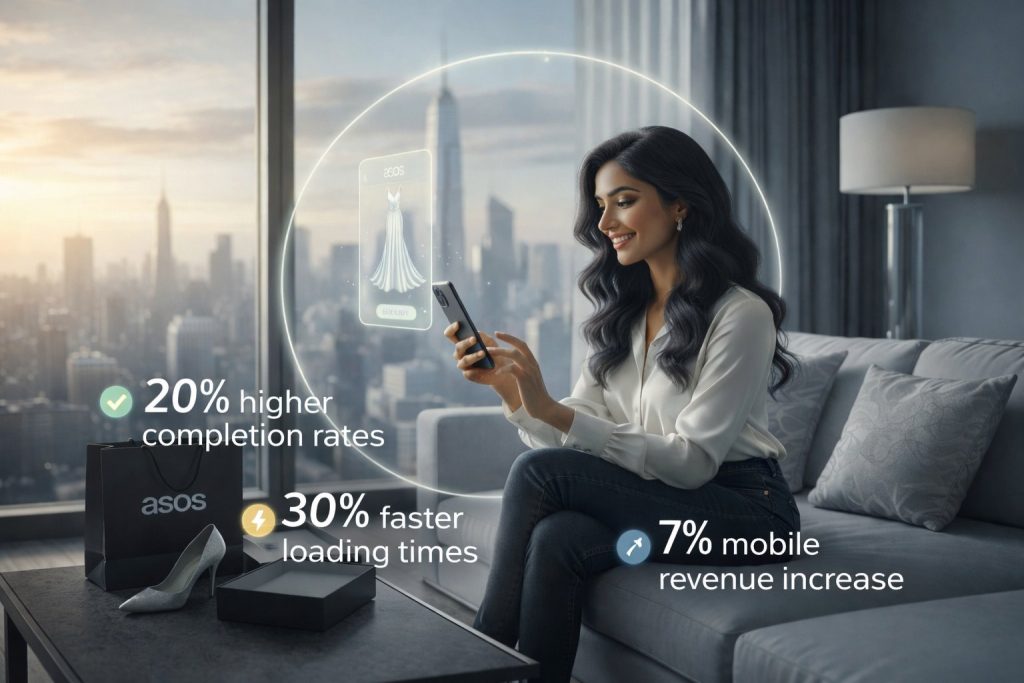
- Brands implementing micro-interactions in complex forms report up to 20% higher completion rates
- Skeleton screens with subtle pulsing animations create perception of 30% faster loading times compared to static spinners, even when actual load times remain identical
- Haptic feedback and motion cues during “Add to Cart” interactions reduce cart abandonment by reinforcing action success and minimizing user second-guessing
These aren’t marginal improvements, they represent substantial revenue impact when applied across thousands or millions of user sessions.
Real Success: When Motion Drives Revenue
ASOS and Shopify exemplify platforms that use motion to bridge physical and digital retail experiences. As Google’s Material Design Guidelines note, motion transforms disconnected static screens into cohesive narratives that users can follow intuitively.
A luxury fashion retailer’s experience illustrates this principle in action. They implemented “predictive motion” in their mobile app, when users hovered or lingered on products, images subtly shifted to reveal secondary angles while “Quick Buy” buttons faded into view. This single change reduced purchase path steps by 15% and delivered a 7% mobile revenue increase within the first quarter.
The mechanics were simple: fewer taps, clearer pathways, and continuous feedback that kept users confident they were moving in the right direction. The revenue impact was anything but simple.
How AI Scales Motion Infrastructure
Historically, implementing motion as systematic infrastructure faced one major barrier: the time and cost of manual animation work. AI has fundamentally changed this equation.
Generative interaction design now allows AI tools to analyze static UI components and suggest optimal motion paths based on eye-tracking data and interaction patterns. What once required weeks of designer iteration can happen in hours.
Dynamic personalization adapts motion to user behavior in real-time. First time visitors might see more pronounced guiding animations that teach interface patterns, while returning power users experience snappier, accelerated transitions that respect their familiarity.
Automated quality assurance represents perhaps the most practical AI contribution. AI-driven testing platforms can “watch” animations across device types and connection speeds, flagging performance issues before motion becomes technical debt that slows your site.
Implementation Strategy: From Decoration to Infrastructure
Treating motion as infrastructure requires fundamental process changes, it can’t be “added at the end” of design cycles.
Start with a motion manifesto. Define your brand’s animation language through specific duration ranges and easing curves. Are you “snappy and energetic” (think 150-200ms transitions with sharp easing) or “fluid and luxurious” (300-400ms with smooth, natural curves)?
Audit friction points in your analytics. Where do users drop off? Where do support tickets cluster? These pain points often signal places where motion infrastructure could reduce confusion and smooth the path forward.
Prioritize performance relentlessly. Infrastructure must be stable. Ensure all animations use hardware acceleration (transform and opacity properties) to avoid jank on mid-range mobile devices where many of your customers shop.
Measure with purpose. Track task completion rates, time-on-task, and error rates before and after motion implementation. These metrics reveal infrastructure impact more accurately than subjective “delight” scores.
The Competitive Reality
Every eCommerce brand now has clean layouts and high resolution photography. Visual design has reached parity. How your interface moves has become the differentiator that separates intuitive experiences from frustrating ones.
Motion design functions as your UX’s nervous system, it communicates state changes, provides continuous feedback, and maintains forward momentum toward conversion goals. Without this infrastructure, you’re not just missing decorative polish; you’re losing customers to competitors who’ve built smoother, more intuitive pathways.
The question isn’t whether motion design matters for your bottom line. The data already answers that. The question is whether you’ll treat it as the strategic infrastructure investment it deserves, or continue to see it as optional decoration while competitors pull ahead.
Key Takeaway: Motion design directly impacts conversion metrics, task completion, and perceived performance. Treating it as infrastructure rather than decoration requires early integration into design processes, performance first implementation, and measurement against business KPIs—not just aesthetic appeal.
You may also like …