
The Evolution of eCommerce Architecture
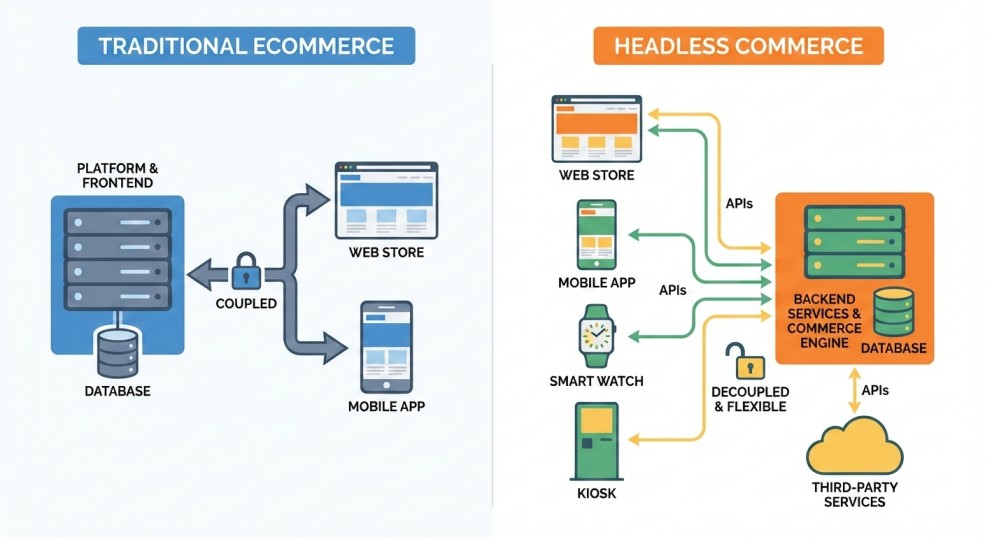
The eCommerce landscape is undergoing a fundamental transformation. For years, businesses relied on monolithic platforms where the frontend presentation layer and backend commerce engine were tightly interwoven—a coupling that made sense in the early days of online retail but has become increasingly restrictive as digital commerce has matured.
Traditional platforms offered simplicity: everything in one place, managed through a single interface. But this convenience came at a cost. Customization meant working within rigid template systems. Performance optimizations were limited by platform constraints. And every design decision had to account for backend limitations that had nothing to do with user experience.
Headless commerce represents a paradigm shift in how we approach eCommerce development, and Shopify Plus has emerged as one of the most compelling platforms to embrace this architecture. By decoupling the frontend from the backend, businesses gain unprecedented control over their customer experience while leveraging enterprise-grade commerce infrastructure without the traditional overhead.
Understanding Headless Commerce
At its core, headless commerce is about separation of concerns. The “head” (frontend) is detached from the “body” (backend), with the two systems communicating exclusively through APIs. This architectural approach fundamentally changes what’s possible in eCommerce development.
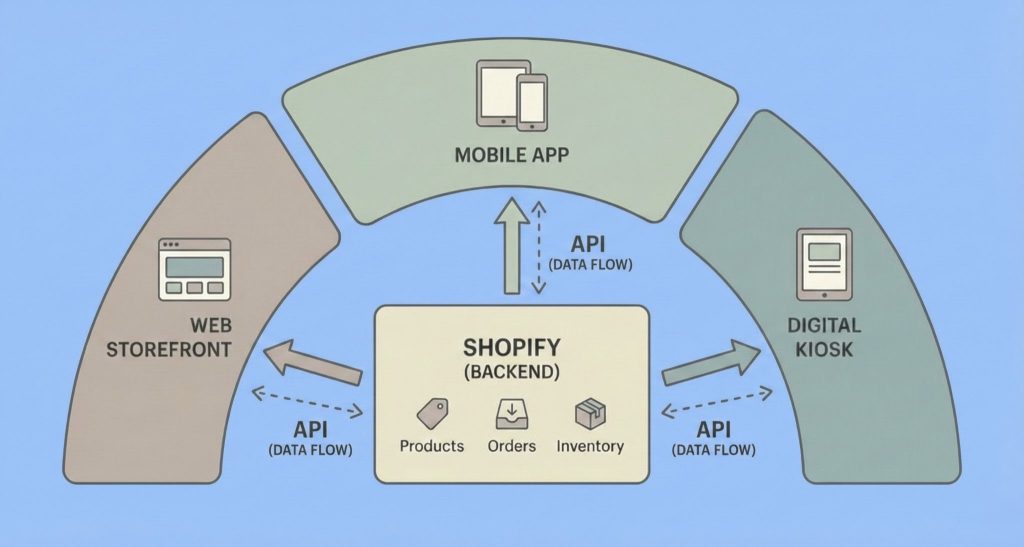
In a headless Shopify implementation, Shopify manages the entire commerce engine, products and variants, inventory tracking, order processing, payment orchestration, discount logic, and customer data management. Meanwhile, developers gain complete autonomy over the frontend: the user interface, experience flows, performance optimization strategies, SEO implementation, and every aspect of how customers interact with the store.
This separation creates a powerful dynamic. The backend can focus entirely on being the best possible commerce platform, while the frontend can prioritize speed, user experience, and brand differentiation without compromise.
Why Shopify Excels as a Headless Platform
Shopify’s transformation from a traditional eCommerce platform to a comprehensive commerce infrastructure provider has been deliberate and strategic. The platform now offers a robust API-first approach that makes headless development not just possible, but genuinely practical.
API Excellence
Shopify’s API ecosystem is remarkably mature. The Storefront API enables developers to build completely custom customer facing experiences, querying product data, managing cart operations, and processing checkouts with fine grained control. The Admin API provides programmatic access to backend operations, enabling custom dashboards, inventory management systems, and workflow automation. Both APIs embrace GraphQL, a query language that allows developers to request exactly the data they need nothing more, nothing less, resulting in faster, more efficient applications.
Real-time webhooks complete the picture, pushing notifications about order updates, inventory changes, and customer actions to external systems instantly. This enables reactive architectures where storefronts can respond to backend changes without constant polling or manual intervention.
The 2048 Variant Milestone
Shopify’s recent expansion of the product variant limit to 2048 per product represents more than a simple number increase, it signals the platform’s commitment to serving complex, enterprise scale use cases. For businesses selling apparel with multiple size, color, fit, and material options, or industrial products with numerous configuration permutations, this expansion removes a significant constraint.
In headless implementations, this capability becomes even more powerful. Traditional theme based storefronts might struggle to present hundreds of variants in a usable interface, but custom frontends can implement sophisticated filtering, visual selection tools, and progressive disclosure patterns that make even the largest variant sets navigable. The variants can be dynamically rendered based on user selections, loaded on demand, and presented in ways that would be impossible within template constraints.
This scalability demonstrates Shopify’s architectural strength the backend is built to handle complexity while allowing the frontend to solve the presentation challenge in whatever way best serves the user.

The Ecosystem Advantage
One of headless Shopify’s most compelling advantages is that you’re not just getting APIs, you’re getting access to Shopify’s entire ecosystem. The platform’s app marketplace includes best-in-class solutions for payments, shipping, tax calculation, promotional engines, subscription management, and countless other specialized functions.
In a traditional custom built eCommerce system, you’d need to build or integrate each of these capabilities yourself. With headless Shopify, you configure these services within Shopify Admin, and they work seamlessly with your custom frontend through the APIs. You get enterprise-grade functionality without enterprise-level development costs.
This ecosystem approach means your frontend developers can focus on what makes your brand unique, the customer experience—while Shopify and its app partners handle the complex commerce operations that don’t differentiate your business but must work flawlessly.
React.js and Next.js: The Frontend Foundation
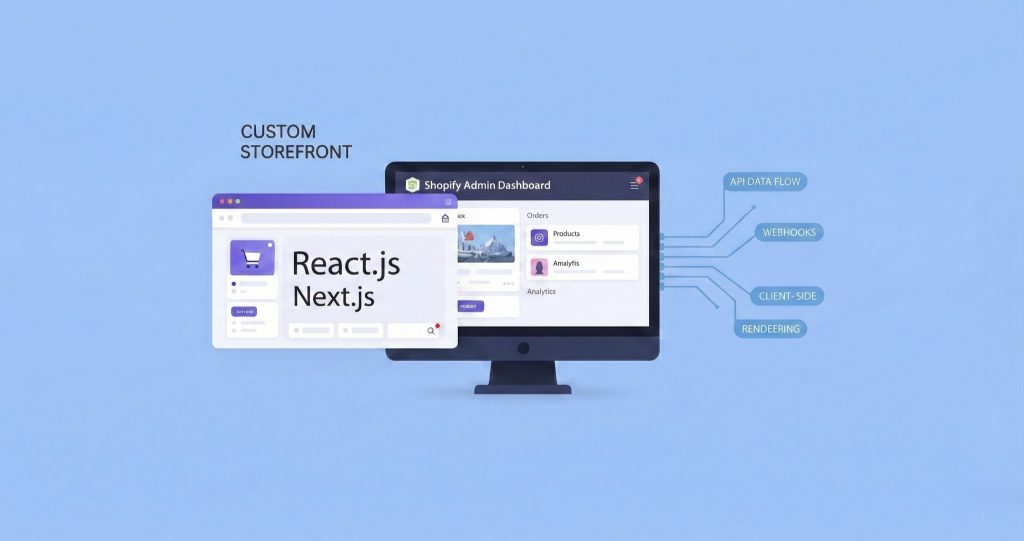
Modern headless Shopify storefronts typically leverage React.js and Next.js, and this combination addresses two critical eCommerce requirements: developer experience and performance.
React.js provides a component based architecture that makes complex UIs manageable and maintainable. Product cards, cart drawers, checkout flows, and account dashboards can be built as reusable components that share state and logic elegantly. For teams building custom storefronts, React’s vast ecosystem and community support accelerate development significantly.
Next.js builds on React by adding crucial eCommerce-specific capabilities. Server side rendering (SSR) ensures that search engines can crawl product pages effectively, solving one of the historic challenges of JavaScript heavy applications. Static site generation (SSG) allows frequently-accessed pages like the homepage or popular product listings to be pre-rendered and served with minimal latency. Incremental static regeneration keeps content fresh without rebuilding the entire site.
These technical capabilities translate directly to business outcomes: better search engine rankings, faster page loads, improved Core Web Vitals scores, and shopping experiences that feel as responsive as native apps. In an era where page speed directly impacts conversion rates, these advantages are substantial.
The Economic Case for Headless Shopify
Beyond the technical benefits, headless Shopify offers compelling economic advantages, particularly for startups and growing businesses that need to optimize resource allocation.
Traditional custom eCommerce development requires substantial backend expertise. You need developers who understand database design, server architecture, security best practices, payment gateway integration, inventory management, and order processing logic. You need infrastructure engineers to handle scaling, monitoring, and uptime. You need security specialists to ensure compliance with payment card industry standards.
With headless Shopify, these requirements largely disappear. Shopify provides secure, scalable infrastructure with guaranteed uptime. The platform handles PCI compliance, database management, and all the operational complexity of running a commerce engine. Your development team can be lean and frontend-focused, reducing payroll costs while potentially accelerating development timelines.
For a startup, this can mean the difference between building a sophisticated eCommerce experience with three frontend developers versus needing a team of eight spanning frontend, backend, DevOps, and security. For growing businesses, it means redirecting resources from infrastructure maintenance to customer experience innovation and growth initiatives.
The Final Though: The Strategic Choice
Headless commerce has moved from experimental to essential. The question for businesses building or rebuilding their eCommerce presence isn’t whether to go headless, but which platform will power their headless architecture.
Shopify’s combination of robust APIs, extensive ecosystem, variant scalability, and infrastructure reliability makes it an exceptionally strong choice. By using Shopify as your commerce backend and React/Next.js as your frontend framework, you gain the speed and agility of a custom-built solution with the reliability and features of an enterprise platform—without the cost and complexity of building and maintaining commerce infrastructure yourself.
Whether you’re launching a new direct-to-consumer brand, modernizing a legacy eCommerce site, or building a complex B2B purchasing portal, headless Shopify provides a foundation that can grow with your ambitions. In today’s competitive eCommerce landscape, that combination of power, flexibility, and efficiency isn’t just advantageous it’s transformative.
You may also like to read