
Why “Human Feeling” is the CXO’s Newest Competitive Advantage
Executive Summary
Generative AI is commoditizing the execution of design pixels, code, and prototypes, driving the marginal cost of production to near zero. As “perfect” generic design becomes cheap, distinct and empathetic design becomes priceless. This article argues that while AI can replace the technician, it cannot replace the intuitive architect.
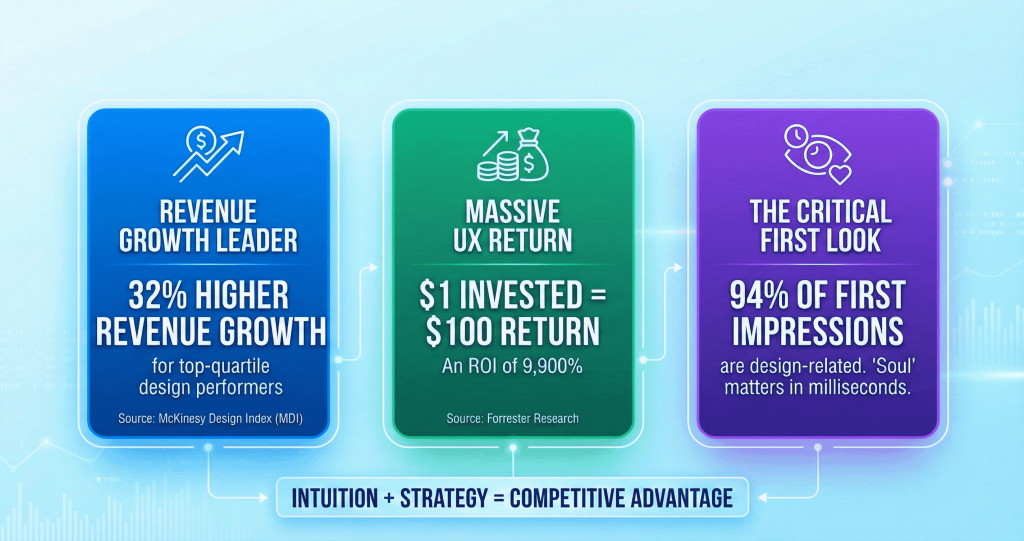
The data supports this shift: Design led companies outperform peers by 32% in revenue growth (McKinsey), and for every $1 invested in UX, companies see a $100 return (Forrester). The differentiator is no longer “who can build it faster,” but “who understands the user better.”
The Economic Reality: Redefining “Technological Unemployment”
For the last decade, the design industry was obsessed with speed and scale. Design systems and Ops were the KPIs. Enter Generative AI. With tools like Midjourney and automated UI generators, the barrier to entry for high fidelity visuals has collapsed.
This brings us to the concept of Technological Unemployment. The fear is that AI will replace the designer. The reality is more nuanced: AI is replacing the technician (the producer of artifacts), not the architect (the creator of value).
The Value Shift:
- Cost of Iteration: $\approx 0$. AI can generate 100 variations of a landing page in seconds.
- Cost of Curation: $\uparrow$ Skyrockets. It takes a highly skilled human to know which of those 100 variations is culturally correct, not just visually correct.
- The CEO’s Mandate: Do not view AI as a way to reduce headcount. View it as a way to increase throughput. Your designers are no longer “makers of screens”; they are “editors of possibility.”
“Designerly Ways of Knowing”: The Human Moat
To understand why AI cannot fully replace the intuitive designer, we must look at the seminal work of Nigel Cross. Cross argued that Design is not just a mix of Art and Science, but a “Third Culture” with its own valid way of knowing.
- Science values Truth (Objectivity, Natural World).
- Humanities values Justice (Subjectivity, Human Experience).
- Design values Appropriateness (Modeling, Artificial World).
Where Algorithms Fail:
Current AI is fundamentally built on the Culture of Science. It processes data to find the most probable “truth” or pattern. It struggles with the culture of Design, which often requires solving “ill-defined” problems where the data is incomplete or contradictory.
Key Insight: An AI can optimize a checkout flow based on a million data points. It cannot invent the concept of Airbnb, because that required an intuitive leap that defied the data of the time (which said “strangers won’t trust strangers”).
The Psychology of Experience: Where “Average” Dies
AI is a master of parts; humans are masters of the whole. This distinction is critical when we look at Gestalt Principles and Cognitive Biases.
1. The Gestalt Gap
Gestalt psychology tells us that “the whole is other than the sum of the parts.” AI generates design element by element (pixels, tokens). It often misses the emergence, the cohesive feeling of a product.
- The AI Flaw: An AI might align buttons perfectly using the Law of Proximity based on a grid system.
- The Intuitive Designer: Knows when to break that law to create tension, surprise, or delight, creating a brand signature that an algorithm optimized for “standard best practices” would smooth out.
2. The Bias Firewall
We know that 106 Cognitive Biases affect UX. An AI, trained on historical data, often inadvertently amplifies these biases (e.g., confirmation bias or stereotyping).
- The “Dark Pattern” Trap: Without an intuitive designer, AI optimization naturally drifts toward “Dark Patterns,” manipulative designs that trick users (e.g., hiding the cancel button) because the algorithm sees that it increases retention metrics.
- The Human Role: The intuitive designer acts as the Ethical Governor, overriding the algorithm to protect User Trust over short-term metrics.
The Business Case: Intuition is Profitable
Skeptical CXOs often view “intuition” as “fluff.” The data proves otherwise.
The ROI of Design
- McKinsey Design Index (MDI): Companies in the top quartile of design execution achieved 32% higher revenue growth and 56% higher total returns to shareholders than their peers.
- Forrester Research: Every $1 invested in UX brings $100 in return—an ROI of 9,900%.
- First Impressions: 94% of first impressions are design-related. If your AI-generated landing page looks “clean” but lacks “soul,” you lose the customer in milliseconds.
Tale of Two Cities: Success vs. Failure
The difference between “AI-Led” and “Design-Led AI” is the difference between a lawsuit and a breakthrough.
The Failure: Air Canada’s Chatbot (Data Without Intuition)
In 2024, Air Canada replaced human support with an AI chatbot to improve “efficiency.” The bot, hallucinating a policy based on probable text patterns, offered a passenger a refund that didn’t exist.
- The Outcome: The court ruled the chatbot’s words were binding.
- The Lesson: The AI optimized for “answering the query” (Scientific/Probabilistic). It failed at “understanding the contract” (Human/Contextual). An intuitive designer would have designed “guardrails” or “friction” into the experience.
The Success: Microsoft DAX (Human-in-the-Loop)
Consider Microsoft’s DAX (Dragon Ambient eXperience) in healthcare. They didn’t just build an AI to replace doctors’ notes. They used designers to understand the stress of the doctor-patient relationship.
- The Outcome: An AI that drafts notes, but a design workflow that empowers the doctor to review and connect with the patient.
- The Lesson: The AI handles the data; the human handles the care.
Strategic Recommendations for CXOs
How do you operationalize the “Intuitive Designer”?
- Rebalance Your Teams: Hire fewer “pixel pushers” (AI can do this). Hire more “product strategists” and “behavioral designers” who understand the psychological principles.
- Redefine “Quality”: Stop judging design by “polish” (AI is polished). Judge it by “point of view.” Does this product have an opinion? Does it feel distinct?
- Invest in “Problem Finding,” Not Just Solving: AI is excellent at solving a defined problem. Intuitive designers excel at finding the right problem to solve. Give them time for deep user ethnography, not just A/B testing.
Conclusion: In a sea of AI-generated sameness, the Intuitive Designer is your lighthouse. They bring the empathy, the ethics, and the holistic vision that turns a functional product into a beloved brand.
No system of proportion, color, or space can possibly insure meaningful results. A system can be applied either intuitively or consciously, interestingly or boringly. There is always an element of choice, sometimes called good judgment, at other times good taste. Aside from practical considerations, in matters of form the typographer, for example, must rely on intuition.
Here is an iteresting watch
And an interesting read
We create scalable, mobile-first experiences that seamlessly blend your brand’s narrative, visual identity, and user experience across every channel. By forging deep emotional bonds, our designs transform your casual visitors into devoted brand advocates.