

Your Monolith Is Costing You Millions (You Just Don’t See It Yet)
Picture this: It’s 2015. Your CIO just signed a seven-figure contract with a major eCommerce vendor. The pitch was seductive, one platform, one throat to choke, one invoice. Everything you need in a single, monolithic package. It felt like the safe play.
Fast forward to 2026. That same “safe” architecture is now the anchor dragging your business to the ocean floor.
Here’s what changed. Your customers stopped living on desktops. They’re now browsing on TikTok, buying through Instagram, asking Alexa to reorder, and expecting the same flawless experience on a smartwatch as they get on a laptop. Your monolithic system, designed for a world where “web” meant a single desktop browser, is now trying to serve fifteen different touchpoints with code so tangled that your developers are terrified to touch it.
The result? Your marketing team launches campaigns that your backend can’t support. Your mobile app feels like an afterthought because it technically is one. And every time someone says “Let’s try something new,” the answer from IT is the same: “That’ll take six months and a quarter million dollars.” This isn’t a theoretical problem. It’s happening right now, and it’s costing you revenue every single day you wait.
This guide strips away the vendor marketing and gives you the brutal truth about migrating from legacy systems to composable architecture, without destroying your SEO, alienating your team, or watching your revenue crater during the transition.
Decoding the Architecture Wars: What These Terms Actually Mean
The industry loves its buzzwords. “Headless,” “composable,” “MACH” these terms get thrown around like confetti at a tech conference. But beneath the jargon lies a fundamental shift in how we think about building digital commerce experiences.
The Monolith: Your Beautiful Prison
Legacy platforms like SAP Hybris, Oracle ATG, or first-generation Magento operate as a single, unified codebase. Everything, your storefront design, your product catalogue, your checkout flow, your inventory logic, lives in one massive application where every piece depends on every other piece.
This architecture made sense when “eCommerce” meant a single website. The problem? That code fusion that once felt comprehensive now feels suffocating. Want to change a button color for an A/B test? You might need to redeploy the entire application, triggering a full regression test cycle that takes weeks. Your developers aren’t being difficult when they say “no” to seemingly simple requests, they’re genuinely afraid that touching one line of code might break checkout for customers across the entire platform.
This is what technical debt looks like in practice: a system so interconnected and fragile that innovation becomes impossible.
Headless Commerce: Breaking the First Chain
Headless architecture was the industry’s first rebellion against monolithic rigidity. The concept is elegant; detach the presentation layer (what customers see) from the commerce logic (how transactions actually work).
In practical terms, your backend becomes a service that delivers raw data, product information, prices, inventory levels, through APIs to any frontend you build. Want a React website? Connect it to the API. Building a mobile app? Same API. Testing a voice interface? Still the same API.
This solved the frontend bottleneck. Marketing teams could finally iterate on user experience without waiting for backend developers to finish their sprint cycles. But here’s the catch that vendors don’t advertise; headless architecture only addresses half the problem. Your frontend might be liberated, but if your backend is still a monolithic mess, you’ve just moved the bottleneck deeper into your stack.
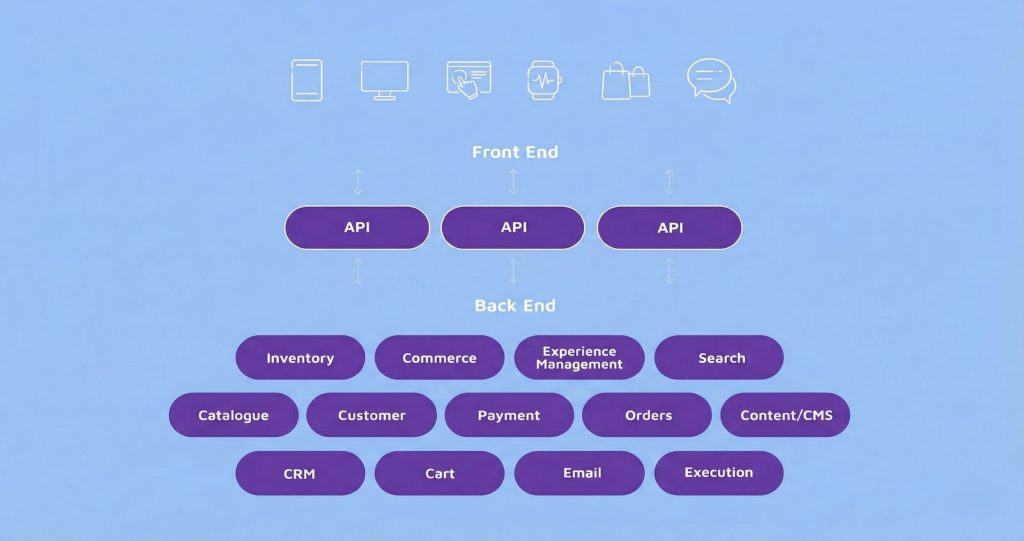
Composable Commerce: The Complete Decoupling
Composable architecture takes the headless philosophy and applies it systemically. Instead of decoupling just the frontend, you decompose the entire backend into independent, specialized services.
The framework that defines this approach is MACH (Microservices, API-first, Cloud-native, Headless). But frameworks don’t matter if you can’t visualize what this actually looks like in practice.
Think of it this way; your shopping cart becomes a standalone service. So does search. So does pricing, inventory, and checkout. Each service does exactly one thing, does it exceptionally well, and communicates with other services through APIs. If your search service crashes, your checkout still processes. If you want to upgrade your payment processor, you swap out that one service without touching anything else.
The analogy that actually works? Lego bricks. You select the best search engine (Algolia, for instance), the best content management system (Contentful, perhaps), and the best commerce engine (Shopify Plus or Magento) and snap them together. Two years from now, when a better search solution emerges, you swap that single brick. You don’t demolish the entire structure.
This is fundamentally different from the vendor lock-in you’re living with now.
The Real Business Case (That Finance Will Actually Approve)
CFOs hear “replat forming” and think “burning money in the parking lot.” Historically, they’ve been right. eCommerce migrations were capital destruction exercises, multi-year death marches costing millions with breakeven points somewhere beyond the planning horizon.
Composable commerce changes the economics entirely. The value proposition shifts from “infrastructure replacement” to “revenue acceleration.” Let me show you how the math actually works.
Agentic Readiness: Why AI Agents Can’t Read Your Monolith
Here’s the question that should be keeping you up at night: What happens when your customers stop shopping and start sending agents to shop for them? It’s already happening. ChatGPT can book your travel. AI assistants can order your groceries. As per a recent Mckinsey’s report By 2030, we’re looking at $3 trillion flowing through these agentic systems globally. And here’s the brutal reality: those AI agents can’t access your monolithic platform.
Your monolith is a black box designed for human web browsers, not machine clients. There’s no clean API layer for an AI agent to query your product catalogue, check real-time inventory, compare pricing, or execute a purchase. The agent can’t “see” your offerings because there’s no standardized endpoint to access them.
Composable architecture makes you discoverable and transactable in the AI economy.
Every microservice speaks through well-documented APIs. An AI agent can interact with your commerce platform exactly as easily as it interacts with any other web service, seamlessly and at machine speed. When the next generation of AI interfaces emerges, your composable stack will be ready because it’s fundamentally designed to serve any client through standardized interfaces.
The brands that win the agentic commerce era won’t be the ones with the prettiest website. They’ll be the ones whose systems can be discovered, queried, and transacted with by artificial intelligence. If your architecture can’t speak the language of APIs, you’re building a storefront in a city that AI agents can’t even map.
Speed to Market: Quantifying the Cost of “No”
In monolithic environments, the deployment queue is where revenue goes to die. Your marketing team wants to test a new checkout flow for the holiday season. Simple request, right? Except in a coupled architecture, changing the checkout UI risks breaking the payment processing logic, which might break the inventory system, which could corrupt customer data. So that “simple” change requires a full regression test of the entire platform, scheduled for the next deployment window, which happens to be three weeks away, after the holiday season is over.
Composable architecture eliminates this bottleneck through independent deployment. Marketing launches campaigns through the headless CMS without touching the commerce engine. Developers push cart improvements without redeploying the catalogue service. The payment team upgrades processors without involving the frontend squad.
The metrics here aren’t abstract. Enterprises moving to composable architectures report 30-50% increases in developer velocity. But velocity isn’t the real story, the real story is the competitive advantage of being able to respond to market opportunities in days instead of quarters. When your competitor takes six months to launch a feature you shipped in two weeks, you don’t just win that sale, you fundamentally alter customer expectations in your category.
The Hidden Costs Your TCO Calculation Ignores
On paper, composable looks more expensive. Instead of one invoice from SAP or Oracle, you’re suddenly managing contracts for a commerce engine, CMS, search provider, payment gateway, and tax service. Your procurement team sees five line items where they used to see one and assumes costs have multiplied. This is where legacy vendors win deals, by hiding their true cost structure.
Let’s talk about what you’re actually paying for with your monolith. You’re paying for peak capacity year-round even though you only need it for Black Friday. You’re paying for features you’ll never use because you can’t unbundle the suite. You’re paying for “version upgrades” every 18-24 months that freeze innovation for months and cost hundreds of thousands in implementation fees. You’re paying for on-premise or managed hosting at costs that cloud-native SaaS solutions have made obsolete.
Most importantly, you’re paying with opportunity cost. Every feature you can’t launch, every market you can’t enter, every customer experience you can’t deliver because your platform won’t support it, that’s revenue you’re leaving on the table.
Composable shifts you from irregular, massive capital expenditures to predictable operational expenses based on actual usage. Your infrastructure auto-scales for Black Friday and scales back down in January. You pay for what you use, not what you might need. Updates happen automatically without breaking your store. And when you outgrow a service, you replace just that service, not your entire platform.

Yes, you will have more invoices. But you trade ‘Vendor Lock-in’ for ‘Vendor Leverage.’ When your search provider tries to double their price at renewal, you don’t have to replatform—you just swap the search ‘brick.’ You regain negotiating power because no single vendor owns your entire business anymore.
The financial model transforms from “replace everything every five years” to “evolve continuously forever.”
The Omnichannel Reality Check
Your monolith was designed for desktop web. Everything else, mobile apps, social commerce, in-store kiosks, IoT devices, was bolted on later as an afterthought, often requiring duplicate databases and fragile middleware connectors.
This creates the nightmare scenario that retail executives know too well; a customer sees “in stock” on your mobile app, drives to the store, and finds the item unavailable. Or inventory shows available for buy-online-pick-up-in-store, but the store system can’t see it. These aren’t edge cases, they’re daily occurrences caused by systems that were never designed to maintain a single source of truth across channels.
Composable architecture is inherently channel-agnostic. Your commerce engine doesn’t care whether it’s serving data to a website, an app, a voice assistant, or a smart refrigerator. A central product information management system and order management system feed data through APIs to every touchpoint simultaneously.
Want to sell through a new channel? You don’t need a new platform or a “connector.” You build a lightweight interface for that channel and plug it into your existing API layer. The backend already speaks the same language.
The Essential Components: What You’re Actually Building
If composable architecture is “Lego bricks,” which specific bricks do you need? Unlike monoliths where the vendor dictates every component, here you act as the architect. You select best-of-breed solutions for specific functions.
While every stack is unique, enterprise composable commerce typically consists of four critical layers that work in concert.
The Commerce Engine serves as the transactional heart. Unlike a monolith, this engine doesn’t handle your blog, your frontend templates, or your marketing campaigns. It focuses exclusively on the Shopify Plus commerce mechanics, cart management, checkout processing, order routing, complex pricing rules, and promotion logic. Solutions like Magento (Adobe Commerce in headless mode, or Elastic Path can process thousands of transactions per second without choking because they’re optimized for exactly one job: making the “buy” button work flawlessly.
The Headless CMS becomes your content voice.
In the monolithic era, commerce platforms had terrible content tools, and CMS platforms had terrible cart functionality. Composable architecture solves this by letting you use a dedicated headless CMS for everything content-related, product descriptions, blog posts, landing pages, legal text, and visual assets. Modern solutions like Contentful, Sanity, or Strapi now include visual editors that let marketing teams drag and drop components without writing code, eliminating the old bottleneck where marketers needed developers for every text change.
Search and Discovery acts as the customer guide.
For catalogues with more than a few hundred products, the default search functionality in legacy platforms is demonstrably inadequate. Composable stacks offload search to dedicated, AI-powered engines that handle autocomplete, typo tolerance, faceted filtering (size, color, price range), and behavioural personalization. Services like Algolia, Klevu, or Bloomreach return results in milliseconds compared to the multi-second database queries of monolithic systems. Since search is often the highest converting navigation path, this single optimization can deliver measurable lift to your conversion rate.
The Frontend is what customers actually experience.
Because it’s decoupled, your storefront becomes a standalone application that communicates with backend services through APIs. You face a critical build-versus-buy decision here. Custom building with frameworks like React, Vue.js, or Next.js offers total creative freedom but requires a skilled engineering team for ongoing maintenance. Alternatively, Frontend-as-a-Service platforms like Vercel or Netlify provide hosting infrastructure, while tools like Vue Storefront or Shogun Frontend offer pre-built Progressive Web App components that accelerate development. The performance impact is substantial, well optimized headless frontends load instantly even on slow mobile networks, easily passing Core Web Vitals assessments that legacy monoliths consistently fail.
The magic happens in how these components communicate. When a user loads a product page, the frontend simultaneously calls the CMS API for descriptions and images, the commerce engine API for real-time pricing and inventory, and the reviews API for star ratings. To the customer, this appears as a single, unified page. To you as the architect, it’s a symphony of independent services orchestrated through API calls.
The Migration Playbook: How to Execute Without Destroying Your Business
The biggest obstacle to composable adoption isn’t cost or complexity, it’s fear. Specifically, the fear that ripping out your core transaction engine will crash your revenue stream.
This fear is completely rational if you’re planning a “Big Bang” migration, shutting down the legacy system on Friday and flipping the switch to the new architecture on Monday. The industry is littered with cautionary tales of enterprises that lost millions during botched overnight cutovers. The solution isn’t replacing everything at once. It’s strangling the monolith slowly.
The Strangler Fig Pattern: Gradual Replacement in Production
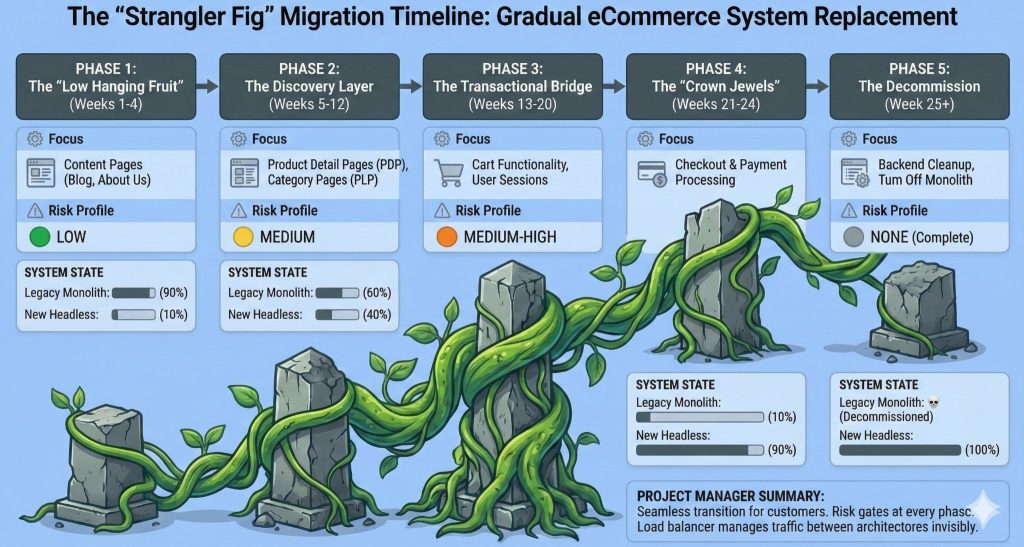
Martin Fowler coined this architectural pattern after observing strangler fig trees, which grow around a host tree and eventually replace it entirely. In eCommerce terms, you build the new composable system around your legacy monolith’s edges, gradually migrating functionality one piece at a time while keeping the lights on.
Here’s how it works in practice. You identify the weakest link in your current system, but you don’t start with checkout, which is far too risky. Instead, you begin with a low-risk, high-impact area like your blog or content pages. You spin up a new headless CMS and modern frontend (Next.js, for example) specifically for those pages. Then you configure your load balancer or CDN to route traffic, users hitting /blog go to the new system while /shop and /checkout still hit the old monolith. To the customer, it’s a seamless experience. They don’t realize they’re navigating between two completely different architectures.
Once the content layer proves stable, you migrate product detail pages. Then category pages. Then cart functionality. Finally, when the entire discovery experience runs on the new stack, you migrate checkout, the crown jewels of your commerce operation. Each phase can take weeks or months, and at every stage, you can pause, validate, and course correct without risk to your core business.
Only after the monolith is doing literally nothing do you decommission it. By that point, it’s not a scary leap into the unknown, it’s the inevitable conclusion of a process you’ve been executing successfully for months.
Synchronizing Data Across Two Worlds
During a strangler migration, your legacy monolith and new micro-services must coexist and share data. If a customer updates their address on the new frontend, the old backend needs to know. If an order processes through the new commerce engine, your legacy ERP still needs to receive it for fulfilment.
This requires implementing a dual-write or event-driven synchronization strategy. You position an orchestration layer, typically an API gateway, between your frontend and backend systems. When an order is placed, the gateway broadcasts that data to both the new order management system and your legacy ERP simultaneously. This ensures your finance and logistics teams can continue using their existing tools while you build the future incrementally.
The synchronization layer isn’t permanent infrastructure, it’s scaffolding you remove once the migration completes. But during the transition period, it’s the mechanism that lets you move fast without breaking things.
Protecting SEO: The Non-Negotiable Technical Requirements
Architecture migrations often involve URL structure changes, from site.com/p/12345 to site.com/products/product-name, for instance. Without rigorous redirect mapping, you risk resetting your hard-won domain authority to zero.
Every legacy URL must map one-to-one to its new destination with proper 301 redirects. No exceptions. But redirects alone won’t save you if search engines can’t crawl your new JavaScript-heavy frontend. Since most composable frontends use React or Vue, you must implement either Server-Side Rendering or Static Site Generation. This is non-negotiable for maintaining search visibility, JavaScript-only rendering effectively makes your entire catalogue invisible to search bots.
Pre-launch, you need to crawl your new site exactly as Google would, identify any gaps in coverage, and fix them before you flip the switch. Post-launch, you monitor search console daily for crawl errors and ranking drops. SEO protection isn’t a one-time checklist, it’s an active process throughout your migration.
The Uncomfortable Truth About Who Actually Succeeds
Not every enterprise should migrate to composable commerce. Let’s be honest about the prerequisites for success.
You need executive sponsorship that goes beyond budget approval. Someone at the C-level must genuinely understand why this matters and be willing to defend the decision when the going gets tough, because it will get tough. You need an engineering team capable of working with APIs, modern JavaScript frameworks, and cloud infrastructure. If your current team only knows legacy PHP or Java monoliths, you’ll need to hire or train. You need stakeholder patience to accept that this is a 12-18 month journey, not a 90-day sprint.
Most critically, you need to be honest about whether your business actually requires this level of architectural sophistication. If you’re running a single-channel business with stable traffic patterns and infrequent changes, a modern monolith might serve you better than a complex microservices architecture. Composable commerce solves specific problems, multi-channel complexity, high change velocity, scale variability, and the need for best-of-breed integrations. If you don’t have those problems, you don’t need this solution.
But if you’re reading this and recognizing your own pain points in every paragraph. if you’re tired of telling stakeholders “no” because your platform can’t keep up, if you’re losing competitive battles because your architecture won’t support what the market demands, if you’re paying more for less every year because you’re locked into a vendor’s depreciation schedule, then you already know this migration isn’t optional.
The only question is whether you start now or wait until the crisis forces your hand.
What Happens Next
The market has already decided. Composable commerce isn’t emerging technology, it’s rapidly becoming table stakes for enterprise digital commerce. Your competitors are either migrating now or planning their migration. The vendors building monolithic platforms are either evolving toward composable architectures or watching their market share erode.
What makes this shift even more critical; the agentic economy. While we are still figuring out how to serve multiple human-facing channels, AI agents are already learning to navigate commerce platforms. The businesses that position themselves in this window, with API-first architectures that both humans and machines can access, will own disproportionate market share in the AI-commerce era.
You have a window to make this transition strategically, on your timeline, with minimal disruption. That window closes a little more every quarter you wait. Eventually, the technical debt compounds to the point where you’re not choosing the best path forward, you’re choosing the least-bad emergency option.
The businesses that thrive over the next decade won’t be the ones with the biggest budgets or the most established brands. They’ll be the ones with architectures flexible enough to adapt to whatever comes next, and visible enough for AI agents to find them. Because in digital commerce, whatever comes next always arrives faster than you expect.
Let’s ThinkNext and PracticeNext
















Pingback: Headless Spectrum: Native Pioneers vs. Adapted Giants I ThinkNext
Pingback: Why Your Website Is No Longer Your Storefront I ThinkNext
Pingback: Gartner Magic Quadrant for Digital Commerce 2024-2025: Critical Analysis - ThinkNext
Pingback: How AI and Composable Commerce Are Disrupting LVMH I PracticeNext
Pingback: Top 10 Tools Transforming eCommerce in 2026 I PracticeNext