

Shopify’s genius is also its greatest risk.
The platform makes launching an online store almost effortless. But that same simplicity can become a trap. Brands that explode on Shopify often discover their tech stack was optimized for launch day, not year three. Apps multiply like weeds, page speeds crawl, data scatters across disconnected tools, and every new feature becomes an engineering nightmare.
Here’s the thing: scaling on Shopify doesn’t mean abandoning it. The platform itself handles growth remarkably well. The problem is usually everything built around it.
This guide will walk you through what a truly scalable Shopify tech stack looks like, the essential layers you need to get right, and real examples from brands that figured it out the hard way so you don’t have to.
What Scalability Actually Means (Hint: It’s Not Just Traffic)
Most people think scalability means handling Black Friday without crashing. That’s part of it, but it’s not the whole story. A scalable Shopify stack lets you:
- Launch new sales channels without rebuilding everything
- Maintain fast performance as your catalog grows from 50 to 5,000 SKUs
- Keep data consistent across every tool in your stack
- Ship changes confidently without breaking existing functionality
- Expand internationally without starting from scratch
Growth should feel like adding another floor to a solid building, not like duct taping extensions onto a house of cards. If every new campaign, integration, or market launch feels harder than the last one, your stack isn’t scaling, it’s buckling.
Shopify Is Your Core, Not Your Entire System
Think of Shopify as the engine, not the entire car. At the center, Shopify handles what it does exceptionally well: product catalogs, checkout, payments, order management, and core APIs. Even massive global brands like Gymshark and Allbirds keep Shopify at their core because checkout and payments are wickedly hard to build from scratch.
The golden rule: don’t rebuild what Shopify already does well. Extend it strategically instead. Around that core, you build several interconnected layers. Each one needs to pull its weight without creating unnecessary complexity.
The Frontend Decision: Traditional vs. Headless
This is where scalability choices start to diverge.
Traditional theme-based setups get you to market faster with lower engineering costs, but they limit your flexibility as you grow. Headless or composable frontends, where Shopify handles commerce logic while you build custom experiences with Next.js, Hydrogen, or similar frameworks, give you far more control over performance and user experience.
When does headless make sense? When you’re dealing with high traffic volumes, complex content needs, multiple international storefronts, or several channels pulling from the same backend. Allbirds moved toward composable architecture precisely for this reason: they needed flexibility in storytelling, performance optimization, and global expansion that themes couldn’t provide.
When doesn’t it make sense? Early-stage brands with small catalogs and limited development resources shouldn’t overcomplicate things. Go headless only when experience velocity becomes a genuine bottleneck, not because it sounds impressive.
The App Layer: Quality Over Quantity
Here’s where most Shopify scalability problems actually live.
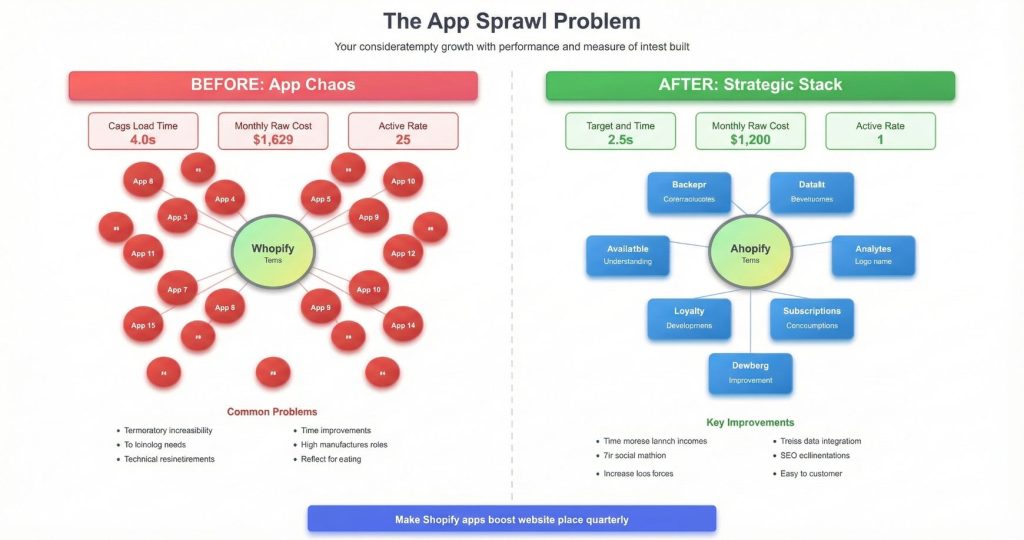
Apps are seductive. There’s an app for everything. Reviews, search, subscriptions, loyalty programs, promotions, bundling, each one promises to solve a specific problem. Before you know it, you’re running 20+ apps, and your site loads like it’s 2005.
At scale, every app should solve one clear problem, integrate cleanly with your data layer, and not duplicate functionality elsewhere in your stack. Multiple apps modifying checkout or cart behavior? That’s a recipe for disaster. Apps injecting heavy scripts on every page? Performance killer. Overlapping analytics tools? Data chaos.
Pattern and several other fast-growing D2C brands hit performance walls not because of Shopify’s limitations, but because their app bloat was suffocating the platform. The fix wasn’t more infrastructure—it was ruthless consolidation and removal.
Make every app earn its place. Quarterly reviews are your friend.
The Data Layer (Where Most Brands Fail)
As you scale, data fragmentation becomes your silent killer.
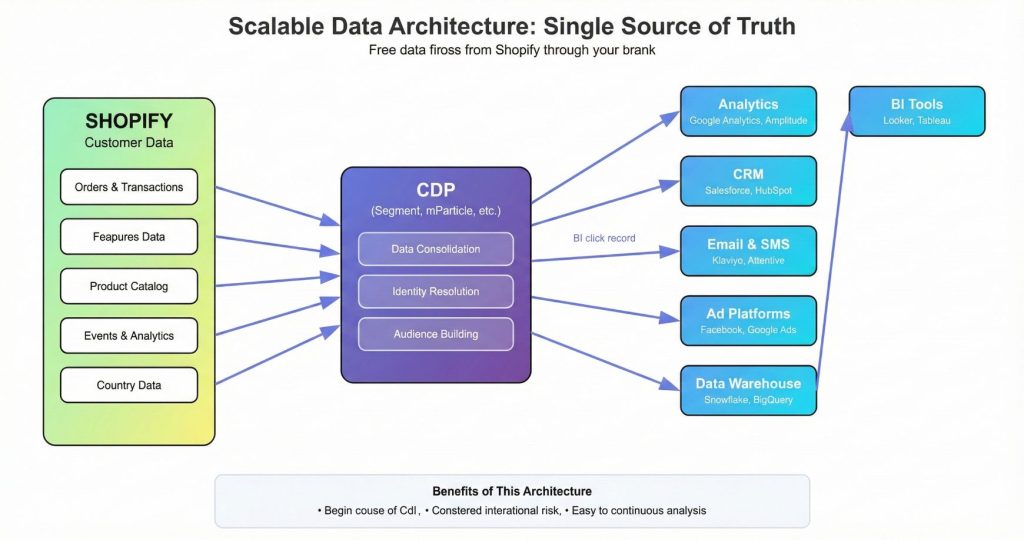
Shopify gives you transactional data, but not a complete picture of your business. Without a proper data architecture, your team will spend more time arguing about which numbers are “real” than making decisions based on them.
A scalable stack typically includes a customer data platform like Segment that sits between Shopify and everything else—your analytics, CRM, ad platforms, and email tools. Add a data warehouse for long-term analysis, and suddenly you have a single source of truth.
Subscription brands figured this out early. They need to understand churn, lifetime value, and cohort behavior metrics Shopify alone can’t fully surface. So they invested in proper data pipelines before they desperately needed them.
Scaling isn’t about collecting more data. It’s about creating shared truth across your organization.
Marketing & Retention: Where Growth Gets Real
Traffic is easy. Retention is hard. And retention is what actually builds a business.
Your marketing and retention stack should support lifecycle messaging, personalization, and cross-channel consistency without requiring an army of people to manage it. Email and SMS platforms, customer segmentation, and automation workflows form the foundation.
What breaks at scale? Over-triggered messages that annoy customers. Channel silos where email says one thing and your site says another. Manual campaign setups that can’t keep pace with growth.
Brooklinen built strong retention not through any single tool, but by aligning site experience, email, and customer support into a cohesive system. Shopify handled transactions; everything else was orchestrated around it. The scalability mindset here is simple: retention systems should reduce manual work as volume increases, not multiply it.
Search & Discovery: The Underrated Conversion Driver
As your catalog grows, discovery becomes a bottleneck. Default Shopify search works fine for 50 products. At 500 products, it starts to crack. At 5,000 products, it’s actively hurting your conversion rate.
Fashion and lifestyle brands with large catalogs often replace default search with more sophisticated solutions early on. Smart search, collection automation, and personalization aren’t nice to haves at scale, they’re table stakes. If users can’t find what they’re looking for quickly, all the traffic in the world won’t matter.
Operations: The Unglamorous Foundation
Operational scalability gets ignored until something breaks catastrophically. Overselling products. Inventory mismatches across channels. Manual reconciliation eating up hours every day.
A scalable stack integrates Shopify with inventory management systems, ERP or accounting tools, and fulfillment providers. Omnichannel retail brands—selling online plus in physical stores, learn this lesson fast. They integrate Shopify with POS, warehouse systems, and accounting from day one because operational debt compounds faster than technical debt.
Operational clarity enables growth without chaos. It’s boring, but it’s essential.
Going Global Without Going Insane
Scaling often means multiple currencies, multiple storefronts, multiple languages, and multiple marketplaces. Shopify supports this surprisingly well, but your surrounding stack needs to keep up.
Do you centralize data or localize it? How do you handle regional performance? What about compliance and tax tools that vary wildly by country?
Many global D2C brands keep one commerce core but customize frontend, pricing, and messaging by region. That flexibility only works if your stack is designed for it from the start.
What Scalable Stacks Avoid
Just as important as what you add is what you avoid:
- Over-customizing checkout when Shopify’s version already converts
- Treating apps as permanent solutions instead of temporary scaffolding
- Ignoring performance budgets until load times become embarrassing
- Building without documentation, creating tribal knowledge silos
- Letting every team independently purchase tools without coordination
Scaling fails when speed today creates drag tomorrow. Every shortcut eventually comes due.
A Simple Decision Framework
Before adding any new tool or integration, ask four questions:
- Does this reduce friction for customers or internal teams?
- Does it integrate cleanly with our existing systems?
- Will this still make sense when we’re 5× bigger?
- Can we remove it easily if it doesn’t work out?
If the answer to that last question is “no,” think very carefully before proceeding.
Final Thought
Shopify scales beautifully. Unplanned stacks don’t.
The most successful Shopify brands keep the platform as their stable core, invest selectively in flexibility where it matters, and ruthlessly eliminate unnecessary complexity. They treat their tech stack as an enabler, not an experimentation playground.
A truly scalable tech stack doesn’t chase every trend. It quietly supports growth, week after week, quarter after quarter, without drama or fire drills.
Build for clarity. Build for change. Build so that scaling feels boring.
Because boring, in this case, means you’re doing it right.
















Pingback: Shopify Plus vs. Adobe Commerce: The Strategic Platform Decision I ThinkNext
Pingback: Top 10 Tools Transforming eCommerce in 2026 I PracticeNext
Pingback: AI-Native Digital Growth System: Unified OS for Enterprise I PracticeNext