
Brand design has always demanded human creativity, intuition, and strategic vision, the ability to craft narratives, evoke emotion, and build lasting recognition. But 2026 marks a fundamental shift in this landscape. Artificial Intelligence has evolved from futuristic concept to active collaborator, functioning as both powerful analytical engine and creative partner in brand building.
This transformation isn’t about AI replacing human designers. It’s about augmentation, enabling brands to achieve unprecedented personalization, consistency, and market responsiveness that human teams alone cannot scale. Forward thinking CMOs, understanding AI’s integration with brand design has moved from optional exploration to survival imperative.
The Data-Driven Genesis of Brand Identity
Traditional brand identity research relied on focus groups, surveys, and competitive analysis. These methods remain valuable, but AI introduces a new dimension: predictive analytics and deep audience insights at scale that reshape how brands understand their audiences.
AI systems can analyze vast datasets, social media sentiment, search queries, competitor performance, even non verbal cues in video reviews to uncover nuanced consumer preferences and emerging aesthetic trends that human researchers might miss. This capability allows creation of brand elements (colors, typography, imagery styles) that resonate authentically with target demographics before those audiences even articulate their preferences.
Geographic and cultural nuance becomes manageable at scale through AI-powered localization tools. These systems analyze cultural contexts to ensure brand elements translate effectively across diverse global markets, avoiding costly missteps while enhancing local relevance.
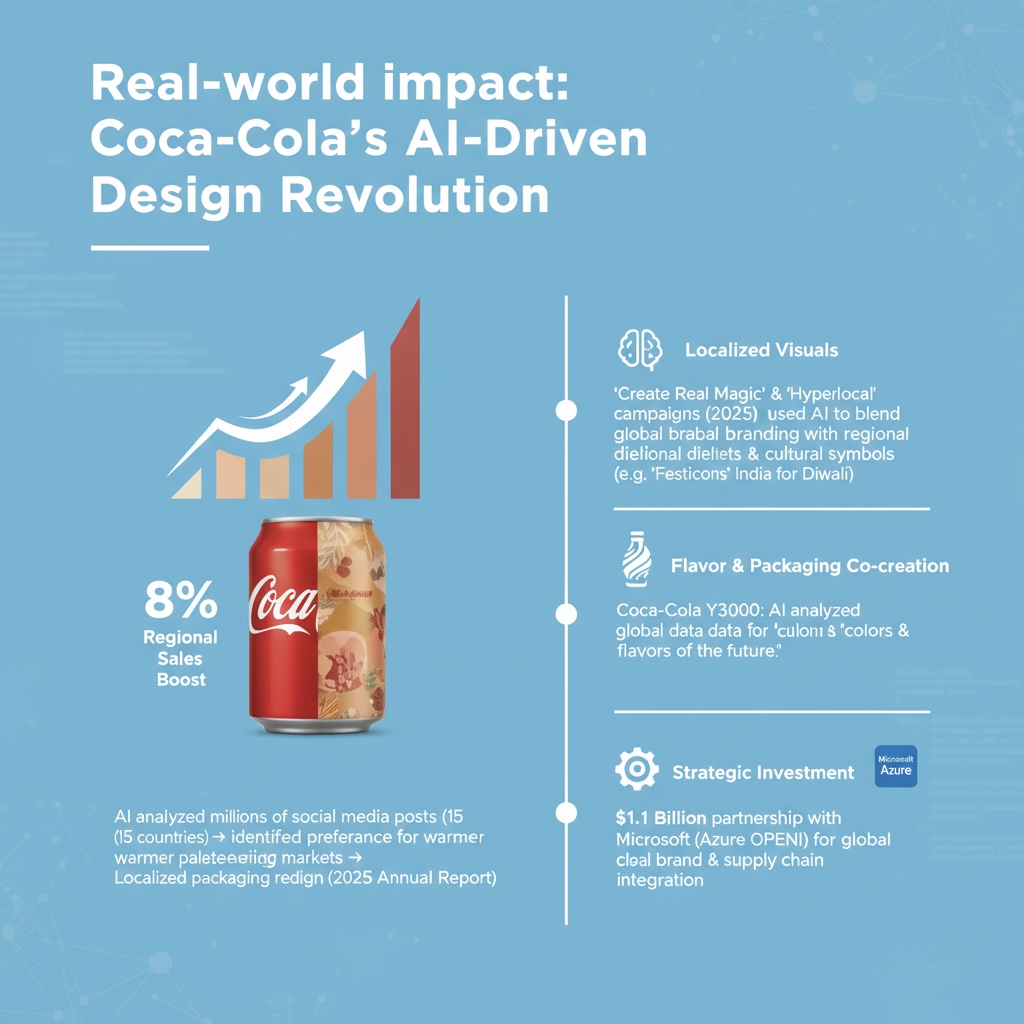
Real-world impact: Coca-Cola utilized AI to analyze millions of social media posts across 15 countries. The analysis identified a subtle but pervasive preference for warmer, more natural color palettes in emerging markets. The resulting localized packaging redesign boosted regional sales by 8%, according to their 2025 annual report, a significant lift driven by data informed design decisions that human analysis alone might have missed or taken months to identify.
Coca-Cola has been a frontrunner in using AI for localized design and consumer sentiment:
- Localized Visuals: Their “Create Real Magic” platform and 2025 “Hyperlocal” campaigns used AI to blend iconic global branding with regional dialects and cultural symbols (like their “Festicons” campaign in India for Diwali).
- Flavor & Packaging co-creation: They launched Coca-Cola Y3000, which was co-created with AI by analyzing global consumer data to identify the “colors and flavors of the future.”
- Strategic Investment: The company recently deepened this commitment with a $1.1 billion partnership with Microsoft to integrate Azure OpenAI across their entire global brand and supply chain infrastructure.
AI as Brand Consistency Enforcer and Scaler
Maintaining brand consistency across countless touch points, website banners, outdoor billboards, social media posts, emails, AR filters, represents a monumental challenge. Inconsistency erodes trust and diminishes brand equity with each deviation. AI has emerged as the ultimate guardian of brand guidelines.
AI vision models can automatically scan and flag guideline deviations in real-time across all digital assets. This ensures correct logo usage, color palettes, typography, and image styles, dramatically reducing manual review time and human error that inevitably creeps into large-scale brand deployments.
For CMOs managing large product portfolios or personalized marketing campaigns, AI can generate thousands of on-brand variations of banners, social media posts, and ad creatives. This enables hyper segmentation without compromising brand integrity, a capability that transforms how brands balance personalization with consistency.
The business case is compelling: studies by Adobe and Forrester indicate that brands maintaining high visual consistency can see 23% higher revenue compared to those with inconsistent branding. AI makes this level of consistency achievable at scale, transforming it from aspirational goal to operational reality.
The New Creative Frontier: AI-Assisted Design
The most exciting, and perhaps most debated aspect of AI in brand design is its role in the creative process itself. AI isn’t replacing creative directors; it’s empowering them with unprecedented tools that amplify human creativity.
Generative design capabilities allow AI to rapidly produce countless logo concepts, visual styles, and imagery based on textual prompts and existing brand parameters. Designers can explore exponentially wider ranges of possibilities in fractions of the time, accelerating ideation phases that traditionally consumed weeks or months.
Real-time personalization reaches new heights through AI. Websites can feature hero images that dynamically adapt based on user browsing history and demographics. AI enables this level of individualized experience while maintaining brand consistency, creating unique yet recognizably on-brand encounters for every visitor. This sophisticated personalization aligns with E-E-A-T principles (Experience, Expertise, Authoritativeness, Trustworthiness) by delivering highly relevant, tailored content that demonstrates deep understanding of audience needs.
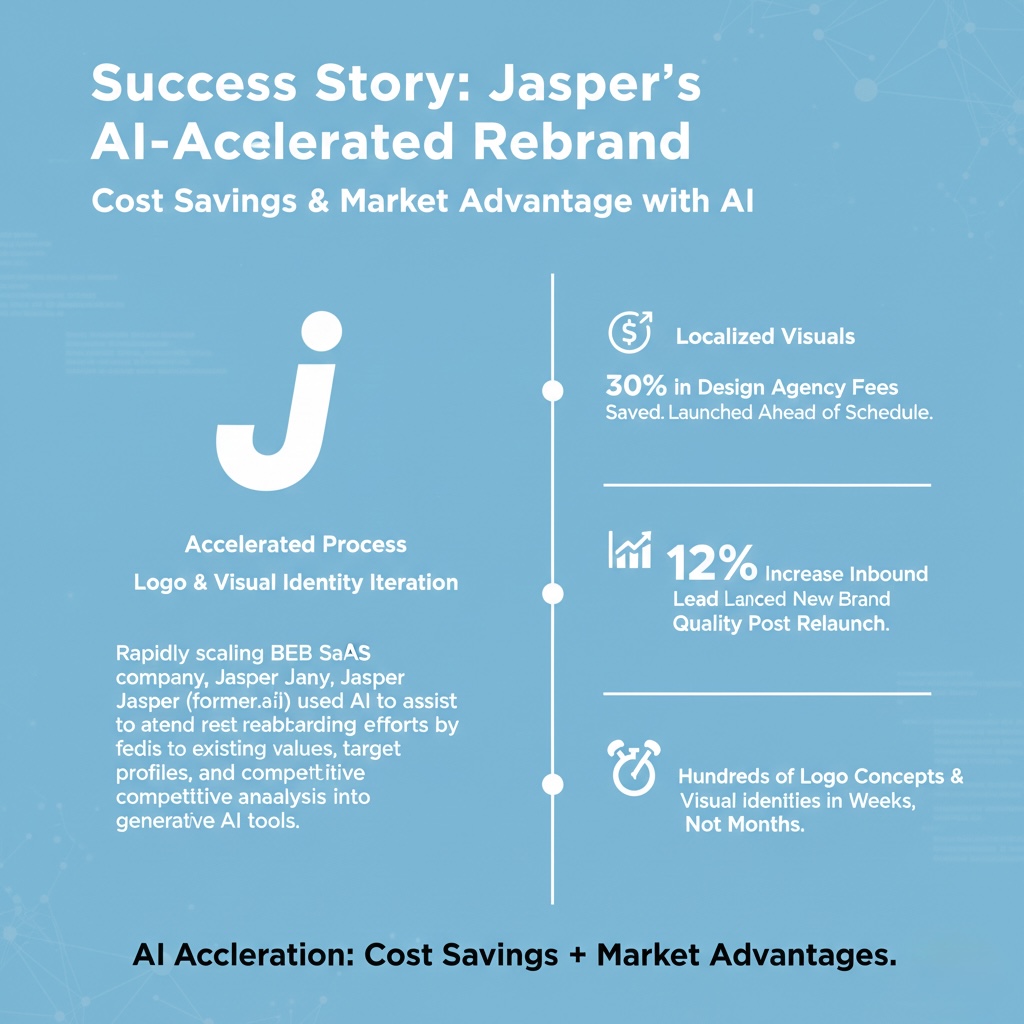
Success story: A rapidly scaling B2B SaaS company, Jasper (formerly Jasper.ai) used AI to assist their rebranding efforts. By feeding existing values, target audience profiles, and competitive analysis into generative AI tools, they iterated through hundreds of logo concepts and visual identities in weeks rather than months. This accelerated process saved an estimated 30% in design agency fees and allowed them to launch their new brand identity ahead of schedule, contributing to a 12% increase in inbound lead quality post relaunch, demonstrating how AI acceleration creates both cost savings and market advantages.
This success highlights that when B2B SaaS companies treat brand design as an “intelligent system” rather than just a static visual project, the ROI moves from aesthetic to athletic, driving real pipeline growth.
Building Trust and Authenticity: The E-E-A-T Connection
In an era of AI-generated content, E-E-A-T (Experience, Expertise, Authoritativeness, Trustworthiness) becomes even more critical for brand design success.
While AI can generate visuals, strategic brand design leverages AI to enhance authenticity rather than obscure it. By analyzing consumer reactions to various visual elements, AI helps identify designs that feel more genuine and trustworthy, fostering stronger emotional connections that build lasting brand loyalty.
AI assists in crafting compelling narratives by identifying emotional resonance in different story arcs and visual sequences. This ensures brand messages feel clear, expert, and authoritative—qualities that algorithms and human audiences alike recognize and reward.
The key distinction: AI provides the analytical foundation and creative acceleration, while human strategists ensure the resulting brand identity carries genuine emotion, cultural awareness, and strategic purpose that pure algorithms cannot manufacture.
Challenges and the CMO’s Strategic Imperative
AI’s power in brand design comes with genuine challenges that demand thoughtful leadership:
Ethical considerations require ensuring AI-generated designs remain free from bias and culturally sensitive. Training data quality directly impacts output quality and fairness.
The human touch remains irreplaceable. Algorithmic efficiency must balance with human creativity, empathy, and strategic vision that understands context beyond data patterns.
Data privacy demands that personalization efforts maintain transparency and strict adherence to privacy regulations. Consumer trust depends on responsible data usage.
For CMOs, the path forward is clear: embrace AI not as threat but as strategic co-pilot. This requires specific commitments:
Invest in AI literacy across marketing and design teams. Understanding AI’s capabilities and limitations prevents both over-reliance and under-utilization.
Develop hybrid strategies that integrate AI tools into existing human led design processes. The goal is augmentation, not replacement.
Prioritize data governance by building robust systems for collecting, managing, and ethically using design-relevant data. Strong governance protects both consumers and brand reputation.
The Future Is Collaborative
The age of AI isn’t just changing operational processes, it’s redefining brand design’s fundamental nature. For CMOs, this represents an unparalleled opportunity to forge brands that are simultaneously visually stunning, deeply intelligent, remarkably consistent, and uniquely personalized.
By leveraging AI to understand audiences at scale, enforce consistency across touchpoints, and augment creative exploration, brands can build stronger, more resilient identities that genuinely resonate in our increasingly algorithmic world.
The future of brand design isn’t human versus AI. It’s the transformative power of both working in concert, human creativity and strategic vision amplified by AI’s analytical depth and execution speed. The brands that thrive will be those whose CMOs recognize this collaborative potential and build the organizational capabilities to harness it effectively.
Key Takeaway: AI transforms brand design from labor intensive craft to scalable, data informed practice. Success requires CMOs to balance technological capability with human creativity, ethical considerations with business objectives, and consistency with personalization, all while maintaining the authentic brand essence that builds lasting consumer relationships.
You may also like a contrarian POV