

Shopify started as a simple way to put products online. For many fast growing D2C brands today, it’s evolved into something far more strategic. It’s no longer just the storefront—it’s the commerce backbone that powers product discovery, subscriptions, retail operations, data infrastructure, and customer experience across every channel they operate.
When used strategically, Shopify becomes the single source of truth that reduces operational friction, speeds up experimentation, and frees teams to focus on growth instead of firefighting integration problems. This article explains how top D2C brands extend Shopify into a true platform for scale, with concrete tactics, example architectures, and a practical checklist you can use to evolve from “Shopify = store” to “Shopify = commerce platform.”
The Fundamental Mindset Shift
Most founders start with a simple premise: “Shopify will host my store.” That’s tactical thinking. The strategic view is fundamentally different: Shopify should own the transaction, product catalog, orders, and checkout and everything else should plug into that core.
This distinction matters more than it might seem at first. Checkout and payments are notoriously difficult to replicate reliably, so keeping them in Shopify reduces both technical and financial risk. A single commerce core keeps inventory, orders, and refunds consistent across channels, which prevents the nightmare scenario of selling products you don’t have or processing refunds twice. And perhaps most importantly, it lets you experiment freely with customer experience through headless frontends or specialized apps without breaking the fundamental transaction flow.
Fast growing D2C brands think in layers: there’s the commerce core (which is Shopify), the experience layer, the data layer, and operations and fulfilment. Each layer is chosen for reliability and integration capability, not just features. This architectural thinking is what separates brands that scale smoothly from those that constantly fight their own technology.
Seven Ways Brands Extend Shopify Beyond the Shop Page
1. Shopify as the Authoritative Product Catalog
Rather than duplicating product data across multiple systems and watching those systems drift out of sync over time, smart brands keep their product catalog in Shopify and push enrichments, content, translations, product bundles, out to other systems as needed. This avoids what teams call “SKU drift,” where different systems show different prices or availability, creating customer service nightmares and lost sales.
The tactical approach here is straightforward but requires discipline. Use Shopify’s Product API as the canonical source of truth. Push product feeds to your headless CMS or content services rather than copying data and managing it in multiple places. Use metafields extensively to store structured product attributes that apps and custom frontends can consume programmatically.
The result is elegant: one change in Shopify ripples everywhere automatically. You update a price once, and it changes on your website, your mobile app, your marketplace listings, and anywhere else you sell. This eliminates an entire category of errors that plague growing brands.
2. Checkout and Payments as the Commerce Anchor
Shopify’s checkout is heavily optimized through years of iteration and billions of transactions. It’s legally compliant across regions, handles edge cases you haven’t thought of yet, and converts at rates that are hard to beat with custom builds. Even brands that build completely custom frontends often keep Shopify checkout, preserving express payment options, fraud protection, and a known conversion path that actually works.
The way this works in practice is through Shopify’s Storefront API or Checkout API, which custom frontends can call to hand off the transaction to Shopify at the critical moment. You get the benefit of Shop Pay, Apple Pay, and Google Pay for frictionless conversion. You keep payment and capture logic centralized in Shopify, which dramatically simplifies financial reconciliation at month-end.
The payoff is fewer chargebacks, smoother user experience, and consistent accounting that doesn’t require heroic spreadsheet work from your finance team.
3. Subscriptions and Recurring Revenue
Many D2C brands add subscriptions to create revenue predictability and improve unit economics. Instead of building subscription logic from scratch, which is far more complex than it appears, they integrate subscription platforms that sync with Shopify for billing and order fulfilment.
The approach that works is using a mature subscription app that writes orders back into Shopify as they occur. Customer lifecycle events like skipping a shipment, pausing temporarily, or canceling flow through the app back to Shopify. This keeps Shopify’s customer records accurate for lifetime value calculations and segmentation.
The result is predictable recurring revenue and a single unified view of order history, whether someone bought once or has been subscribing for two years. Your customer service team sees everything in one place instead of toggling between systems.
4 Unified Data and Customer Data Platform Integration
Shopify has rich transactional data, but growth teams need unified customer views that combine product behavior, email engagement, advertising touchpoints, and sometimes even offline interactions. This is where the architecture starts getting more sophisticated but also more powerful.
The pattern successful brands follow is sending Shopify events to a Customer Data Platform like Segment or Rudderstack, or directly into a data warehouse. The CDP stitches together web browsing, email clicks, and offline events into a single customer profile that actually represents how people interact with your brand. You then feed segments back into marketing channels—email platforms, advertising systems—for personalization that’s based on complete data rather than fragments.
The result is better targeting, higher return on ad spend, and clean lifetime value calculations that you can actually trust when making decisions about customer acquisition cost.
5 Headless and Composable Frontends
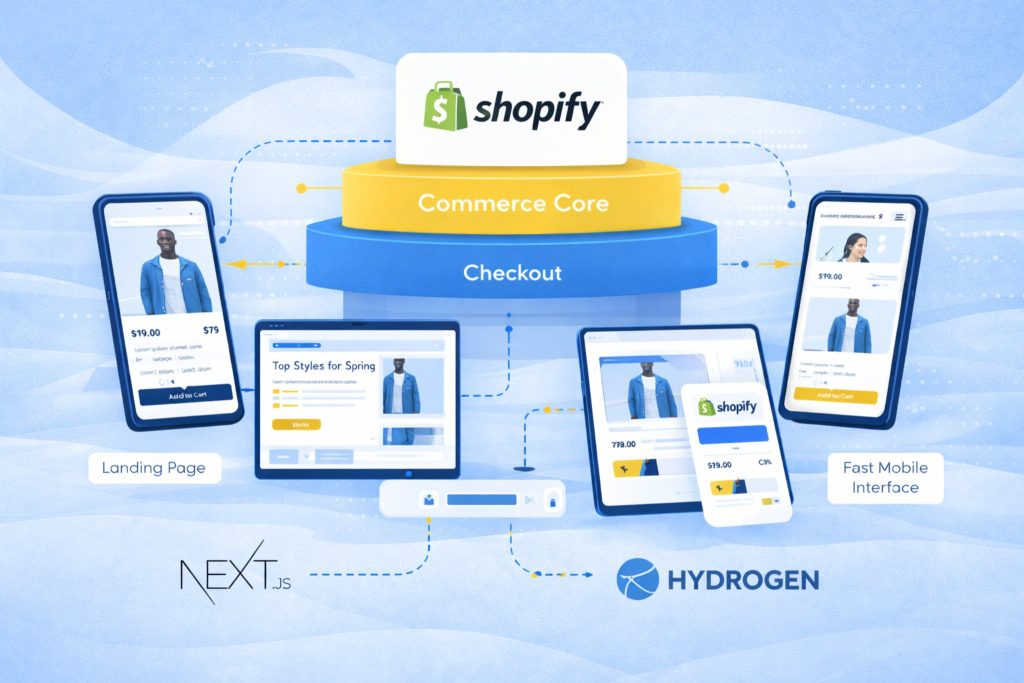
When storytelling or conversion optimization requires custom experiences, lightning fast landing pages, complex content structures, or highly optimized mobile UX, brands decouple their frontend from Shopify while keeping all commerce workflows safely in Shopify. This is where “headless commerce” stops being buzzword and becomes practical.
Brands typically use frameworks like Next.js or Shopify’s own Hydrogen to build fast, SEO friendly frontends that feel nothing like a traditional Shopify theme. They keep cart and checkout interactions routed to Shopify for reliability, because that’s where you absolutely cannot afford bugs or downtime. They cache product data aggressively or use edge caching to reduce API calls and improve performance.
What you get is faster page loads, complete control over user experience and content structure, and protected checkout integrity. You can iterate on your storefront experience without risking the transaction engine underneath.
6 Omnichannel Operations: Retail, Marketplaces, and Point of Sale
Shopify can serve as the operational hub for both online and offline commerce, with inventory, orders, and reporting consolidating across POS systems and marketplace integrations. This is particularly valuable for brands expanding from pure D2C into retail or wholesale channels.
The tactical implementation uses Shopify POS for retail operations, syncing inventory in real time so your online store doesn’t sell items that just walked out of your physical location. Marketplace connectors centralize order management back to Shopify regardless of where the sale originated. Fulfilment logic, whether you’re shipping from your own warehouse or routing to a third-party logistics provider—flows through Shopify web-hooks and apps.
The outcome is coherent inventory across every channel, dramatically reduced overselling incidents, and simplified fulfillment orchestration. Your operations team manages one system instead of five.
7 Automation Through Shopify Flow
Operational scale fundamentally depends on automation. Shopify Flow, available on the Plus plan, along with other automation tools, eliminates entire categories of manual work that bog down growing teams.
Practical applications include automatically tagging high-value orders for special handling or quality control. You can use flows to batch-update large numbers of SKUs or trigger alerts when inventory hits critical levels. Connecting flows to Slack or ticketing systems gives your operations team visibility into issues before customers complain about them.
The result is fewer human errors and faster, more consistent responses to common events. Your team spends time solving new problems instead of repeatedly handling the same situations manually.
A Practical Architecture Blueprint
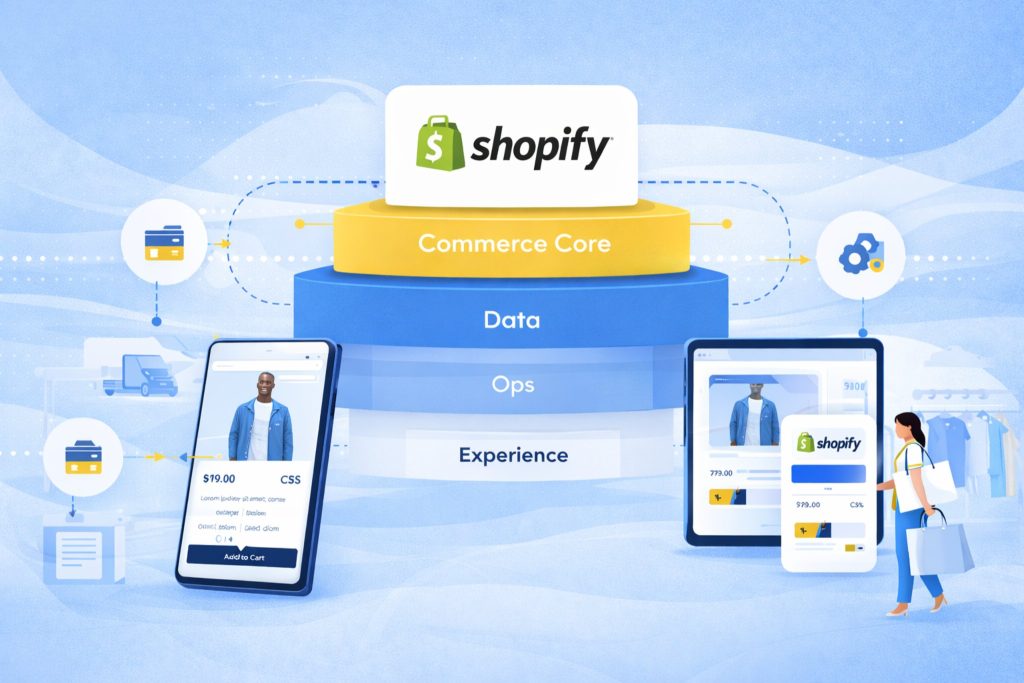
Here’s what a common, resilient architecture looks like for growing D2C brands. At the center is Shopify serving as the commerce core, managing products, SKUs, checkout, payments, and orders. The frontend might be headless using Next.js or Hydrogen, or it might still be theme-based depending on where the brand is in its evolution.
A Customer Data Platform like Segment or Rudderstack centralizes all events flowing through the system. These events land in a data warehouse, Snowflake or BigQuery are common choices for longterm analysis and marketing attribution. Email and SMS platforms like Klaviyo or Attentive handle lifecycle automation and write relevant data back to Shopify to keep customer records complete.
If the brand runs subscriptions, an app like ReCharge or Shopify’s native subscription functionality handles the recurring logic. Search and merchandising might run through Algolia, Elasticsearch, or Bloomreach to power product discovery. Fulfillment integrations sync with warehouses or third-party logistics providers to keep inventory accurate. And there’s a carefully curated set of apps for reviews, user-generated content, and loyalty programs, audited quarterly to prevent bloat.
The key architectural rule is that every integration must have a single source of truth for each type of data. Usually that’s Shopify for orders and products, and the CDP for unified customer events. When you violate this rule, you create conflicts that waste enormous amounts of time to resolve.
Signals You’re Ready for This Evolution
You should consider evolving your Shopify strategy if certain warning signs appear. If your checkout is heavily customized and causing errors that cost you sales, that’s a red flag. If multiple systems show different product or inventory counts and you’re not sure which to trust, you’ve outgrown your current approach. If your marketing team relies on spreadsheets for customer segmentation because your systems don’t talk to each other, you’re leaving money on the table.
Page performance dragging because too many client-side scripts are loading is another common symptom. And if adding a new sales channel doubles your operational workload instead of being relatively straightforward, your architecture needs attention. These aren’t signs of failure, they’re signals that you’re growing and your infrastructure needs to mature with you.
The Checklist for Platform Thinking
Start by centralizing your product data. Make Shopify the canonical source and move important metadata into Shopify metafields where it belongs. Keep your checkout in Shopify unless you have a genuinely compelling reason to replace it, because custom checkout is where good intentions go to die.
Consolidate your apps by auditing them quarterly. Remove duplicates and scripts that run globally when they’re only needed on specific pages. Invest in a Customer Data Platform or data warehouse setup, stop passing raw CSV files around and centralize your events properly.
Introduce automation for common workflows. Automatically tag, notify, and route common order events instead of handling them manually. Plan for headless frontend only when you have clear, measurable UX or performance gains to justify the complexity. Start with theme improvements first, they’re faster and lower risk.
Document your integrations meticulously. Maintain an integration map so new hires can understand data flow without reverse-engineering everything. And measure operational KPIs that matter: inventory accuracy, fulfillment service level agreements, chargeback rate, and the ratio of lifetime value to customer acquisition cost.
The Final Thought
Shopify offers an remarkable combination of reliability and extensibility that few platforms match. Fast growing D2C brands win by treating it as their commerce core and building a thoughtful, integrated stack around that foundation. The formula is conceptually simple but requires deliberate execution: centralize truth in Shopify, automate repetitive operations, unify your customer data, and only customize the experience when it materially improves outcomes you can measure.
When you use Shopify this way, scaling stops feeling like constant firefighting and becomes a predictable, repeatable process. You spend less time fixing integration problems and more time on the creative and strategic work that actually differentiates your brand.
The platform isn’t your ceiling, it’s your launchpad. Use it accordingly.