

A Strategic Brief for Commerce Leaders Navigating the AI Inflection Point
While most retailers spent the last decade digitizing, moving catalogs online, implementing responsive design, launching mobile apps, a handful of leaders were doing something fundamentally different. They were building intelligence into the foundation of their commerce architecture. Not as a feature. As the architecture itself.
The gap between these two approaches is no longer measurable in conversion points or average order value. It’s existential. One model serves static experiences to broad segments and hopes for relevance. The other predicts individual intent and shapes reality around it in real-time.
If your commerce strategy still begins with “How do we optimize our homepage?” you’re already behind.
The Segment is Dead. Long Live the Individual
Let’s dispense with the comfortable fiction that better segmentation is the answer.
Your “Millennial Urban Professional” segment contains a marathon runner who shops at 6 AM, a new parent who browses at midnight, and a price-sensitive researcher who visits twelve times before buying once. Treating them as interchangeable isn’t just inefficient, it’s strategic malpractice in an era where your competitors are serving each of them a completely different store.
The AI-native commerce platform doesn’t have a homepage. It has millions of them, algorithmically assembled at the moment of contact.
When Sarah lands on your site Tuesday morning from her iPhone, the platform doesn’t show her “trending products.” It reconstructs the navigation to surface sustainability filters. It replaces hero imagery with activewear content. It adjusts pricing displays based on her established sensitivity. The entire site architecture bends to her immediate context and historical behavior. This isn’t personalization as you’ve known it. This is architectural fluidity at scale.
Generative AI has accelerated this shift from interesting to inevitable. Your customers no longer want to search for products; they want to describe problems and receive solutions. “I need something for an outdoor wedding in Tuscany that works with gold sandals” isn’t a search query, it’s a consultation request. GenAI delivers consultation economics that scale infinitely.
The question isn’t whether to build this capability. It’s whether you can afford to compete without it.
The Supply Chain Doesn’t Support Your Business, It Is Your Business
While CMOs obsess over front-end experiences, the actual competitive moats are being dug in the supply chain.
Your legacy infrastructure is fundamentally reactive: forecast, manufacture, distribute, discount what doesn’t sell, repeat. This model was expensive when it was the only option. It’s suicidal when competitors are operating predictively.
AI-driven demand sensing doesn’t extrapolate from last year’s data, it synthesizes signals your team can’t even track manually. Weather patterns. Social virality coefficients. Search trend velocity. Economic indicators by microregion. The result isn’t better forecasting; it’s a different paradigm. Instead of reacting to stockouts, you’re positioning inventory where demand will emerge, days before consumers consciously decide to buy.
This transforms your entire cost structure. Markdowns aren’t a margin leak to be minimized, they’re a strategic failure to be eliminated. Stockouts aren’t a logistics challenge—they’re a signal your intelligence layer is failing.
Consider autonomous pricing: Most retailers still set prices seasonally, in spreadsheets, by humans making educated guesses. Meanwhile, algorithms are analyzing competitor movement, inventory velocity, and individual price elasticity in real-time to optimize every transaction for either margin or volume, depending on strategic priority at that moment.
This isn’t surge pricing. This is surgical precision. Offering the nudge that converts the hesitant buyer while protecting margin on the customer who would have paid full price anyway. You’re either doing this or you’re subsidizing your competitor’s margin.
The Leaders Aren’t Experimenting; They’re Rebuilding
The brands winning this transition didn’t bolt AI onto existing systems. They rebuilt their foundations with intelligence as the core premise.
Sephora recognized early that every customer interaction, including AR makeup trials, isn’t a marketing gimmick but a data capture event that refines the intelligence layer. They’ve created a flywheel: better data enables better recommendations, which creates more engagement, which generates more data. Each customer makes the system smarter for everyone.
Kroger applied this thinking to one of retail’s lowest-margin categories. Their AI doesn’t send generic promotions—it analyzes household purchase patterns to deliver offers that genuinely alter behavior, driving loyalty and basket size in a sector where most competitors are still printing circular flyers.
Stitch Fix didn’t retrofit AI into existing retail—they built retail from scratch around algorithmic intelligence. Human stylists provide the final touch, but algorithms do the impossible work: evaluating millions of combinations to match specific body types with specific aesthetic preferences. They proved that personalized curation could replace browsing entirely.
These aren’t success stories. They’re existence proofs that the old model is optional.
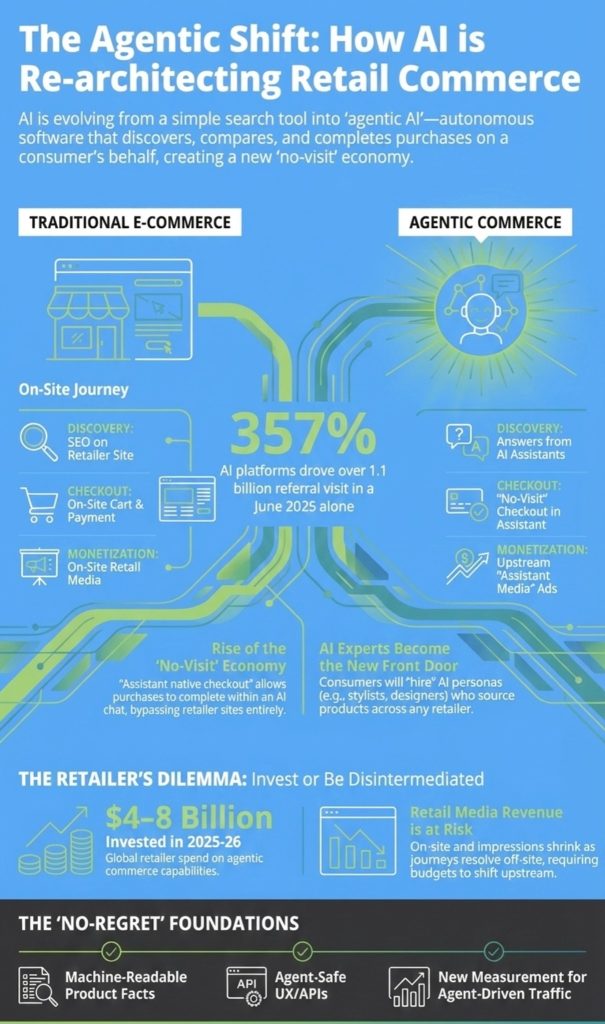
Your Strategic Blueprint: Four Non Negotiables
If you’re leading a commerce organization and this isn’t causing strategic discomfort, you’re not paying attention.
1. Unify Your Data or Surrender
AI’s effectiveness has an absolute ceiling: your data quality. If your POS, eCommerce platform, loyalty program, and customer service systems don’t speak to each other, every AI initiative will deliver fractured, contradictory results.
Invest in a unified customer data platform before you buy a single AI tool. This isn’t exciting work, but it’s foundational. You can’t build intelligence on fragmented data any more than you can build a skyscraper on sand.
2. Prove Value, Then Scale; Not the Reverse
Identify the highest friction, highest impact opportunity in your operation:
- Is search broken? Deploy semantic vector search.
- Are returns destroying margin? Implement AI-driven sizing recommendations.
- Is customer service underwater? Route tier-one inquiries through GenAI agents.
Pick one. Prove ROI in 90 days. Scale ruthlessly. Repeat.
The brands that fail at AI are the ones that launch enterprise wide “AI transformation initiatives.” The brands that win start with surgical pilots that demonstrate undeniable value.
3. Elevate Your Talent, Don’t Replace It
The AI replacement narrative is a distraction. AI doesn’t replace merchandisers, it liberates them from spreadsheet work so they can focus on creative strategy. It doesn’t replace customer service agents, it handles routine inquiries so agents can solve complex problems that build loyalty.
Your strategic imperative is workforce transformation, not reduction. The companies that win will be those that retrain teams to manage, interpret, and strategically deploy AI—not those that try to cut headcount.
4. Transparency is Your Competitive Advantage
As you build hyper-personalized experiences, the line between “helpful” and “creepy” is razor thin. The brands that win will be those that are radically transparent about data usage.
If AI recommends a product, explain why: “Based on your preference for organic cotton, we thought you’d like this.” Transparency builds trust. Trust generates data sharing. Data sharing powers better AI. It’s a flywheel, but only if you earn it.
The Window is Closing
Here’s what keeps me up at night: this transition is happening faster than most executive teams realize, and the advantage compounds.
Every transaction your competitors process with AI makes their system smarter. Every customer interaction trains their models. Every data point widens the gap. The longer you wait, the more expensive it becomes to catch up, not because the technology gets more expensive, but because the competitive gap becomes unbridgeable.
The retail landscape is being redrawn by algorithms and neural networks. The static storefront, the fixed supply chain, the one-size-fits-all pricing model—these aren’t just inefficient anymore. They’re artifacts of a bygone era.
The question for every commerce leader is binary: Are you rebuilding your foundation with intelligence at its core, or are you optimizing a system that’s already obsolete?
The winners of the next decade won’t be the brands with the best products. They’ll be the brands that built the most intelligent architecture to connect those products with people who need them, before those people even realize the need exists.
The re-architecture has begun. You’re either holding the blueprint or living in a condemned building. Which is it?
















Pingback: Gartner Magic Quadrant for Digital Commerce 2024-2025: Critical Analysis - ThinkNext
Pingback: The SaaSpocalypse is Here: Why the $285 Billion Market Crash is the Best Thing to Happen to eCommerce - ThinkNext
Pingback: Top 10 Tools Transforming eCommerce in 2026 I PracticeNext
Pingback: Autonomous eCommerce Stack with Google AI Ecosystem I PracticeNext