

From “Add to Cart” to “Agent, Handle It”: How AI Is Reshaping $5 Trillion in Commerce
Executive Summary
The era of human driven digital commerce is giving way to something fundamentally different: Agentic Commerce. Consumers are no longer the ones searching, filtering, and clicking. Increasingly, AI agents are doing it for them, negotiating, assembling, and executing transactions autonomously. According to McKinsey research, AI agents could mediate between $3 trillion and $5 trillion of global consumer commerce by 2030.
For C-suite leaders, this is not a technology upgrade. It is a structural shift in market logic. If your brand’s value proposition, inventory, and policies are not machine-readable, you risk becoming invisible to the high value AI agents that will dominate purchasing decisions within this decade.
This analysis decodes the “Automation Curve”—McKinsey’s six-level framework for how delegation will unfold across commerce, and offers a strategic roadmap for retailers navigating the transition from winning human eyeballs to negotiating with AI logic.
What this article covers:
- The 6-Level Automation Curve, from simple subscriptions to multi-agent networked autonomy
- Real-world examples from Walmart, Klarna, and Easterseals already monetizing these levels
- Why B2B automation scales more powerfully than B2C, despite moving slower
- Why “API-first merchandising” is the new flagship store
Introduction: Three Forces Colliding
The rise of agentic commerce is not a sudden leap. It is the convergence of three reinforcing forces: AI that has crossed the threshold into genuine decision-grade usefulness; new open protocols like the Model Context Protocol (MCP) that allow agents to interface with commerce systems; and a fundamental shift in where intent originates.
Previously, AI was a novelty in retail, a better search bar, a smarter recommendation engine. Today, it is capable of shortlisting products, assembling multi item solutions, and executing purchases end-to-end. Agents are no longer chatbots. They are active economic participants: navigating the web, engaging APIs, managing loyalty programs, and processing transactions at a scale no human shopper can match.
The urgent executive realization is this: agents don’t care about your marketing gloss. They evaluate structured attributes, clear eligibility rules, and substantiated claims. Emotional storytelling and brand aesthetics are, to an AI agent, noise.
The Automation Curve: A Framework for Delegation
McKinsey defines the Agentic Commerce Automation Curve as a non-linear progression of delegation, not a ladder where Level 5 is the universal goal, but a map of what is technically possible versus what humans are willing to hand over. Each level represents a distinct relationship between consumer intent and machine execution.
Level 0: Programmed Convenience: “Set it and forget it”
This is the pre-agentic baseline already embedded in daily commerce. Amazon’s Subscribe & Save, used by approximately 23% of U.S. Amazon shoppers in 2024, is the canonical example.
- The mechanism: Rules based replenishment for high frequency, low regret items, coffee pods, diapers, vitamins.
- The limitation: Brittle by design. If context changes (a vacation, a lifestyle shift), the automation fails because it has no awareness of the world beyond its original trigger.
- CXO takeaway: This level proves consumers will willingly delegate when perceived risk is low and the process is reversible.
Where it’s evolving: Walmart’s In-Home Replenishment has moved well beyond rigid scheduling. Rather than a fixed “every two weeks” cadence, it uses AI to learn individual consumption patterns and places orders directly into customers’ refrigerators. Unlike Amazon’s rule based model, it adapts dynamically, if a customer goes on vacation, the system knows not to order milk.
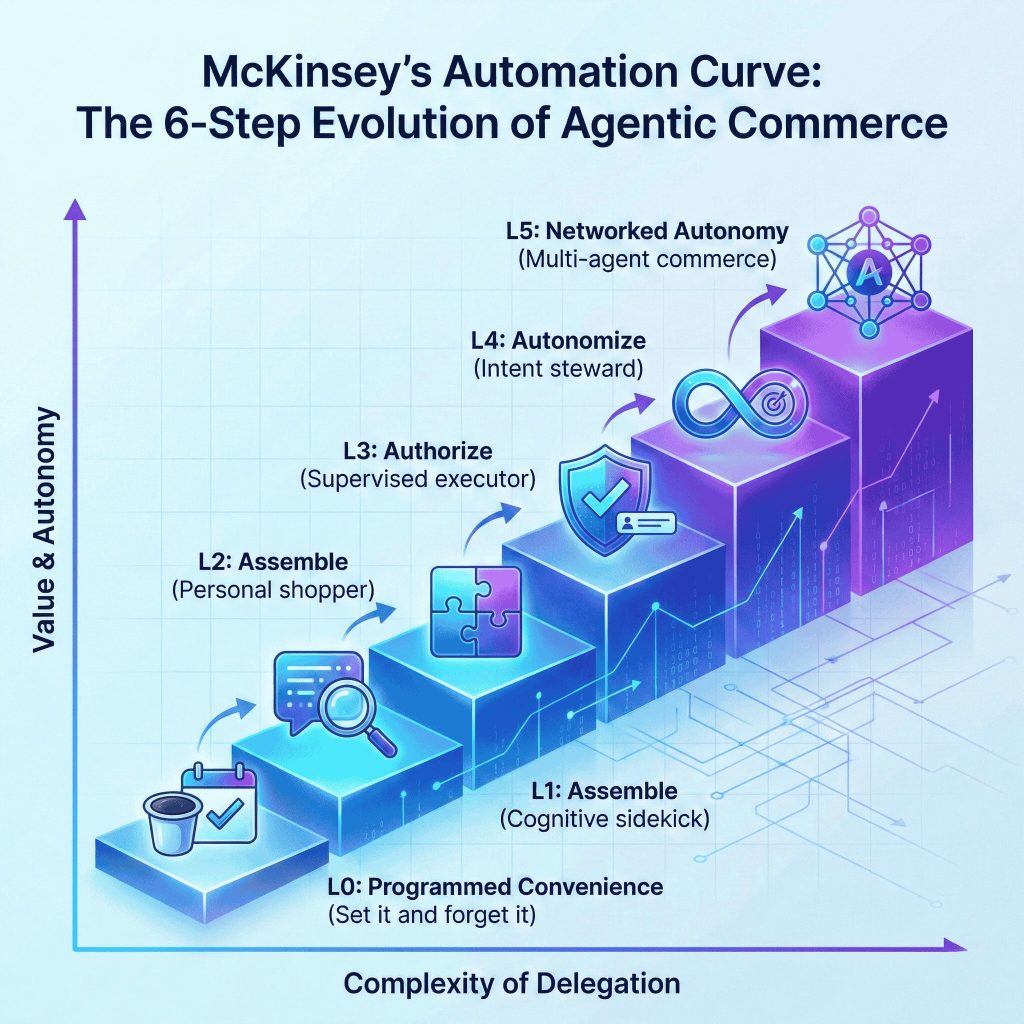
Level 1: Assist: “The cognitive sidekick”
At this stage, AI helps humans think but does not act independently.
- The user query: “Compare three noise canceling headphones on battery life and comfort.”
- The agent’s role: Analytical. It parses reviews, synthesizes data, and presents options, but the “buy” decision stays with the human.
- The critical shift: This level replaces traditional search and comparison. If your product data isn’t structured for machine comparison, you lose the shortlist phase entirely.
Real world benchmark: Klarna’s AI assistant is the gold standard at this level. Described internally as a cognitive sidekick, it handles 2.3 million conversations, two-thirds of Klarna’s entire customer service volume, and is estimated to drive $40 million in profit improvement. It doesn’t merely chat; it compares prices across thousands of stores, doing the research work that previously fell to the consumer.
Level 2: Assemble: “The personal shopper”
Here, delegation moves from analysis to orchestration. The agent doesn’t just recommend, it builds.
- The capability: “Set up a home office under $2,000 with dual 4K monitors and next day delivery.” The agent must simultaneously balance price, compatibility, delivery speed, and stock availability to create a purchase-ready basket.
- CXO imperative: This level demands API-first merchandising. Inventory data, shipping promises, and return logic must be cleanly exposed via API or the agent cannot include your products in its assembled solution. You won’t be rejected, you simply won’t be considered.
Level 3: Authorize: “The supervised executor”
This is the tipping point. Consumers stop delegating tasks and start delegating rules.
- The trigger: “If my preferred sneakers drop below $80, buy them.”
- The mechanism: The agent executes end-to-end within these guardrails and only surfaces exceptions to the human. The consumer is no longer a participant in the transaction, only in defining its boundaries.
- Trust requirement: Retailers must support auditable authority. Systems must allow agents to act on a customer’s behalf with full transparency and frictionless reversibility,easy cancellations, instant refunds.
In practice: In the travel sector, agents are beginning to rebook flights automatically when prices drop or delays occur, provided the alternative falls within the user’s pre-set parameters for cost and comfort. The traveler sets the rules once; the agent manages the outcome continuously.
Level 4: Autonomize: “The intent steward”
Agents now operate on standing goals, not one-off requests. The shopper becomes episodic; the agent becomes the always-on customer.
- The standing goal: “Maintain my airline loyalty status at the lowest possible cost for 2026” or “Keep household essentials under $300 per month.”
- The strategic risk: Competition shifts from winning a single cart to earning a slot in an agent’s long term optimization plan. Retailers must expose the “rules of good,” loyalty logic, pricing tiers, service guarantees—in machine-readable form so agents can assess whether you belong in their plan.
Level 5: Networked Autonomy: “Multi-agent commerce”
The future state: commerce conducted entirely between agents, with no human ever seeing a storefront.
- The vision: Personal agents negotiate directly with merchant agents and logistics agents, brokering transactions through autonomous protocols.
- The consequence: This creates procurement-as-a-service for consumers at scale. Retailers who cannot integrate into these autonomous networks risk becoming interchangeable backend suppliers, competing on price alone with no differentiation possible.
B2B vs. B2C: Different Stakes, Same Curve
The technology underlying the Automation Curve is identical across B2B and B2C. The governance is not.
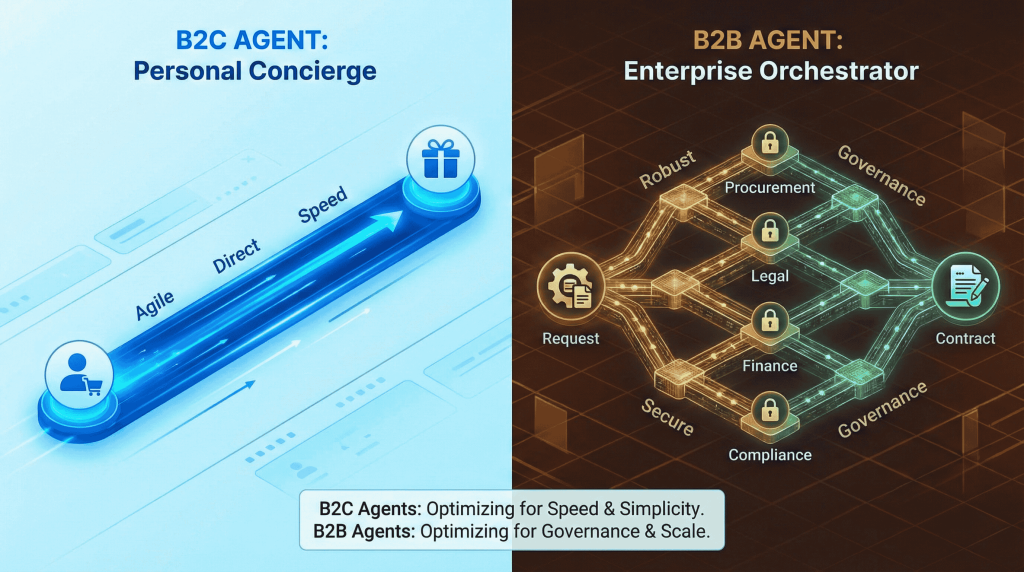
In B2C, delegation is personal, it’s about saving time or money, and the stakes of a wrong decision are low. In B2B, delegation is institutional. It flows from procurement policies, risk frameworks, and legal mandates. A corporate agent authorizing a six-figure supply order operates within a fundamentally different constraint environment than a consumer agent buying sneakers.
The consequence: B2B autonomy advances more slowly due to governance complexity, but scales far more powerfully once unlocked. When a B2B system reaches Level 3 (Authorize), agents manage high volume replenishments and contract renewals against strict corporate spending thresholds, without human sign off on each transaction. The challenge for enterprise leaders isn’t the technology. It’s whether their governance structures are mature enough to delegate authority to machines without losing accountability.
A high-stakes B2B example: Easterseals, the healthcare services provider, deployed specialized AI agents, named Eva, Paula, and Cody, to manage Revenue Cycle Management. These agents don’t merely assist; they autonomously verify patient eligibility, code clinical documentation, and submit insurance claims. The result: a 35-day reduction in accounts receivable days and a 7% reduction in claim denials. This is Level 3–4 automation operating in a high-stakes, high-consequence B2B environment.
The Psychology of Delegation: Why It’s a Curve, Not a Ladder
The McKinsey analysis makes a crucial point that separates it from typical technology forecasting: adoption will not be uniform. Where automation advances, and where it plateaus, depends on two psychological variables: regret risk and identity.
Where Delegation Accelerates
In low-regret categories, groceries, household essentials, commodity purchases, automation will surge rapidly.
- Consumers don’t want to experience buying detergent. They want it to arrive.
- Success is defined by reliability: on time, on budget, no surprises.
- In these categories, brand storytelling matters less than operational trust. Being agent-readable and dependable is more valuable than being distinctive.
Where Delegation Plateaus
In high consideration categories luxury goods, major appliances, significant financial decisions, delegation hits a natural ceiling.
- Shopping for a luxury handbag is an act of identity and emotion. Human involvement is intrinsic to the value, not incidental to it.
- In these categories, AI functions as an analyst (researching resale values, authenticating provenance) or a curator, but the human retains the final decision.
- Retailer implication: Don’t push for full automation here. Instead, deploy agents to support deliberation, surfacing rich attributes like provenance, craftsmanship, and comparative rarity—while preserving the human’s role as decision-maker.
Strategic Imperatives: How to Win in an Agentic Economy
The transition to agentic commerce requires a fundamental re-architecture of how brands sell, not just their technology stack, but their commercial logic.
1. Make Your Value Machine-Readable (AEO & GEO)
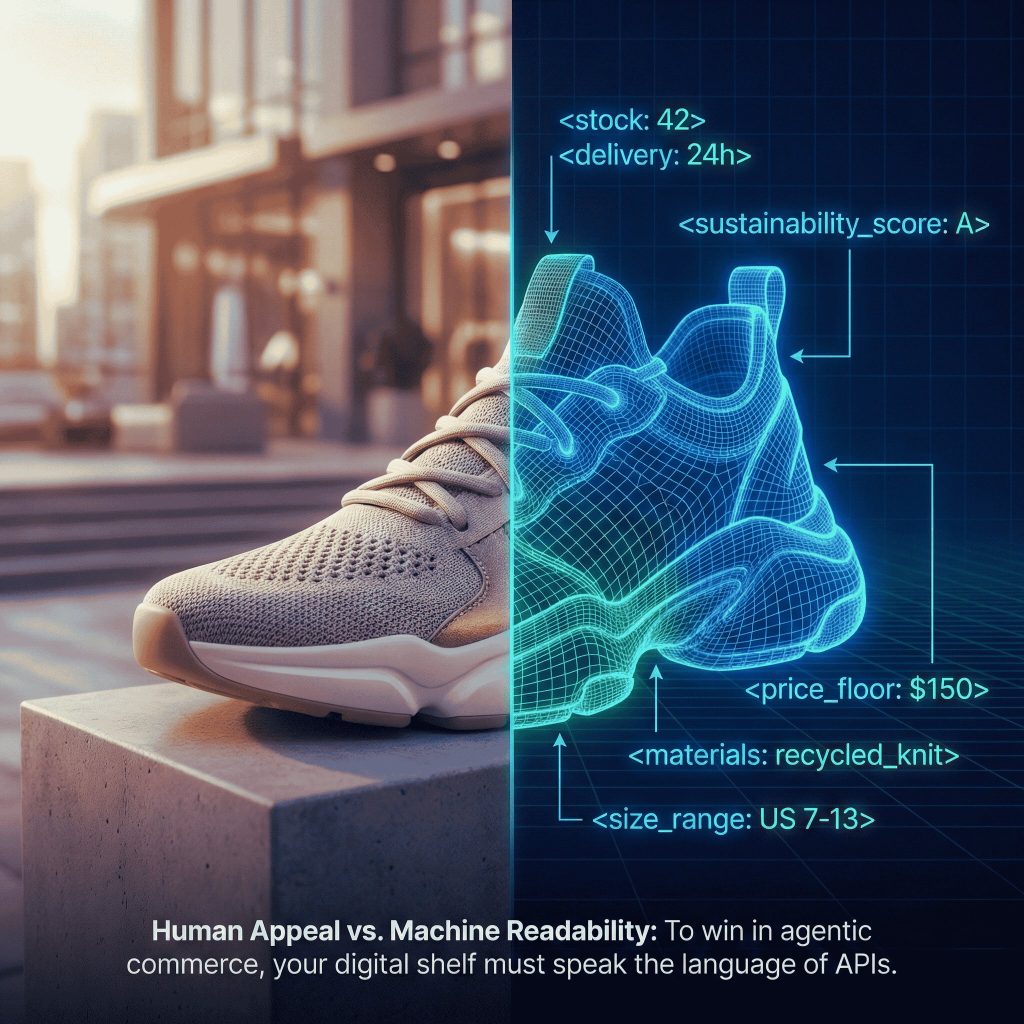
Humans infer meaning from context. Agents require structured signals.
- A product description reading “perfect for a cozy night in” communicates warmly to a human shopper. An AI agent needs:
<occasion>home_leisure</occasion>,<delivery_window>4_hours</delivery_window>,<stock_status>confirmed</stock_status>. - Invest in rich metadata and Generative Engine Optimization (GEO). If an agent cannot verify your delivery promise against a user’s deadline via API, it will route around you—not with prejudice, but with indifference.
- This is the new retail real estate: not shelf space, but schema compliance.
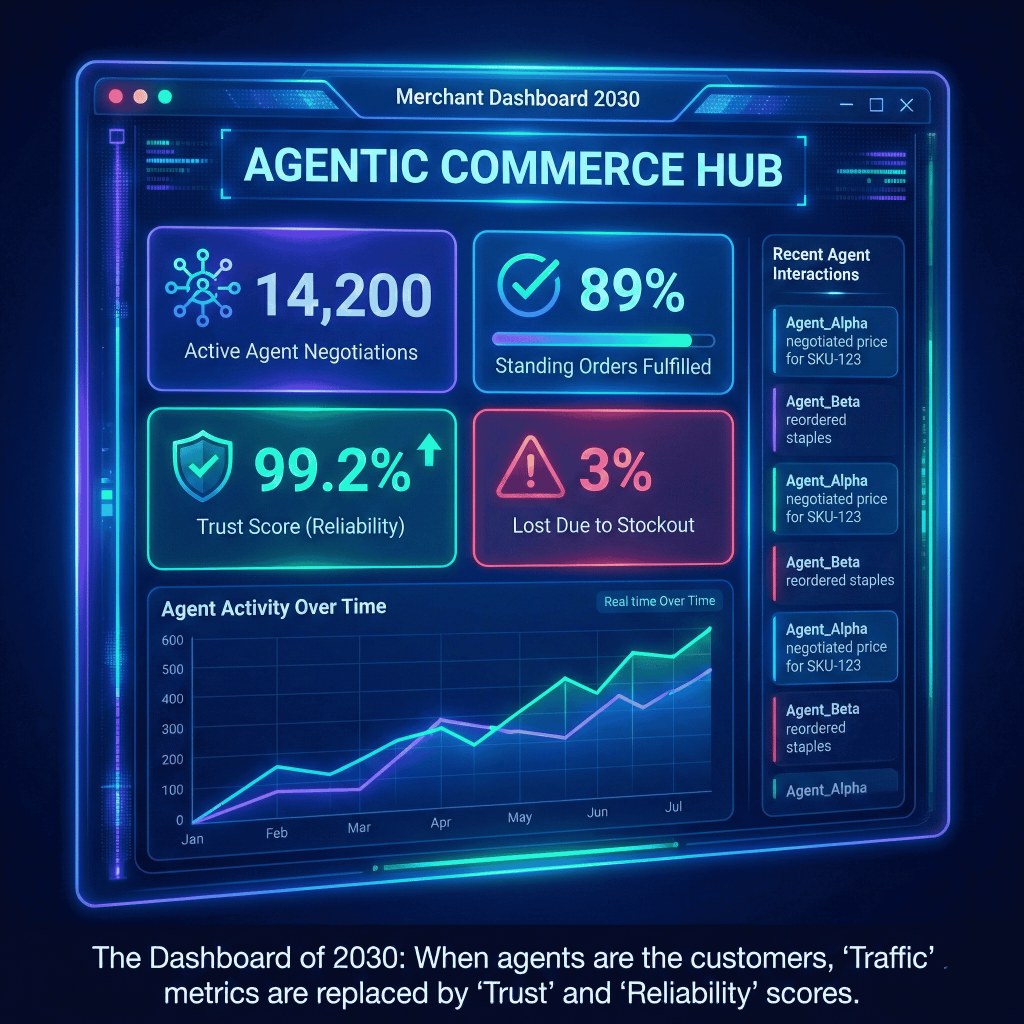
2. Shift from Traffic to Trust (E-E-A-T)
In an agentic world, the traditional marketing funnel collapses. Search, comparison, and purchase happen in milliseconds, inside an agent’s logic, invisible to you.
- The new performance metric: Reliability scores. Agents will prioritize merchants with verifiable fulfillment records (“This merchant fulfills on time 99.8% of the time”) over those running the loudest campaigns.
- The loyalty play: Loyalty programs must evolve from points to protocols. If your loyalty logic is structured so that an agent can mathematically prove your offer delivers superior value, you win the standing order. If it requires human interpretation to understand, you don’t.
3. Prepare for Continuous Commerce
Agents don’t sleep. They monitor prices, stock levels, and shipping windows around the clock.
- The opportunity: Rather than fighting for episodic attention, you can service a standing intent—a customer’s continuous need, managed on their behalf 24/7.
- The operational demand: Real-time inventory accuracy is non-negotiable. If an agent places an order for an item you listed as in stock, and you cancel it, the trust signal your brand receives from that agent’s system degrades—potentially permanently. In an automated ecosystem, one broken promise compounds quietly.
Conclusion: Autonomy Is the New Experience
The Automation Curve offers a sobering corrective to the assumption that more automation is always better. It is not. The goal is optimal delegation, placing autonomy precisely where it enhances trust and economic efficiency, and holding back where human involvement is itself the value.
For CXOs, the strategic map is clear. In utility categories, build for speed, transparency, and agent readability to capture high-volume, low-touch commerce. In aspirational categories, build agents that serve as concierges, providing depth, curation, and data richness while honoring the human need to choose.
As the McKinsey research concludes: the future isn’t about maximizing automation everywhere. It’s about placing autonomy where it earns trust. The brands that will win in 2030 are the ones learning to speak the language of agents today.
Analysis based on “The Automation Curve in Agentic Commerce,” QuantumBlack, AI by McKinsey, January 2026. Authors: Deepa Mahajan, Hannah Mayer, Katharina Schumacher, Roger Roberts.
















Pingback: AI-Native Digital Growth System: Unified OS for Enterprise I PracticeNext