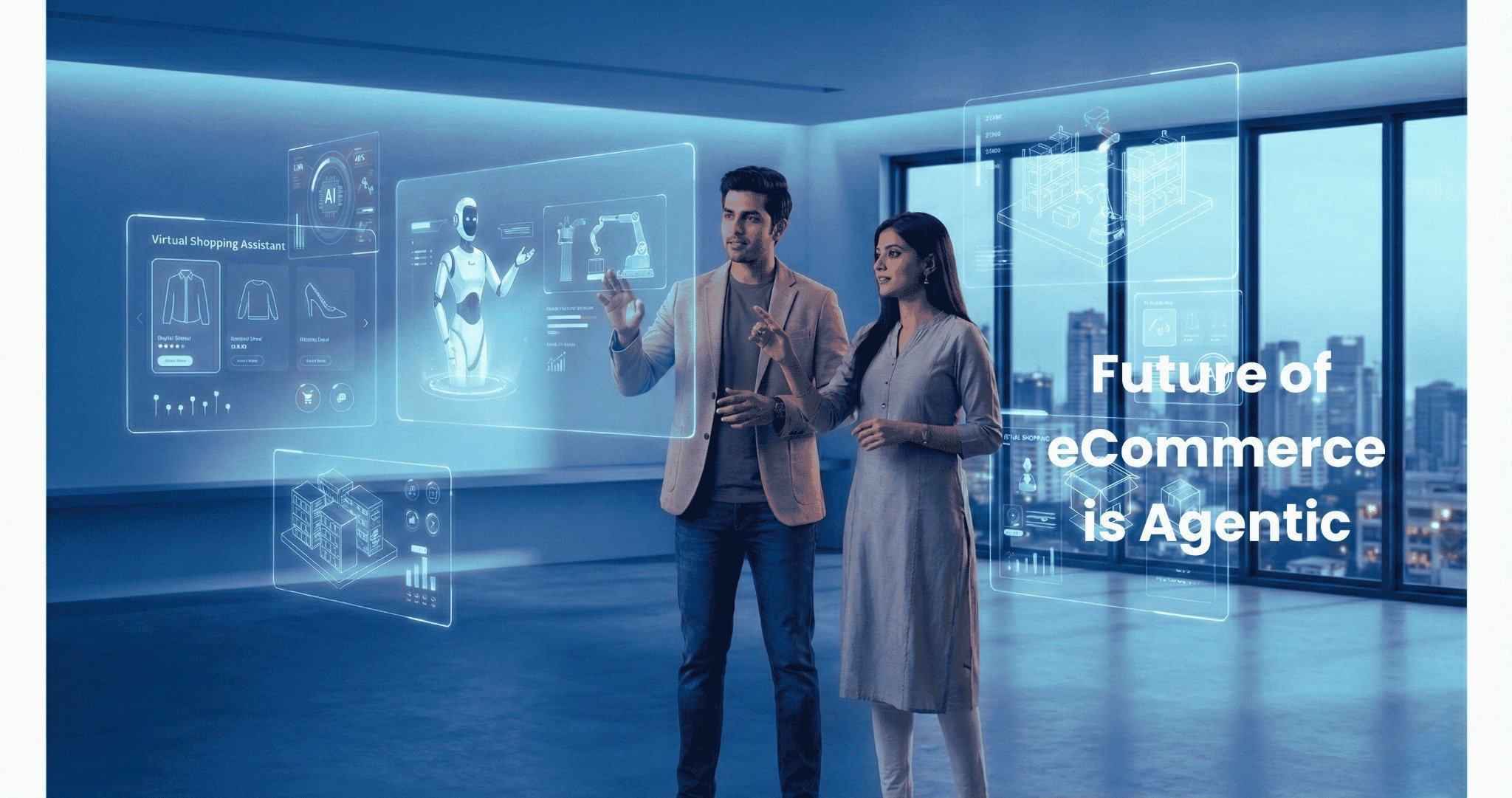

Executive Summery: The Shift from Headless to Agentic Commerce
The eCommerce industry stands at an inflection point. After decades of reducing friction through better user interfaces and faster checkout processes, we’re witnessing a fundamental shift in how commerce operates. The evolution from traditional storefronts to headless commerce was significant, but the emerging paradigm, “agentic commerce” represents a discontinuity rather than incremental progress.
According to Gartner’s 2024 research, by 2028, 33% of enterprise software applications will include agentic AI, up from less than 1% in 2024. For eCommerce specifically, this transformation is already underway, with early adopters reporting conversion rate improvements of 15-40% through AI-powered personalization and automation.
This comprehensive guide examines how Google’s AI ecosystem, spanning from Gemini language models to autonomous agent protocols, is reshaping the technical infrastructure of modern retail. Whether you’re a CTO planning your 2026 roadmap or a business leader evaluating AI investments, understanding this architectural shift is critical to remaining competitive.
Understanding the Three Pillars of AI-Powered Commerce
Cognitive Infrastructure: The Brain of Modern E-Commerce
The Evolution of AI Models for Retail
Modern eCommerce platforms require two distinct types of AI intelligence: fast reflexive responses for real time interactions, and deep deliberative reasoning for complex decision-making. Google’s Gemini 3 family addresses both needs through strategic model differentiation.
Gemini 3 Flash operates as the high speed cognitive layer, optimized for millisecond response scenarios. In practical terms, this powers:
- Real-time search personalization: Replacing traditional keyword matching with semantic understanding
- Dynamic ad copy generation: Creating personalized product descriptions based on user context
- Instant customer service responses: Handling common queries without human intervention
Early deployment data shows impressive results. Retailers implementing Flash generated search descriptions and ad copy have documented a 21.4% increase in CTR compared to static content. The model achieves frontier class performance while consuming approximately 30% fewer computational resources than comparable systems, making it economically viable for high-traffic applications.
Gemini 3 Pro handles the complex reasoning tasks that require planning and multi-step logic. This includes:
- Automated merchandising: Analyzing thousands of product descriptions and trend data to create cohesive product collections
- Complex query resolution: Breaking down requests like “find camping gear for a family of four under $2,000 that fits in a sedan” into actionable sub-tasks
- Strategic inventory planning: Predicting demand patterns and optimizing stock levels
Real World Success: Stitch Fix’s AI-Driven Inventory
Fashion retailer Stitch Fix demonstrates the power of AI-driven cognitive infrastructure. By implementing predictive AI models similar to the Vertex AI architecture, they achieved a 40% increase in average order value and reduced inventory holding costs by 20%, according to their 2024 annual report. Their system analyzes customer preferences, seasonal trends, and inventory data to personalize selections at scale, a task impossible for human stylists alone.
Agent Protocols: How AI Systems Communicate
The most revolutionary aspect of the 2026 AI ecosystem isn’t the intelligence of individual models, but how they communicate with each other. Traditional eCommerce integration relied on REST APIs, requiring human developers to write custom code for each connection. The emerging paradigm uses agent-to-agent protocols where software systems negotiate their own integrations.
Agent2Agent (A2A): The Universal Translator
A2A functions as a standardized communication layer for AI agents, addressing a critical fragmentation problem. With agents built on diverse frameworks (LangGraph, CrewAI, Google ADK), a common language is essential.
The protocol works through three key mechanisms:
- Discovery: Each A2A compliant agent publishes an “Agent Card” at a standard endpoint, declaring its capabilities and interaction preferences
- Modality negotiation: Agents automatically adjust response formats based on the client’s capabilities (voice-only vs. rich visual interface)
- Asynchronous state management: Long running transactions maintain open channels for updates without constant polling
Universal Commerce Protocol (UCP): Standardizing Transactions
Co-developed by Google, Shopify, Wayfair, and Walmart, UCP transforms online stores into machine readable entities. Rather than requiring custom integration for each eCommerce platform, UCP compliant systems expose standardized capabilities like shopping.checkout or catalog.search.
The strategic implication is profound: any retailer implementing UCP becomes discoverable and purchasable by any AI agent, whether it’s Google’s Gemini, ChatGPT, or a custom enterprise assistant. This democratizes access to consumers using AI shopping assistants.
Agent Payments Protocol (AP2): Building Trust in Autonomous Transactions
The biggest barrier to autonomous commerce isn’t technical capability, it’s trust. How does a merchant verify that an AI agent is authorized to spend a customer’s money? AP2 solves this through cryptographic mandates:
- Intent Mandate: When a user instructs their agent to “buy a coffee maker under $150,” the device generates a cryptographically signed authorization with specific limits
- Cart Mandate: Once the agent selects a product, a cart mandate locks in the SKU and price
- Payment Execution: The final transaction serves as non-repudiable proof of authorized action
For global B2B transactions, the x402 extension enables cryptocurrency settlements, allowing autonomous agents to transact across borders instantly using stablecoins, bypassing traditional banking delays.
Generative Experience Layer: Personalization at Scale
Beyond Static Content: Dynamic Creative Generation
Traditional eCommerce content creation requires significant human labor: photoshoots, video production, graphic design. The generative experience layer automates this at unprecedented scale and personalization levels.
Nano Banana Pro (built on Gemini image generation) addresses the historical challenge of visual consistency. The system can generate a virtual model and place them in hundreds of different environments while maintaining exact facial features and product details. This enables:
- Hyper-personalized ads: Testing thousands of creative variations instead of three or four
- Automated localization: Generating culturally appropriate imagery for different markets
- Product visualization: Showing items in context without physical staging
Case studies demonstrate a 17.4% reduction in cost per conversion and 16.1% increase in conversion rates through advanced dynamic creative optimization using these tools.
Veo 3.1 brings the same generative capability to video, creating:
- Product demonstration videos: Generating physics-accurate simulations of products in use
- Personalized customer communications: Creating unique unboxing videos or styling suggestions for individual customers
- Rapid commercial production: Reducing pre-production time by 40% for advertising campaigns
Maintaining Brand Consistency: The Role of AI Guardrails
As content generation becomes automated, maintaining brand identity becomes critical. Pomelli acts as a brand guardian by extracting a “Business DNA” profile from existing assets, codifying color palettes, typography, tone of voice, and visual style. This ensures all AI-generated content aligns with brand standards, preventing the “generic AI look.”
The Autonomous Engineering Stack: Building Faster with AI
Beyond customer facing applications, AI is transforming how eCommerce platforms are built and maintained. According to McKinsey’s 2024 developer productivity research, organizations using AI coding assistants report 35-45% faster code completion and 20-30% reduction in debugging time.
Google Antigravity and Jules: The AI Development Team
Antigravity represents a paradigm shift from traditional code editors to an orchestration environment where developers manage AI agents rather than writing every line of code themselves. Jules, the AI coding agent, can:
- Autonomously clone repositories and analyze codebases
- Write code, run test suites, and fix regressions
- Complete complex multi-file refactoring in an average of 3 minutes versus hours for human developers
- Generate comprehensive test coverage for legacy code
- Apply security patches immediately upon CVE disclosure
This doesn’t replace developers, it eliminates toil and allows human engineers to focus on architecture and business logic rather than repetitive implementation tasks.
Real-World Impact: PayPal’s Agent Integration
PayPal’s integration with Google’s UCP and AP2 protocols demonstrates the practical viability of these systems. Merchants using PayPal can now offer “agentic checkout” capabilities out of the box, enabling customers’ AI assistants to complete purchases securely and autonomously. This partnership validates that the protocol ecosystem is moving from concept to production implementation.
Implementation Roadmap: A Phased Approach
For technical leaders considering this transition, a structured implementation approach minimizes risk while demonstrating value quickly.
Phase 1: Cognitive Pilot
Objective: Achieve immediate ROI and prepare data infrastructure
Actions:
- Migrate search functionality to AI-powered semantic search (Vertex AI Search or similar)
- Implement AI chatbots for tier1 customer support automation
- Establish brand guidelines profile for AI content generation
Expected Outcomes:
- 20-30% reduction in customer support costs
- 10-15% improvement in search-to-purchase conversion
- Baseline data collection for personalization algorithms
Phase 2: Agentic Foundation
Objective: Enable protocol-based commerce capabilities
Actions:
- Implement standardized commerce protocol endpoints (UCP or equivalent)
- Deploy AI coding assistants for engineering team productivity
- Begin dynamic creative testing for marketing campaigns
Expected Outcomes:
- 2x increase in marketing asset production velocity
- 40% improvement in engineering velocity for routine tasks
- Infrastructure ready for autonomous agent interactions
Phase 3: Autonomous Enterprise
Objective: Achieve full agentic autonomy
Actions:
- Enable authenticated payment protocols for AI agents
- Deploy AI agents for cross-platform selling (selling through customer AI assistants)
- Implement autonomous inventory optimization and reordering
Expected Outcomes:
- New revenue streams from agent-driven sales channels
- Reduced operational overhead through automation
- Competitive advantage in emerging AI-first marketplaces
Critical Considerations: Security, Ethics, and Governance
Security in an Agentic Environment
Deploying autonomous agents introduces new security vectors. A comprehensive security framework should include:
Zero Trust Architecture: Every agent must be authenticated and authorized for specific actions, with role based access controls limiting potential damage from compromised agents.
Continuous Red Teaming: Using adversarial AI agents to test the security and logic of production agents, identifying vulnerabilities before malicious actors can exploit them.
Human-on-the-Loop for Critical Actions: High value transactions or unusual patterns should trigger human review before execution, balancing automation with oversight.
Data Privacy and Compliance
According to IBM’s 2024 Cost of Data Breach report, the average cost of a data breach reached $4.88 million, emphasizing the importance of robust data governance. AI systems must be designed with privacy as a foundation:
- Customer data used for personalization should remain within enterprise security perimeters
- AI models should be deployed on-device where possible to minimize data transmission
- Clear consent mechanisms must govern how customer data trains and informs AI systems
Ethical Considerations
As AI agents gain autonomy in commerce, ethical frameworks become crucial:
- Transparency: Customers should know when they’re interacting with AI
- Fairness: Pricing and recommendation algorithms must be audited for discriminatory patterns
- Accountability: Clear chains of responsibility must exist for AI-driven decisions
The Competitive Imperative: Why This Matters Now
The window for competitive advantage in AI-powered commerce is narrowing. According to Salesforce’s 2024 State of Commerce report, 66% of consumers now expect companies to understand their unique needs and expectations, while 52% expect all offers to be personalized. Traditional personalization methods cannot achieve this at scale—AI is becoming necessary, not optional.
Furthermore, as AI assistants become primary shopping interfaces, retailers without agent-accessible systems risk invisibility. Just as the shift to mobile required responsive design or risk losing mobile customers, the shift to agentic commerce requires protocol implementation or risk losing AI-assisted shoppers.
The Bottom Line: Protocols Over Pixels
The winning eCommerce technology stack of 2026 won’t be defined by its user interface design, but by its machine readable protocols. As AI agents become primary buyers, the visual storefront becomes secondary to the API layer that enables agent interactions.
The transition from human centric to agent accessible commerce represents the most significant architectural shift in eCommerce since the move from physical retail to online stores. CTOs and business leaders who architect their systems to be understood, negotiated with, and trusted by AI agents will define the next era of digital commerce.
The blueprint exists today in Google’s AI ecosystem and similar platforms from other providers. The question isn’t whether to adopt these technologies, but how quickly your organization can execute the transition while maintaining security, brand integrity, and customer trust.
The future of commerce is conversational, autonomous, and protocol-driven. The time to begin the transition is now.
Frequently Asked Questions
Q: How quickly can a typical eCommerce company implement AI-powered commerce capabilities?
A: According to Google’s documentation, the initial cognitive layer (AI-powered search and customer service) can be implemented in 2-3 months. Full agentic capabilities typically require 10-18 months depending on existing technical infrastructure and organizational readiness.
Q: What are the typical cost savings from implementing AI in eCommerce operations?
A: Organizations report 20-30% reduction in customer support costs, 15-25% reduction in content production costs, and 35-45% improvement in engineering productivity for routine tasks. However, initial implementation requires significant investment in infrastructure and training.
Q: Will AI agents replace human customer service representatives?
A: AI handles routine tier-1 support inquiries (password resets, order tracking, basic product questions), but complex issues, empathy-requiring situations, and escalations still benefit from human expertise. The most successful implementations use AI to handle volume while freeing humans for complex, high-value interactions.
Q: How do you ensure AI-generated content maintains brand voice and quality?
A: Brand DNA extraction tools analyze existing content to create guardrails for AI generation. All AI-generated content should go through review processes initially, with increasing automation as confidence in output quality grows. Leading companies use human-in-the-loop review for customer-facing content.
Q: What are the main security risks of autonomous AI agents in commerce?
A: Key risks include unauthorized transactions, data breaches through agent compromise, and agents making decisions outside their intended scope. Mitigation strategies include cryptographic authorization (like AP2 mandates), role-based access controls, transaction limits, and human approval for high-value actions.
About the Report: This analysis synthesizes insights from over 130 technical documents, industry reports, and case studies on AI-powered commerce systems, including research from Gartner, McKinsey, IBM, and Salesforce, as well as technical documentation from Google Cloud, Shopify, and other e-commerce platform providers.
Last Updated: February 2026